
Blinkit has reportedly reduced delivery charges in select micro-markets across cities such as Gurgaon, Bengaluru and Mumbai.
The move comes amid intensifying competition as new players like Amazon Now and Flipkart Minutes rapidly scale up operations.
The cuts are targeted at key customer segments in high-competition areas.
Following in the footsteps of rivals Swiggy’s Instamart and Zepto, Eternal’s Blinkit has reportedly cut delivery charges in select micro-markets across cities such as Gurgaon, Bengaluru and Mumbai. The move is in response to intensifying competition as new players like Amazon Now and Flipkart Minutes scale up.
The drop in delivery charges was reported by The Economic Times (ET), citing sources. The move is aimed at protecting key customer segments in areas where rival platforms are expanding rapidly. Industry executives told the newspaper that the adjustments are targeted rather than across the board, reflecting Blinkit’s strategy of dynamically responding to competitive pressure.

1 September 2026
Get the latest issue of Outlook Business

Platforms such as Amazon Now are gaining traction in some of Blinkit’s core markets, prompting calibrated fee changes to defend its leadership position.


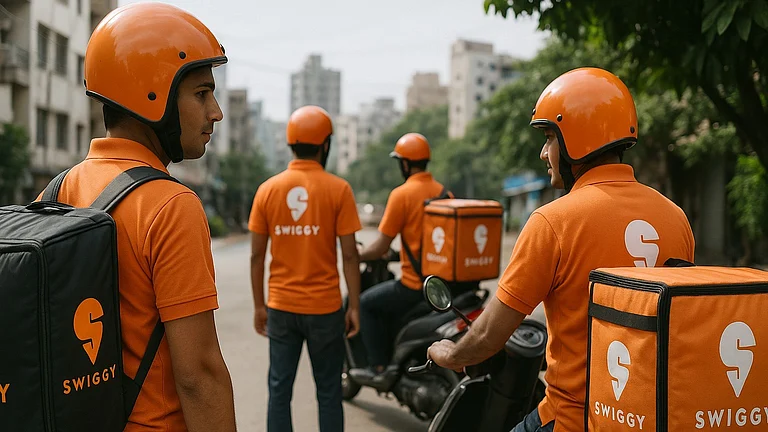

The move comes months after rivals Zepto and Swiggy’s Instamart reduced or removed various user fees. Zepto, following a $450 million funding round in October, eliminated handling and surge charges and lowered the minimum order value for free delivery to ₹99, with Instamart later adopting similar measures. At the time, Blinkit had held on to its charges.
However, a note by BofA in March 2025 predicted that quick commerce players may opt to drop delivery fees as competition heats up.
Advertisement
“We expect competition to remain high for the next 12–15 months: (1) as new platforms launch their services and incumbent platforms enter each other’s turf, they are likely to offer higher discounts initially,” the brokerage analysts wrote.
They added that incumbent players are unlikely to cede their high-end users and are expected to respond aggressively. With a strong focus on securing first-mover advantage, established platforms are likely to remain in expansion mode, which could translate into higher losses in the near term until new stores achieve scale.
Intense competition is also expected to push up marketing spend, drive higher platform-led discounts, reduce delivery charges for consumers, and increase costs related to dark store rentals and employee wages, as per the brokerage firm.
Advertisement
While delivery pricing decisions are internal to platforms, removing fees has helped attract more consumers, particularly in markets where Amazon Now has entered without charging delivery fees, a senior executive told ET.
Last month, Amazon’s Amit Agarwal told ET that its quick commerce service was gaining strong traction, with Prime members switching to Amazon within 90 days of a dark store launch. By December, Amazon was adding two dark stores daily, reaching around 300 by year-end.