
The Trump administration plans to spend nearly $7 billion on 11 Arctic Security Cutters to strengthen the US presence in the Arctic, despite the Coast Guard previously assessing a need for only four to five heavy icebreakers.
The fleet expansion is intended to close the capability gap with Russia's world-leading icebreaker fleet and respond to China's growing Polar Silk Road ambitions.
While the White House views the programme as essential for national security and power projection, critics have questioned the procurement process, long-term costs and whether the expanded fleet exceeds the Coast Guard's operational requirements.
The Trump administration's decision to spend nearly $7 billion on 11 new Arctic Security Cutters (heavy polar icebreakers) has sparked debate in Washington.
While the White House says the investment is essential to restore American power in the Arctic, critics question why the US Coast Guard is being asked to acquire nearly three times the number of ships it said it required.

1 September 2026
Get the latest issue of Outlook Business

The procurement, which forms part of the US-Finland-Canada ICE Pact, comes as melting Arctic ice is transforming the region into one of the world's most strategically contested frontiers.
Beyond scientific exploration, the Arctic is increasingly becoming a theatre for military competition, energy security and global trade.
Why Does Trump Want 11 Icebreakers?
The White House argues the United States has fallen dangerously behind in the Arctic.
Advertisement
For decades, the US has relied largely on USCGC Polar Star, a heavy icebreaker commissioned in the 1970s, and the medium icebreaker USCGC Healy, which has also experienced operational setbacks.
By comparison, Russia operates more than 40 icebreakers, including several nuclear-powered vessels capable of year-round Arctic operations.
Administration officials say the fleet expansion is intended to restore American maritime power, protect future shipping routes, safeguard access to critical minerals and ensure the US can operate continuously in both the Arctic and Antarctic.
Unlike earlier Coast Guard missions centred on search-and-rescue and scientific support, the new strategy views icebreakers as strategic national security assets capable of projecting military and sovereign presence in contested waters.
Advertisement
Why Did the Coast Guard Say Fewer Were Enough?
The controversy stems from the Coast Guard's own assessment. As per reports citing Coast Guard Commandant Admiral Kevin Lunday, the service's operational requirement was four to five heavy icebreakers, or roughly eight to nine vessels when medium icebreakers are included.
Those estimates were based on traditional missions such as maintaining navigable waterways, supporting scientific expeditions, conducting search-and-rescue operations and enforcing maritime law.
The administration, however, adopted a broader strategic objective. Rather than sizing the fleet for routine peacetime operations, it argues the US must maintain a permanent presence capable of deterring Russia and China across the polar region.
Why Is the Arctic Suddenly So Important?
For centuries, the Arctic was largely inaccessible because of permanent sea ice. Climate change is rapidly altering that reality.
As ice melts, new shipping corridors—including the Northern Sea Route, the Northwest Passage and the Transpolar Sea Route—are becoming increasingly navigable during parts of the year.
These routes could significantly shorten voyages between Asia, Europe and North America, reducing dependence on chokepoints such as the Suez Canal and Strait of Malacca.
The Arctic is also believed to contain around 13% of the world's undiscovered oil reserves and 30% of its undiscovered natural gas, along with vast deposits of critical minerals, rare earth elements and valuable fishing grounds.
As accessibility improves, countries are competing to secure economic and strategic influence over the region.
Russia, China and the Arctic Race
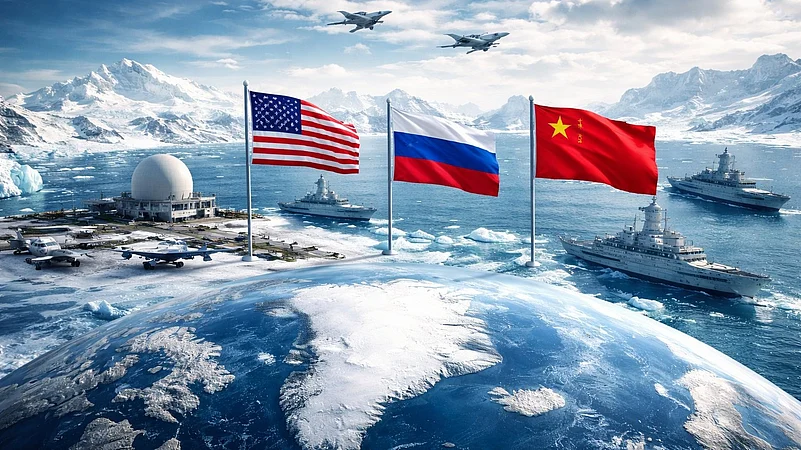
The US build-up is largely driven by growing Russian and Chinese activity in the High North.
Russia remains the dominant Arctic power, operating the world's largest icebreaker fleet while reopening Soviet-era military bases, expanding airfields and strengthening radar installations across its northern coastline.
China, despite lacking an Arctic coastline, declared itself a "Near-Arctic State" in 2018 and has incorporated the region into its Polar Silk Road strategy.
Beijing has invested heavily in Russian Arctic energy projects, shipping infrastructure and its own fleet of research and icebreaking vessels.
Joint Russian and Chinese naval activity near Alaska has heightened concerns in Washington that the balance of power in the Arctic could increasingly tilt toward the two countries.
Why Has the Procurement Drawn Criticism?
The programme has attracted scrutiny from lawmakers and oversight agencies for reasons beyond its size.
The administration used a public-interest exemption to allow the first four vessels to be built in Finland, bypassing normal domestic shipbuilding requirements.
Critics have also questioned the absence of a competitive bidding process, according to a report by The New York Times.
The Government Accountability Office (GAO) has warned that the nearly $7 billion procurement cost covers only ship construction.
Billions more will eventually be required for Arctic port infrastructure, maintenance facilities, fuel, personnel, training and long-term fleet operations, the report said.
Critics argue that the government has yet to present a comprehensive affordability assessment covering the programme's full life-cycle costs.
How Climate Change Is Reshaping Geopolitics
Climate change is no longer only an environmental issue—it is increasingly reshaping global geopolitics.
As Arctic ice retreats, previously inaccessible waters are opening to commercial shipping, energy exploration and military operations.
Areas that once served as natural defensive barriers are becoming contested maritime spaces requiring constant surveillance and enforcement.
The same warming temperatures that enable easier access to oil, gas and mineral deposits are also intensifying strategic competition among major powers seeking to secure future economic and security advantages.
What Could It Mean for Global Security?
The Arctic is gradually evolving from a region known for scientific cooperation into a strategic military theatre.
Growing deployments by the United States, Russia and China increase the risk of military miscalculation in an area that also hosts some of the shortest missile flight paths between North America and Eurasia.
At the same time, disputes over whether Arctic shipping routes constitute international waterways or sovereign waters are becoming more prominent.
Icebreakers are central to those claims because they enable nations to maintain a year-round presence and enforce their interpretation of maritime law.
For the Trump administration, the purchase of 11 Arctic icebreakers is therefore not simply a shipbuilding programme.
It reflects a broader strategic calculation that future geopolitical competition will increasingly be decided in the polar regions—where military presence, commercial access and climate change are rapidly converging.