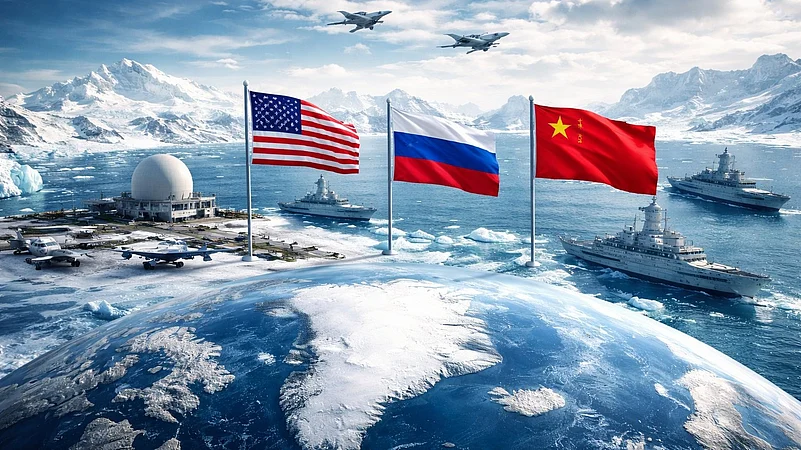

Trump warns of Russia and China “taking over” Greenland, citing national security concerns and reviving US interest in the Arctic territory.
Greenland’s strategic importance lies in defence, shipping routes, and critical minerals, drawing attention from major powers as Arctic ice melts.
NATO allies and Greenland’s leaders have pushed back, while India and other observers watch shifting Arctic geopolitics.
US President Donald Trump on Sunday said the United States would take Greenland “one way or the other,” citing national security concerns and warning that Russia and China could “take over” the territory if Washington did not act. The remarks have renewed attention on the mineral-rich island, an autonomous territory under Denmark, due to its strategic importance in the Arctic.
“If we don’t take Greenland, Russia or China will, and I’m not letting that happen,” Trump said while speaking to reporters aboard Air Force One. His comments have raised concerns among NATO allies and neighbouring Canada, as Greenland falls under Danish sovereignty and the transatlantic security framework. Any move by the US to assert control over the island would have far-reaching implications for European security and global geopolitics.

1 September 2026
Get the latest issue of Outlook Business

What Is Greenland’s Political Status?
Greenland is the world’s largest island and holds autonomous status within the Kingdom of Denmark, with its own government and parliament. While geographically part of the North American continent, it is politically and culturally aligned with Europe, particularly Denmark and Norway.
Advertisement
The United States has long maintained a military presence in Greenland. Washington operates the Pituffik Space Base (formerly Thule Air Base) in north-western Greenland, established during the Cold War, which plays a key role in missile early warning, space surveillance, and Arctic defence. Under existing defence agreements with Denmark, the US is permitted to maintain and expand its presence on the island.
Why Does Greenland Matter?
Greenland’s strategic value has grown as Arctic ice melt has opened up new shipping routes and expanded access to natural resources. Arctic sea routes significantly reduce travel time compared with traditional corridors such as the Suez Canal. At the same time, military and surveillance considerations have intensified competition in the region among the US, Russia, and China.
Advertisement
Why Has the US Long Been Interested in Greenland?
US strategic interest in Greenland dates back to World War II, when Denmark allowed the US to occupy the island to prevent German control. A 1951 defence agreement formalised Greenland’s role within the US security architecture, embedding it into Washington’s Arctic and North Atlantic defence planning.
The US has previously sought to acquire Greenland, proposing to purchase the territory from Denmark in 1946—an offer that was rejected. Denmark and Greenland have consistently opposed any transfer of sovereignty.
More recently, climate change has made Arctic trade routes more viable and resource extraction more accessible. Russia has expanded its military infrastructure along its northern coastline, while China has increased diplomatic and commercial engagement in Arctic states. US officials have framed Greenland as critical to countering these developments and safeguarding American military assets.
What Resources Does Greenland Hold?
Beyond security considerations, Greenland is believed to hold substantial reserves of oil, gas, rare earth elements, and base metals, though much of its resource potential remains underexplored. Industry estimates suggest the island could hold trillions of dollars’ worth of hydrocarbons and critical minerals.
Rare earth elements are particularly significant due to their role in modern technologies, including smartphones, renewable energy systems, and advanced military hardware such as the F-35 fighter jet. China currently dominates global rare-earth supply chains, and US efforts to diversify access have intensified amid export restrictions imposed by Beijing.
Analysts note that Trump has previously framed access to energy and mineral resources as a strategic priority in his foreign policy rhetoric. Recent remarks on Venezuela, where he suggested US oil companies should gain access to the country’s energy resources, reflect a broader emphasis on securing supply chains rather than a direct policy parallel. In Greenland’s case, its untapped reserves add another layer to Washington’s strategic interest.

How Has NATO Responded?
Trump’s remarks have also highlighted Greenland’s position within NATO’s security framework. Denmark is a founding member of the alliance, and under NATO’s collective defence principle—Article 5—an attack on one member is considered an attack on all.
On Sunday, a group of European countries, led by the UK and Germany, discussed ways to strengthen coordination and signalling around Arctic security, according to a Bloomberg report. Germany is expected to propose a joint NATO mission focused on the region. Canada has also stressed the need to uphold international law and national sovereignty in response to Washington’s comments.
What Do Greenlanders Say?
Greenland’s political parties issued a joint statement rejecting any US attempt to acquire the island. “We do not want to be Americans, we do not want to be Danes, we want to be Greenlanders,” the statement said, signed by leaders of five political parties, including Prime Minister Jens-Frederik Nielsen. “The future of Greenland must be decided by the Greenlandic people.”
Will India Have Any Impact?
India is an observer at the Arctic Council, which deals with environmental protection, shipping routes, and sustainable development in the Arctic. Any escalation of geopolitical tensions in the region affects how Arctic governance functions — something India has a stake in as polar routes and climate dynamics evolve. Moreover, India has a "Green Strategic Partnership" with Denmark. Any strain in US–Denmark relations over Greenland would be closely watched in New Delhi, given India’s strategic partnership with Washington and its green strategic partnership with Denmark.
Heightened US–Russia–China competition in the Arctic reflects broader global power dynamics. India, which maintains strategic partnerships with the US while also managing ties with Russia and China, closely tracks shifts in great-power alignment and military posturing.