
Vizhinjam Port can anchor Kerala's transformation into a globally competitive maritime logistics hub
Success depends on integrated infrastructure, skilled workforce, efficient governance and urban development
Sustainable growth, specialised institutions and multimodal connectivity are vital for Kerala's maritime ambitions
For centuries, Kerala's destiny has been shaped by the sea. Long before modern nation-states, the Malabar coast linked the Roman Empire, the Arabian Peninsula, East Africa, and Southeast Asia. Muziris dominated the spice trade, Kozhikode flourished as a global entrepôt under the Zamorin, and Kochi became a cosmopolitan harbour. Maritime commerce underpinned Kerala's prosperity, diversity and outward-looking identity. Yet, India's development gradually shifted inland, leaving Kerala's 590-kilometre coastline and maritime potential underutilised.
Chief Minister V.D. Satheesan's vision of Kerala as a "port city" can create value only when integrated with industry, multimodal transport, finance, digital infrastructure and skilled human capital. The goal is not merely more cargo, but a port-centred economic ecosystem.

1 October 2026
Get the latest issue of Outlook Business

This article explores what that transformation demands: strategic investment in services and urban infrastructure alongside stronger human capital, institutions, regulation and specialised dispute resolution, concluding with key caveats and a vision for Kerala's maritime resurgence.


A Cluster Strategy
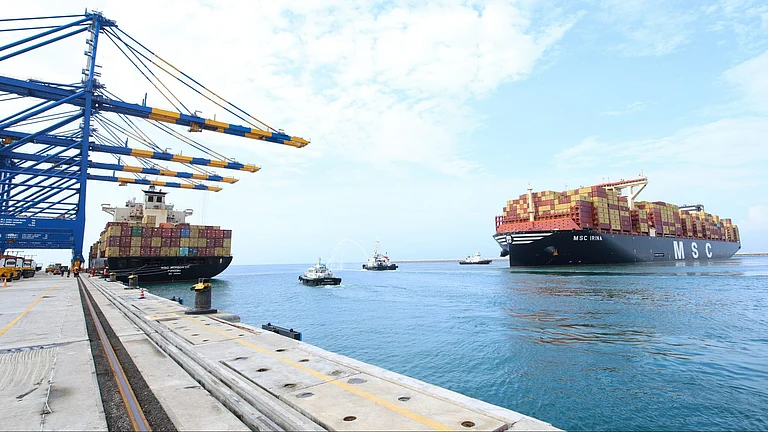
On the face of it, the commissioning of Vizhinjam International Seaport, located just 10 nautical miles from one of the busiest east-west international shipping lanes, has altered India's maritime landscape. It has a natural depth exceeding 20 metres to accommodate ultra-large container vessels without extensive dredging. This geographical advantage is exceptionally rare. The timing couldn’t be more appropriate either. For decades, nearly three-fourths of India's transshipment cargo travelled through foreign ports, particularly Colombo, Singapore, and Jebel Ali, increasing logistics costs and strategic dependence. Vizhinjam offers India an opportunity to reclaim a significant share of this traffic while positioning Kerala as the country's principal gateway to global maritime trade. International investor interest, including the proposed participation of the Mediterranean Shipping Company through Terminal Investment Limited, further underscores the port's global commercial significance.
Advertisement
But world-class ports alone do not create world-class economies. The Port of Rotterdam thrives because it is inseparable from the well-developed European industrial hinterland. Singapore's port is integrated with advanced manufacturing, petrochemicals, finance, and digital commerce. Busan transformed itself from a shipping terminal into a logistics, technology, and innovation hub. Shenzhen's spectacular rise began with its port but accelerated through special economic zones, export-oriented industries, and sustained investment in infrastructure. Even Dubai's Jebel Ali Free Zone owes its success less to harbour facilities and more to regulatory efficiency, ease of doing business and integrated industrial planning. Thus, Kerala must resist the temptation to pat its own back solely through an uptick in cargo volumes or container throughput. The real metric is whether ports expand economic activity inland.
Advertisement
Instead of the traditional conception of ports as isolated government projects, Kerala should pursue a maritime cluster strategy with investment in logistics parks, warehousing, cold-chain infrastructure, ship repair, bunkering, maritime finance, marine insurance, offshore engineering, fisheries, cruise tourism, coastal manufacturing and digital supply-chain management, each reinforcing the others. Such clustering lowers transaction costs, draws private investment, and creates jobs across skill levels, from engineers to warehouse workers.
Satheesan has emphasised that Kerala's maritime future cannot rest on Vizhinjam alone. Alongside the flagship port, Kochi's industrial ecosystem, comprising Cochin Shipyard, LNG infrastructure and the Vallarpadam International Container Transshipment Terminal, Beypore's shipbuilding heritage, and ports such as Azhikkal, Kollam, Alappuzha and Ponnani should perform complementary roles in cargo, fisheries, tourism, coastal shipping and passenger transport. Like China's specialised port network, Kerala must distribute economic activity across an integrated maritime system rather than concentrate investment in a single harbour. He has also highlighted the untapped potential of coastal shipping. More fuel-efficient than road transport, it reduces congestion and emissions while complementing Kerala's long coastline, backwaters, rail corridors and inland waterways. The Centre's 2025 Coastal Shipping Act, which removes licensing requirements for Indian-owned coastal vessels, strengthens this opportunity. Integrated with modern logistics, such multimodal connectivity is the essential foundation of Kerala's port-city vision.
Capacity Enhancement
Infrastructure and networks mean little without the capacity to utilise them effectively. Take, for instance, the Southeast Asian miracle from South Korea to Singapore in the latter half of the previous century. The rapid industrialization and growth were complemented by a commensurate and intensive investment in public education. Kerala, fortunately, possesses several of these comparative advantages already. Unlike many coastal states that must first invest heavily in human capital, Kerala begins with one of India's most educated workforces. Its literacy rates, engineering graduates, management professionals, and globally experienced diaspora constitute a reservoir of talent that few maritime regions can match. Thousands of Malayalis already occupy leadership positions in shipping companies, logistics firms, port operations, and international trade across the Gulf, Europe, and Southeast Asia.
Yet this advantage is heavily skewed toward the top of the maritime workforce pyramid. Kerala's strength in producing managers and officers says little about its capacity to produce the crane operators, riggers, welders, marine electricians, dock workers, warehouse technicians, and safety personnel a modern port ecosystem depends on in far greater numbers. Vocational and technical training in port-specific and maritime trades remains thin, scattered across a handful of institutions rather than organised as a coherent pipeline. A port city cannot be built on management degrees alone; it needs polytechnics, ITIs and apprenticeship programmes calibrated to actual port and shipyard demand, with clear progression from shop floor to supervisory roles. Without deliberate investment here, Kerala risks importing manual and mid-skill labour even as it exports managerial talent.
Another less-discussed constraint is the ease with which Kerala's ports can access the advanced machinery modern operations require — ship-to-shore gantry cranes, automated stacking cranes, terminal operating systems, and the sensors and software that increasingly define port productivity. Much of this equipment is not manufactured competitively in India, and high import duties, slow customs processes, and inconsistent policy on capital goods can make automation prohibitively expensive or administratively painful for terminal operators. If Vizhinjam and Kerala's other ports are to compete with automated terminals in Singapore or Rotterdam on turnaround times, the state and the Centre must jointly examine whether current tariff and clearance regimes for port capital equipment are calibrated for that ambition. Liberalising the import of such machinery through duty exemptions would certainly be a low-cost, high-impact policy lever - but would be beyond the limited scope of the State Government’s ambit. At its end, Kerala can ensure single-window approvals and cheap, efficient procurement assistance, minimising friction from the infrastructure already being built.
Even when solved for, infrastructure alone cannot overcome institutional shortcomings. Kerala has historically struggled with delays in land acquisition, fragmented regulatory processes and inconsistent policy implementation. Several connectivity projects associated with Vizhinjam, including road and rail access and broader urban infrastructure, are progressing more slowly than originally envisaged. Global investors evaluate not only the quality of physical infrastructure but also the predictability of governance. Administrative efficiency must become as important as engineering excellence. Speed of approvals, transparent regulations, digital customs clearance, and coordinated planning across departments are indispensable.
As Kerala builds its maritime economy, regulatory and capacity reforms must be matched by effective dispute resolution. Vizhinjam has already exposed this challenge: the proposed sale of a 49% stake in its concessionaire by Adani Ports to a Mediterranean Shipping Company affiliate raised questions over state approval, competition and control. Whatever the outcome, it highlights whether Kerala's legal and political architecture is equipped for a complex maritime economy. As concession, charter-party and financing disputes grow, ordinary civil litigation will prove inadequate. Kerala needs a specialised maritime bar, efficient arbitration centres, and commercially oriented High Court benches that uphold contractual certainty while safeguarding public interest, competition and the state's regulatory role.
Finally, capacity is also urban. A port engineer weighing a move from Dubai or even Mumbai to Thiruvananthapuram is evaluating the city holistically and not just the port. It matters that the city can offer its families good schools, reliable hospitals, safe housing, functioning public transport, and the everyday conveniences of a globally connected city. Talent attraction and urban liveability are two sides of the same coin. Thiruvananthapuram, in particular, will need to grow faster and more deliberately than its current civic infrastructure suggests it is prepared for. Kerala lacks open space for sprawling expansion in a linear fashion. To accommodate world-class schools, multi-specialty hospitals, quality housing stock, and reliable last-mile connectivity that spring up at par with migration and growth, frictions to a quick-response marketspace for this basket of services must be lowered without losing the city’s reputation for quality of life and affordable and dignified standards of living.
Caveats and Precautions
While laying down the blueprints for a system-wide reform of this kind, it is often advised to err on the side of caution. For decades, environmental sustainability has been a footnote in Kerala’s aspirational developmental conversations. More recently, reality has forced eco-centric thinking to the forefront of the development debate. The state has already experienced the consequences of coastal erosion and climate-related disasters. Future maritime expansion must therefore incorporate resilient engineering, scientific coastal management, renewable energy, green bunkering, electrified port operations and meaningful community participation. In a world sensitive about climate fragility, future generations of global ports would be increasingly evaluated not merely by efficiency but by environmental performance. If Kerala embraces this transition early, sustainability itself could become a competitive advantage.
Recent geopolitical events remind us that one cannot overstate the importance of factoring those risks into the developmental calculus - especially while placing bets on global trade. Fortunately, these uncertainties strengthen Kerala's case in many dimensions. The Indian Ocean is re-emerging as the principal theatre of global commerce and strategic competition. Nearly all major powers are investing in maritime infrastructure, supply-chain resilience, and port connectivity. India's own maritime strategy increasingly emphasises reducing dependence on foreign transshipment hubs while strengthening domestic logistics. Vizhinjam's emergence, coupled with Kochi's established strategic importance, positions Kerala at the heart of this evolving maritime architecture. Few Indian states enjoy such a convergence of geography, infrastructure, and geopolitical relevance.
Kerala once stood at the crossroads of the Indian Ocean world. Though slightly orthogonal to a conversation on trade and development, we should occasionally do ourselves the favour of remembering Dr Shashi Tharoor’s argument on why communal forces have a less damaging impact in Kerala - that new religions and ideas came predominantly as messages and were not enforced with a sword. Ships arrive carrying not just merchants and cargo but also ideas, faiths, and fortunes that, like in the past, can transform this narrow strip of land into one of history's most vibrant trading societies. Vizhinjam has reopened a maritime doorway that can be a harbinger of these fortunes. Whether Kerala merely builds an efficient port or successfully reinvents itself as a globally competitive Port City cluster will depend upon choices made over the coming decade. If the state combines strategic vision with institutional discipline, infrastructure with connectivity, and commerce with sustainability, the Arabian Sea may once again become not the edge of Kerala, but the beginning of its economic future.
Disclaimer: The views expressed in this article are those of the author and do not necessarily reflect the views of the publication.