Prime Minister Narendra Modi on Saturday put energy security, semiconductor manufacturing and advanced technology at the centre of India's next phase of growth, while calling for faster reforms and challenging Indian companies to become global leaders as the country seeks to become a developed economy by 2047.
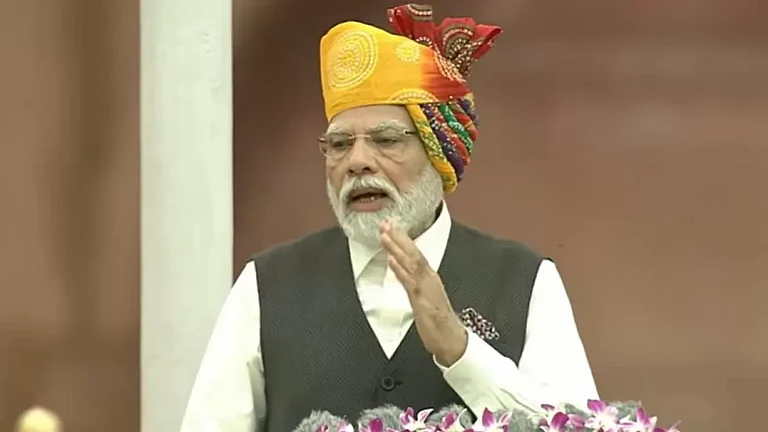
Addressing the nation from the Red Fort on the 80th Independence Day, Modi said India's growing ambitions could not be met without securing the energy, technology and critical minerals needed to power a rapidly expanding economy.
"Energy security is the need of our times," he said, linking rising electricity demand to chips, artificial intelligence and data centres.

1 October 2026
Get the latest issue of Outlook Business

Weeks after the West Asia crisis gave the world an energy supply shock, the prime minister pitched for self-reliance, setting a target of 100 gigawatts of nuclear power by 2047 as well as accelerating offshore exploration to find oil and gas that could replace imported molecules that are making the economy vulnerable to external shocks.



He also warned that the weaponisation of resources and strategic sea routes by some countries posed risks to India's economic security, and called for greater self-reliance in energy to reduce the country's vulnerability to overseas supplies.
Modi said India was also accelerating offshore oil and gas exploration, after opening up 99% of its coastline that had previously been designated as "no-go" areas.
Advertisement
"We have opened up that 99% , which used to be no-go areas, as go-ahead areas, and now we are engaged in exploration within the sea and in the effort to discover new reserves," he said, adding that the government has allocated ₹85,000 crore to accelerate the Samudra Manthan programme.
Equally, semiconductors are key to the vision of a more self-reliant India, with the prime minister saying the country could no longer afford to depend on overseas supplies for technologies critical to its economy.
"Whether it is any electronic goods, our medical equipment, or our modes of transport, a chip is essential in everything, and a situation has arisen where the world would come to a standstill without this chip," Modi said.
Advertisement
Three semiconductor plants have already started production, he said, adding that another five to eight plants would start in the next seven to eight years.
He said that India has transformed from 'Fragile Five' to the world's fastest-growing major economy in the last 12 years.
Modi also highlighted critical minerals as a strategic priority, saying India was stepping up exploration and forging agreements with other countries to secure supplies needed by the technology sector.
The emphasis on domestic capabilities comes as India seeks to reduce vulnerabilities in global supply chains and build greater resilience in areas ranging from energy and minerals to chips and digital technologies.
"India should no longer live by depending on other countries; we should become self-reliant," Modi said.
He said that the next five to seven years would have to deliver what had not been achieved over several previous decades, requiring a change in India's work culture, thinking and pace of execution.
He outlined a sevenfold growth strategy spanning manufacturing; agriculture and food processing; technology and innovation; infrastructure and connectivity; defence; the green and blue economy; and India's broader global capabilities.
Manufacturing, he said, must cover the entire value chain, from design and components to finished products, while Indian companies must compete globally on cost, quality and scale.
"Our zero-defect precision manufacturing should become our identity," Modi said. "There should be no compromise on quality, and therefore our mantra should be quality, quality, quality." He also called for reforms across government and industry, saying existing policies and rules could not be allowed to constrain India's future ambitions.
"We cannot operate with the policies and rules of the past. We have to formulate policies and rules according to the dreams of the future," Modi said.
He described the reform agenda as a matter of conviction rather than necessity.
"We have set out on the Reform Express, and in the coming days too, we are going to move towards the next level of reform," Modi said.
Modi framed the push for energy and technological self-reliance as essential to India's ambition of becoming a developed country by 2047, arguing that the country's growing economic weight would increasingly depend on its ability to secure the resources and technologies needed to sustain that growth.
The prime minister said India must go beyond being a major technology market and become a global innovation hub, pointing to artificial intelligence, quantum computing, space, robotics, data centres and next-generation communications.
"Today is the age of AI, quantum, space, robotics, data centres; an entirely new field has opened up," he said. "We must not make the country merely a market for the world; we have to become a hub of innovation." He said India should develop and deploy Made-in-India 6G technology globally and take its digital public infrastructure to other countries.
The prime minister also announced a plan to train 1 crore young Indians in AI skills over the next year, saying the country's youth needed to be equipped to lead in an economy increasingly shaped by artificial intelligence.
Modi challenged Indian businesses to set much larger global ambitions, saying the country should aim to produce companies capable of competing with the world's biggest corporations.
"Why should 50 of these Fortune 500 companies not be from India in the coming decade? Why should this not be our goal?" he said.
He also set an ambition for India's banking sector, saying at least one Indian bank should rank among the world's top five.
"Today, the banking sector is flourishing. Why should the flag of an Indian bank not fly among the world's top banks? An Indian bank should also be a top bank; one of the top five banks should be an Indian bank," Modi said.
He similarly called for Indian pharmaceutical companies, technology firms, consulting companies and accounting firms to achieve global leadership.
"India's technology companies should be at the top in the world - this should be our goal," he said.