
The conference concluded that the focus should shift from whether technology can improve governance to how AI and digital tools can be effectively deployed to deliver citizen-centric public services.
Experts showcased innovations spanning healthcare, agriculture, multilingual AI, cybersecurity, digital learning and voice-first public services, highlighting their potential to transform governance.
Officials proposed district-level pilot projects to test secure data sharing and interoperable governance systems before scaling successful AI-driven models across Rajasthan and other states.
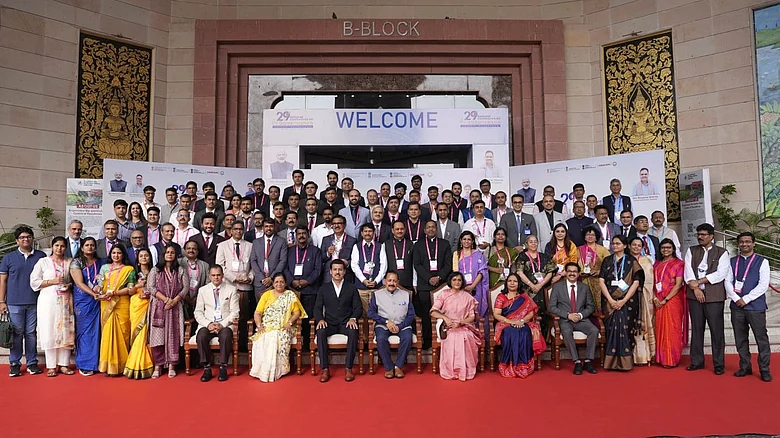
The 29th National Conference on e-Governance concluded on Thursday emphasised that the next phase of digital governance should focus on implementing citizen-centric artificial intelligence (AI) solutions, improving coordination across government departments and translating successful innovations into scalable governance models.
The discussions highlighted that the debate has moved beyond whether technology can improve governance to how governments can deploy technology more effectively to deliver better public services.

1 October 2026
Get the latest issue of Outlook Business

"The question is not that can governance be improved with information technology. The question is how can we bring governance improvement through technology," speakers noted during the closing session, stressing that citizens must remain at the centre of every digital governance initiative.




Throughout the two-day conference, discussions revolved around responsible AI, cybersecurity, digital public infrastructure, healthcare, agriculture and multilingual digital services.
Presentations showcased AI-enabled digital learning platforms, voice-first technologies for public services, sovereign AI models, quantum computing applications and AI-driven healthcare solutions integrated with government platforms.
Advertisement
Among the technologies highlighted were digital learning systems aimed at reducing dependence on printed textbooks, multilingual platforms capable of serving citizens across multiple Indian languages, AI-assisted doctor-patient communication tools, cybersecurity frameworks for AI systems, AI-powered clinical decision support systems, digital public infrastructure for agriculture and indigenous AI models supporting hundreds of Indian languages.
The conference concluded with a commitment to ensure that discussions translate into action. Government officials said all recommendations and observations made during the sessions have been compiled and will be reviewed over the coming months as part of a structured follow-up exercise.
Guidance for Pilot Projects
As part of the implementation strategy, officials proposed launching district-level pilot projects to improve coordination among government departments through secure data sharing while maintaining privacy safeguards.
Advertisement
The idea is to create interoperable governance systems that enable faster and more informed decision-making before expanding successful models across Rajasthan.
The conference also encouraged states to adopt and replicate proven governance innovations showcased during the event, with participants expressing confidence that collaboration between governments would accelerate the adoption of AI-enabled public services across the country.