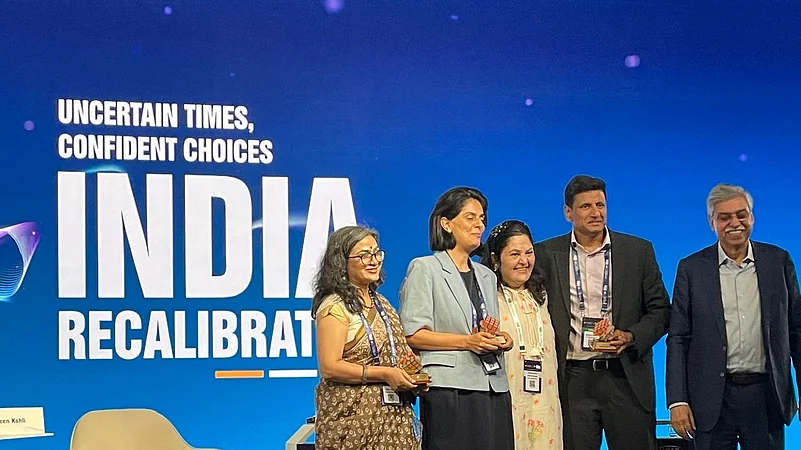

ICICI Lombard MD and CEO Sanjeev Mantri said the insurance industry continues to face a trust deficit despite paying nearly ₹1 lakh crore in claims annually.
Go Digit General Life Insurance MD and CEO Jasleen Kohli said insurance products must be affordable, easy to understand, compare and purchase if India is to achieve universal insurance coverage.
Kohli noted that savings-linked products often dominate distribution channels, causing pure protection products such as term insurance to take a back seat despite their importance for financial security.
India may be the world's 10th-largest insurance market, but insurance penetration remains significantly below the global average, highlighting the challenges that must be addressed to achieve the country's goal of "Insurance for All by 2047," industry leaders said at the MindMine Summit in New Delhi.
As per estimates, insurance penetration in India stands at 3.7% of GDP, roughly half the global average of 7.3%. The market remains heavily skewed toward life insurance, which accounts for 2.7% of GDP, while non-life insurance penetration, including health, motor, and property insurance, remains at just 1%.

1 September 2026
Get the latest issue of Outlook Business

Speaking at the summit, Jasleen Kohli, Managing Director and Chief Executive Officer of Go Digit General Insurance, said achieving widespread insurance coverage would require a collective effort focused on affordability, simplicity, and accessibility.



"When we speak about one billion insured lives, it is a powerful aspiration. But it is more important to fix the underlying economics than focus only on the numbers," Kohli said.
Advertisement
She said insurance products must be affordable, easy to understand, easy to compare, and simple to purchase. In particular, products need to be designed in a manner that allows consumers in rural and underserved areas to discover and adopt them without friction.
Kohli also highlighted the need to reduce the industry's cost of delivery.
"We need to bring acquisition costs, servicing costs, compliance costs and claims costs down significantly so that small-ticket insurance products become commercially viable. If we don't solve the cost-of-delivery problem, products become unviable for the industry. At the same time, if affordability is not addressed, they remain out of reach for those who need them most," she said.
Advertisement
Term Insurance Needs to Become Mainstream
During the discussion, Outlook Money Editor-in-Chief Nidhi Sinha raised concerns about the “relatively low adoption of term insurance despite growing awareness about financial protection”.
Responding to the question, Kohli said the life insurance industry has historically focused on increasing average ticket sizes rather than expanding protection coverage to more households.
"Every household needs protection. The challenge is not the product itself; it is largely a distribution issue," she said.
According to Kohli, savings-linked products, endowment plans and ULIPs often receive greater attention because they generate higher commissions and offer better economics for distributors. "Unfortunately, term cover takes a back seat and gets deprioritised at the point of sale. Term insurance has to become mainstream," she added.
Private Insurers and Ayushman Bharat
The discussion also touched on the role of private insurers in government-backed health insurance schemes such as Ayushman Bharat.
Addressing questions on the relatively limited participation of private insurers, ICICI Lombard Managing Director and Chief Executive Officer Sanjeev Mantri said participation is largely determined through competitive bidding processes.
"It is not by choice. These schemes operate through tendering processes where insurers quote prices based on the risks involved. We participate, but we do not always win the bids," Mantri said.
He added that private insurers continue to play an important role in expanding awareness and improving access to insurance across the country.
Trust Remains a Major Challenge
Kohli identified trust as one of the most significant challenges facing the insurance industry.
She noted that the insurance ecosystem involves three key stakeholders—customers, insurers and healthcare providers—and that a lack of trust among these participants often creates friction.
"As an industry, we paid nearly ₹1 lakh crore in claims last year. Yet the perception often remains that insurers do not stand by customers when they need support. Bridging this trust deficit is one of the biggest challenges before the industry,"s he said.
According to industry leaders, achieving universal insurance coverage will require not only innovative products and lower costs but also stronger consumer confidence in the system.