A US-Iran peace deal pushed crude oil below $84 per barrel, boosting Indian equities and strengthening the rupee.
Lower oil prices are expected to ease inflation, reduce India's import bill and improve corporate earnings.
Experts say SIP investors should stay focused on long-term investing and avoid reacting to short-term geopolitical events
The announcement of a peace agreement between the United States and Iran triggered a broad-based relief rally across global financial markets on Monday, sending Indian equities sharply higher, strengthening the rupee and raising hopes of lower inflation and improved economic conditions in the months ahead.
The BSE Sensex surged 1,155 points at the opening bell, while the NSE Nifty50 climbed more than 340 points to approach the 24,000 mark as investors cheered reports that Washington and Tehran had agreed to end their 107-day conflict and reopen the Strait of Hormuz, one of the world's most critical oil shipping routes.

1 September 2026
Get the latest issue of Outlook Business

The agreement marks a significant de-escalation in a conflict that had rattled global markets for months, disrupted energy supplies and pushed crude oil prices sharply higher. For India, which imports more than 85% of its crude oil requirements, the development carries implications that extend far beyond a single day's stock market rally.


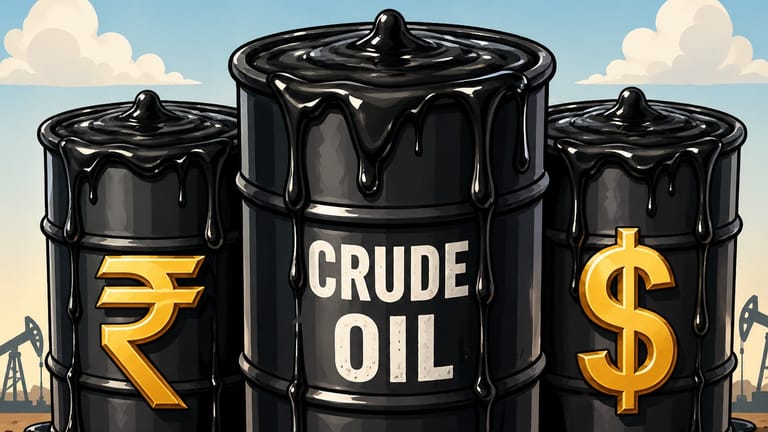

The biggest beneficiary of the peace deal has been crude oil itself. Brent crude prices fell nearly 4% to around $83.80 per barrel, while WTI crude dropped close to 5% to about $80.90 per barrel. Both benchmarks have now retreated to their lowest levels since March as traders priced in the restoration of oil flows through the Strait of Hormuz.
Advertisement

Why The Peace Deal Matters For India
The Strait of Hormuz handles nearly one-fifth of global oil supplies and is a vital route for crude shipments from the Middle East. Concerns over disruptions in the waterway had fuelled fears of prolonged supply shortages and higher energy prices.
The peace agreement announced by US President Donald Trump and confirmed by Iranian authorities is expected to restore crude supplies to pre-war levels over the next several weeks. If sustained, lower energy prices could significantly improve India's macroeconomic position.
For India, cheaper oil means lower import bills, reduced pressure on the current account deficit, easing inflation and improved corporate profitability. It also provides relief to sectors heavily dependent on fuel and logistics costs.
Advertisement
Vikas Gupta, CEO and Strategist at OmniScience Capital, said the decline in oil prices removes a major overhang that had been weighing on both corporate earnings and household budgets.
"For retail investors and long-term wealth creators, this peace deal is a meaningful structural relief valve. The geopolitical premium built into oil prices over the past several months had been acting as a persistent tax on corporate earnings and household budgets," Gupta said.
"With reports of a preliminary US-Iran understanding aimed at reopening the Strait of Hormuz, Brent crude has fallen sharply to trade in the $80s per barrel. For a major energy-importing nation like India, lower oil prices, if sustained, directly ease corporate input cost pressures and help cool wholesale inflation."
Wholesale inflation had surged to a multi-year high of 9.68% in May, driven largely by a more than 30% increase in fuel and power costs. A sustained correction in crude prices could therefore provide significant relief to inflationary pressures.
Why The Rupee Strengthened
The positive impact of the peace deal was visible almost immediately in the currency market.
The rupee opened 41 paise stronger at 94.70 against the US dollar and continued to gain throughout the session. The currency eventually settled at 94.71, up from the previous close of 95.11. During the day, it touched 94.46, its strongest level in nearly five weeks.
The rally in the rupee reflects expectations that lower crude prices will reduce India's import bill and improve external balances.
Jateen Trivedi, VP Research Analyst - Commodity and Currency at LKP Securities, said the reopening of the Strait of Hormuz has significantly improved sentiment towards oil-importing economies.
"Rupee traded strongly with gains of around 53 paise or 0.56% near 94.68, as sentiment improved significantly following positive developments on the US-Iran peace front and confirmation of the reopening of the Strait of Hormuz," Trivedi said.
"The removal of supply disruptions has eased concerns over crude oil availability and pricing, providing substantial relief to oil-importing economies such as India."
According to Trivedi, the normalisation of crude flows is expected to improve current account expectations and support capital market sentiment, both of which are positive for the currency.
The rupee's gains also narrowed its year-to-date decline to 5.6%, after the currency had earlier fallen to a record low near 97 per dollar.

Why Stocks Rallied
The sharp rally in equities was driven by expectations that lower oil prices could improve profitability across multiple sectors.
Companies in aviation, automobiles, paints, hospitality and specialty chemicals are among the biggest beneficiaries of lower crude prices because fuel, logistics and raw material costs account for a significant portion of their expenses.
Domestic consumption sectors could also benefit if lower energy costs support household spending and ease inflationary pressures.
Gupta said India's broader macroeconomic outlook could improve meaningfully if the current de-escalation proves durable.
"The forward-looking outlook for Indian equities is constructive but requires a selective, bottom-up approach and depends heavily on whether this de-escalation holds," he said.
"A durable decline in crude would ease one of the key sources of pressure on the currency and import costs. A sustained fall in oil prices would support a more comfortable inflation trajectory and give the RBI more room going forward."
Investors also interpreted the peace deal as reducing one of the biggest global risks that had weighed on financial markets over the past several months.
The relief was reflected globally. Japan's Nikkei gained 3%, South Korea's Kospi jumped 4.3%, while US equity futures pointed to a strong opening on Wall Street.
Akshay Chinchalkar, Managing Partner and Head of Markets Strategy at The Wealth Company, said Indian markets were responding to a combination of lower oil prices and improving macroeconomic expectations.
"Indian markets cheered reports of a US-Iran peace deal today, with gains seen across the board - the rupee rose, bond yields fell and stocks closed markedly higher - even though they came off their intraday highs at the closing bell. The big story was Brent of course that is now closing in on $80/barrel, and this matters disproportionately for us: the country imports more than 85% of its annual requirement, so every $10 drop typically cools fuel and freight costs, narrows the current-account deficit, reduces inflation pressure and supports the rupee, thereby giving the RBI more room to pause rather than hike."
What It Means For SIP Investors
While the market rally grabbed headlines, experts caution long-term investors against making investment decisions based on short-term geopolitical developments.
However, Chinchalkar cautioned that the sustainability of the rally would depend on several factors beyond the peace announcement itself. "Whether the tailwinds last will hinge on deal follow-through, OPEC+ supply, global growth and the path of US rates. If geopolitics stays calm and inflation keeps easing, the rally can broaden but expect volatility in the months ahead," he said.
He also pointed out that investors should remain realistic about the pace of energy market normalisation. "Let us not forget that the damage to refineries is real and the pre-war supply is unlikely to return to the market anytime soon," Chinchalkar added.
Gupta said the episode reinforces the value of remaining invested through periods of uncertainty rather than reacting to temporary market swings.
"For Systematic Investment Plan (SIP) investors, this development reinforces the power of consistency. While the conflict-driven volatility tested patience, any subsequent recovery underscores why staying invested matters," he said.
If lower energy costs eventually improve corporate earnings and support economic growth, the benefits could flow through to long-term investors over the coming quarters. However, Gupta stressed that the durability of the current decline in crude prices remains the key variable.
He also noted that investors should avoid changing asset allocations based on short-term events.
"SIPs should not have been disturbed anyway, even if the crisis lasted longer. Long-term wealth creation should not depend on such issues since in an open economy, globally and domestically some issue will always come up every year or two," he said.
"Single-day rallies should be completely ignored by long-term investors."
Can The Rally Sustain?
The sustainability of Today's rally will largely depend on whether the peace agreement translates into a lasting improvement in geopolitical conditions.
While both Washington and Tehran have confirmed the agreement and a formal signing ceremony is reportedly scheduled for June 19 in Switzerland, markets will continue to monitor implementation risks and any signs of renewed tensions.
For now, however, the peace deal has removed one of the biggest risks confronting global markets. Lower crude prices, a stronger rupee and easing inflation concerns have collectively improved India's economic outlook, giving investors reasons to cheer after months of uncertainty.
If oil prices remain near current levels and the Strait of Hormuz reopens as planned, the benefits could extend well beyond a single day's market rally, potentially improving corporate earnings, supporting the rupee and providing a more favourable backdrop for India's growth story in the months ahead.