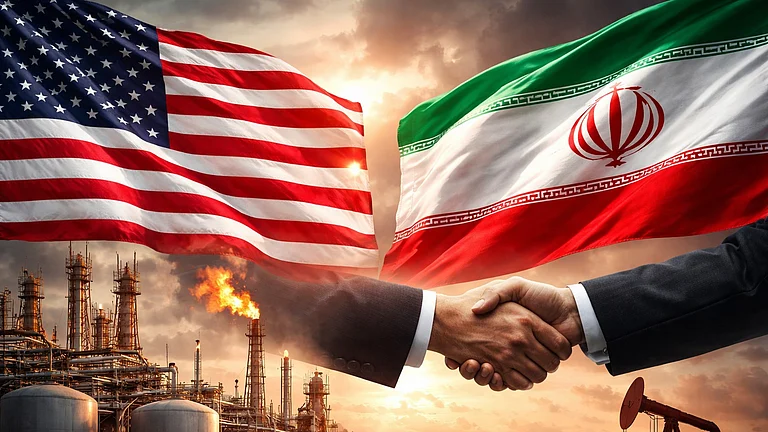
Oil prices edged lower in early Asian trade as markets tracked Iran–US ceasefire negotiations expected later this week.
Trump extended the temporary truce, but uncertainty persists as Tehran remains undecided on joining the next round of talks.
The Strait of Hormuz blockade — a key route for nearly 20% of global oil trade — continues to keep supply concerns and price volatility elevated.
Oil prices eased on Wednesday by nearly $1 in early Asian trade as investors eyed developments in West Asia. Market participants are closely assessing the Iran–US ceasefire talks, which are expected to be held later this week.
On Tuesday, US President Donald Trump announced an indefinite extension of the two-week temporary ceasefire, which was supposed to expire on April 22.

1 October 2026
Get the latest issue of Outlook Business

Following his announcement, benchmark Brent crude futures fell to $98.27 per barrel, down 0.2% from the previous close, while West Texas Intermediate (WTI) futures slipped 0.3% to $89.39 per barrel.
Heightened Uncertainty Keeps Oil Market on Edge
Although Trump announced the deadline extension, his decision comes amid heightened uncertainty over a longer-term ceasefire, as Iran is yet to decide whether to join the next round of negotiations.
The US naval blockade of the Strait of Hormuz also remains a critical flashpoint, as the vital waterway — which carries nearly 20% of global energy trade — has been practically shut since the beginning of the war.
Advertisement
Iran–US military attacks began on February 28, with Tehran and Washington holding the first round of talks on April 11.
The first round of peace talks did not yield a meaningful ceasefire, as Iran claimed US demands were ‘excessive,’ while Washington asked Tehran to surrender its enriched uranium and agree to a 20-year moratorium on the same.
Analysts have warned that if the war prolongs beyond mid-May, it risks triggering a global economic slowdown, supply chain disruptions, and a potential recession.
The oil market has been volatile since the conflict began, with major oil-producing countries halting exports and slashing production.
Advertisement
The uncertainty and evolving geopolitical tensions also pushed Brent crude to a four-year high of $119 per barrel, following which the International Energy Agency released its biggest-ever emergency reserves, while the US lifted — and even extended — some sanctions on Russian crude oil to prevent global prices from hitting the psychologically crucial level of $150 per barrel.
Increasing Instability in West Asia
Meanwhile, the Israeli military continues to launch strikes against Iran-backed militant group Hezbollah in Lebanon. Tel Aviv fired rockets at the group, alleging that the militants violated the ceasefire ahead of the peace talks between the US and Beirut.