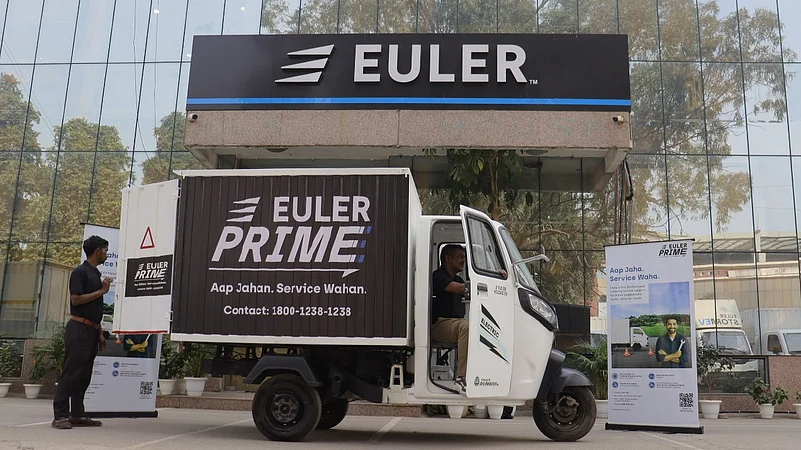

Euler expects its on-the-go service to push vehicle uptime above 95%
EVs enable deeper diagnostics and allow predictive maintenance, says the company
On-site repair reduces downtime dramatically, helping commercial EV users avoid lost earnings
Dealership revenue models will shift, with higher reliance on AMCs and software-based service
Everyone loves owning a vehicle—until it's time for repairs and service schedules. Typically, a vehicle sees the inside of a workshop once every three months. For commercial vehicle owners, the frustration of delays and waiting rooms is compounded by the loss of revenue associated with unexpected breakdowns.
These are the pain points that EV startup Euler Motors targets with Euler Prime, its newly launched vehicle support app available in more than 45 cities.

1 September 2026
Get the latest issue of Outlook Business

The Hero MotoCorp-backed company expects the Prime service to push vehicle uptime above 95%, says Ashish Tandon, Euler’s Global Head for Customer Excellence.
In an interview with Outlook Business, Tandon says EV technology enables doorstep servicing, thanks to the ability to continuously monitor 50 data points from the vehicle.
While the reduction in service centre visits may affect the traditional revenue model of dealerships—many of which rely on service and after-sales income—Tandon is confident that new revenue models, such as AMCs, will help support dealerships. Edited excerpts of the interview:
What was the need to introduce Euler Prime service?
Advertisement
In ICE vehicles, there is a big ecosystem already. But in EVs, this is one of the barriers because it's just a four-year-old journey for the industry, and the entire ecosystem to support EVs is still developing. So, from a customer’s perspective, you would always think: if something goes wrong, whom do I contact? How will people come? A roadside mechanic will not be able to repair the vehicle.
These are the barriers that stop people from adopting EVs. We want to remove that barrier from their mind. So we say: you have an app while driving. If something goes wrong, you press the Euler Prime button. You request customer support, and the call immediately connects to the call center. At the backend, they have complete data about your vehicle, and they can predict what type of problem you might have.
Advertisement
How will it change the user experience?
Think from a commercial vehicle customer’s point of view. They carry consignments and cannot miss delivery deadlines. If a breakdown happens, normally the vehicle must be towed to a workshop, an appointment is taken, repairs are done—meaning that the entire day is gone.
Here, you are getting an experience where, after your name and phone number, they (Euler service team) know your vehicle’s complete history. They can track your location and organize immediate onsite repair.
In this case, we go live, repair the vehicle onsite, and get it running again. That’s the idea behind Prime.
Does it also employ predictive maintenance?
Ideally, predictive maintenance happens through our app. We can predict issues through simple indicators like energy consumption per kilometer. If it drops, we know there could be a problem. Suppose you normally run at 7 km/kWh and suddenly it falls—we investigate if it’s a battery, motor, or sensor issue.
We solve it either through firmware updates, asking the customer to visit a workshop, or sending a technician. The idea is: a solution must be available. So, the first attempt is always predictive. If we can’t predict and it becomes a breakdown, then Prime solves it onsite. The blend of both gives customers peace of mind—they can be up and running in 2–3 hours.
How many Euler vehicles are on the road now?
Currently, we have 12,000+ EVs running. We track 100% of them daily. It’s management by exception—if some parameter goes down, we attend to those vehicles. Out of 12,000, we may have 10–20 vehicles showing issues. We either solve it through software updates—the vehicle remains stationary for half an hour—or send a technician.
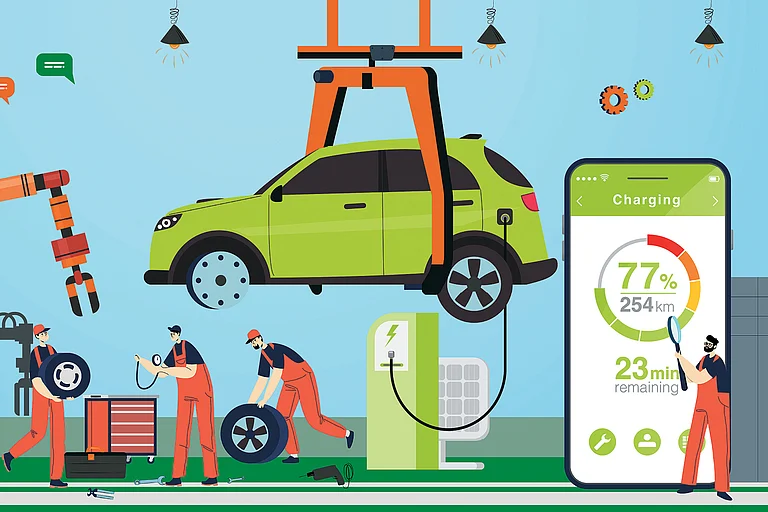
On a per-day basis, how many vehicles actually need predictive maintenance, and how many breakdowns happen?
Per day, 20–25 vehicles may require predictive maintenance checks. There are many reasons: customers may not have charged the vehicle fully, improper charging habits, etc. Charging to 100% once a week is necessary—charging only to 99% sometimes creates issues.
Some cases may be sensor failures due to supplier quality issues. For such cases, we send technicians. That would be 5–10 cases per day where Prime is used.
If predictive maintenance wasn’t done, these cases could easily double. Predictive maintenance is essential in EVs.
Don’t you think this is a small number to launch a separate service?
For customers to buy EVs, they need to be anxiety-free. Even if it’s 100 cases, they need the confidence that if something goes wrong, they are taken care of.
Otherwise, towing charges, delays, workshop visits—all create friction. Customers hate workshops now. They want: use it, charge it, forget it.
This is very important for individual customers whose livelihood depends on daily driving. Missing one day of earning is a challenge. Fleet owners also appreciate this service—we give them dashboard access through APIs. They see fleet performance, identify vehicles not performing well, and we take preemptive action.
How is the vehicle uptime going to change after this service?
There are two categories of vehicles. Vehicles whose users are disciplined have more than 96% uptime. Those who skip services have around 91%. With Euler Prime, uptime will improve significantly.
If a customer goes to a workshop, half a day is lost—about five hours—and repairs may take another day. With on-site service, downtime reduces sharply, helping us achieve around 95% uptime for customers who currently skip services.
You said people nowadays don’t want to go to service centers. How do you think EV technology will change the nature of servicing? How will it differ from ICE vehicles?
Customers don't want to go to service centers, and with EVs we can track many data points. That’s why we’re able to offer predictive maintenance. In ICE vehicles you cannot track such granular data.
In EVs, the data points we can measure are far more—because ultimately it’s software running on wheels. We can track around 50 data points, compared to maybe 5–6 in ICE. The system identifies whatever is relevant for the customer in terms of performance, uptime, or the life of components, and flags potential issues.
Now, what I foresee is this: only the mechanical parts—steering, brakes, suspension—will require physical servicing, because EVs still have these three components. They’ll need lubrication or mechanical checks, but even then, a 3–4 month interval is enough. Over time, we can design these components so that service intervals rise from 10,000 km to 30,000 km. In that case, the customer would need to come in only once a year.
I visualize a future where servicing is largely doorstep-based. Just like with a Tesla, you plug in your car at night, and by morning software updates and diagnostics are already done. Eventually, servicing anxiety around EVs will disappear. Compared to ICE—where customers go every three months—EV will be a once-a-year or even a remote experience.
Many dealerships earn a part of their revenue from servicing. If customers stop visiting, won’t this affect their business? How will this change the nature of dealerships?
Dealerships depend heavily on parts revenue and service labor revenue. Typically, after you sell a vehicle, you earn from its service and labor over the next 7–8 years.
But in commercial vehicles, the local ecosystem is cheaper than OEM workshops, so today service penetration at dealerships is only 30–40%. The rest goes to outside garages.
However, in EVs, customers don’t have that choice. They either come to the dealership or the dealership’s technician visits them. So, in terms of labor revenue, things remain similar—whether it's software servicing or mechanical servicing, the customer pays for labor.
As for electrical components, they don’t need regular servicing. You can’t “open up” a motor; it's either lifetime use or plug-and-play replacement. This reduces parts revenue because of longer component life.
But many customers are now taking AMC (annual maintenance charge) packages—for example, in Euler, 30% of customers have taken AMC. AMC revenue ultimately flows to the company, just like insurance. Customers don’t mind paying because it gives them peace of mind.
In the category that Euler serves, the minimum fuel saving per month is around ₹10,000–12,000. So, customers don’t mind paying ₹2,000 monthly for AMC, which is assured revenue for us. That’s the business model: higher reliance on AMC, so revenue goes to both the company and the dealership.