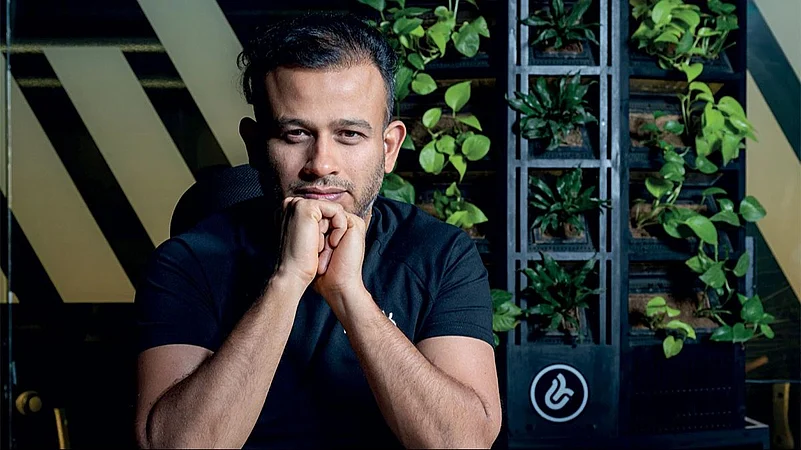

Vikram Chopra argues that Delhi’s pollution crisis needs urgent and uncomfortable policy interventions
He believes political will, not technology, is the biggest missing link
For him, safeguarding public health outweighs any potential hit to the used-car market
In the start-up world, growth is gospel, and founders have a reputation for chasing it at all costs; rarely are they known to advocate for anything that could shrink their addressable market.
However, founders also have a reputation for not doing the obvious, for thinking out of the box. That may be what led Vikram Chopra, cofounder of Cars24—one of India's largest used car platforms—to call for strict measures, including tough restrictions on the use of cars inside the city, to bring Delhi's unwieldy air pollution under control.

1 September 2026
Get the latest issue of Outlook Business

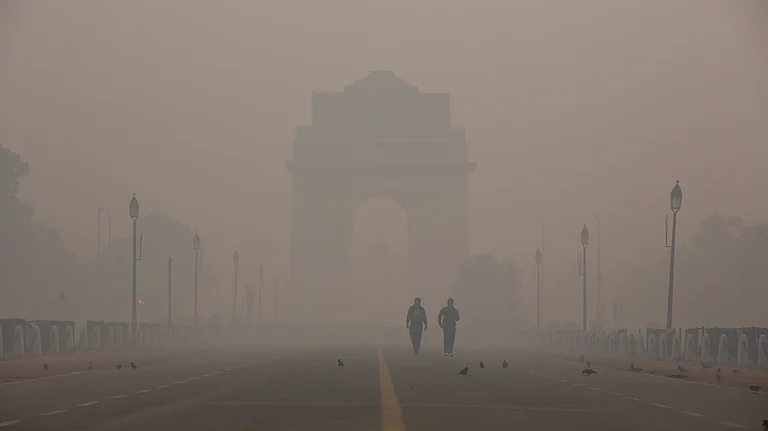
As Delhi chokes under 500-plus AQI readings, Chopra puts up a simple argument: what's the point of building a company for the next generation if that generation grows up with half the lung capacity of a normal adult?
Edited Excerpts:
You have openly called for restrictions that can directly hurt your own industry. What was the personal trigger point that pushed you to publicly call out both citizens and the government?
There was no particular incident. I was genuinely contemplating moving out of Delhi due to the air pollution crisis. And this thought stayed in my mind for about 15 minutes. But then I wondered, will moving out of the city actually solve the problem? Obviously, the answer is no. It may solve it for me, but what about my family, my team members, my friends, and everyone living not just in Delhi but across the country?
So, this thought triggered something in me, and I felt the need to start speaking about this issue as strongly as I feel it.
I’ll give you an example. I was recently at a friend’s birthday event at night. Everyone was sitting inside, and then they all decided to step out because it was such a nice Delhi winter evening. And then I pulled out my phone to show AQI to everyone, which was above 500. Still, I was the only one sitting inside the room.
We have normalised it to an extreme. But I can’t allow myself to normalize it. Everyday when I look at my child, I feel guilty and embarrassed: What am I doing to his future and the future of the young generation growing up now? This pushed me to start talking about it. We talk about this very openly in our company, try to educate team members, families, and friends. But beyond the pollution problem, my main concern is normalising it, especially those of us living in Delhi.
Advertisement
What exactly should the central and Delhi state governments implement in the next 6-12 months to prevent this?
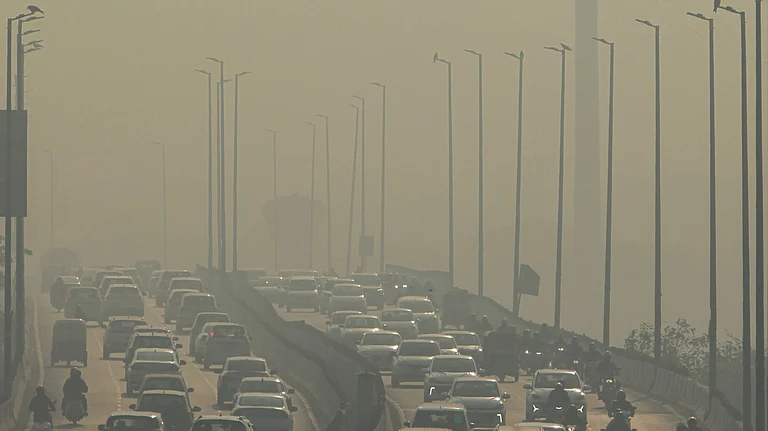
We have to do everything possible to bring pollution down. The city is uninhabitable. It’s an emergency situation. We need odd-even, encourage carpooling, implement congestion fees, improve public transport, stop construction activities, regulate commercial vehicles, fix unpaved roads, etc.
And on an individual note, if you believe smoking is horrible, then ask someone who smokes whether they want their children to do the same. They will always say no. There is so much that can be done, but we procrastinate because as citizens we think: what difference will it make?
Advertisement
Do you think these measures can be implemented permanently?
As long as there is political will, there is a way. These four months, i.e., from November to February, are consistently the worst. There is no choice. If we want the best for our children, parents, ourselves, we have to accept short-term inconvenience. This is a classic case of short-term gain and long-term pain.
When I look at children, I genuinely feel sorry. This is not the future we should be giving them. If it means I have to sell fewer cars, I’m okay with it. Health is wealth. Business will survive, but health will not come back. This is irreversible damage.
Where do you think the biggest policy failure lies, enforcement, political will, inter-state coordination, or lack of long-term planning?
I think the biggest failure is the political will. It’s the will to prioritise air pollution as a serious health issue. Other countries like China and London have been through this. There is enough documentation on it, simple measures can show progress. London introduced a congestion tax when air pollution reached its peak.
People opposed it at first, but once they saw results, they started supporting it. This is the classic example of short-term pain and long-term gain. Currently, in India, we are choosing short-term gain, long-term pain. And this never works.
What is the single most effective policy Delhi NCR should adopt immediately?
There is no magic bullet, but several high-impact steps exist like odd-even to reduce the number of cars on roads, congestion tax, compulsory carpooling, controlling diesel generators, pushing commercial sites to use batteries, etc.
Consistently maintaining the AQI under 50 will take years. But bringing it down from over 500 to below 150 is absolutely possible with short-term measures.
Look at the scrapping policy, fitness-expired vehicles, PUCC-expired vehicles, 15–20-year-old cars still running. The rule was rolled back in June because of public backlash. But the same public is suffering today due to pollution. So yes, people need to demand action. And the government must take measures even if it means short-term backlash or inconvenience.
The government is also promoting EV adoption as one of the strategies to cut urban emissions, yet EVs currently make up only around 2-3% of India’s passenger vehicle sales. Do you believe EV promotion alone can realistically move the needle on Delhi-NCR’s air pollution crisis?
Electric vehicles are a long-term measure, and it should be pursued. But we are in a crisis right now. The short-term measures we discussed are more urgent because they can show immediate impact, while EVs will help structurally over the long-term.
Cars and commercial vehicles are just one part of the pollution problem. They contribute nearly 20-30% to it, while the rest is construction, roads, diesel generators, stubble burning, etc.
EVs will take time to scale, globally and in India. But we need more immediate action, because relying only on long-term measures means suffering 500 AQI for the next 5–10 years.
You have publicly supported policies that could significantly reduce the number of cars on the road. If the government actually implements any such policy. Are you operationally and strategically ready for that shift?
When Covid-19 pandemic hit nations, everyone thought the world would end. But the world emerged stronger and more resilient because we treated it as an emergency.
It’s the same today. Yes, it may create short-term disadvantages for my business. But I will not compromise my children’s health, my parents’ health, or my team’s health.
Whatever we are building, it’s for the next generation. If that means my business takes a short-term hit, so be it. I won’t give the next generation a damaged future just to optimise my business. Children who are five today might grow up to age 20 with half the lung capacity of a normal adult. Do we want that?
How will restrictions on diesel vehicles, older vehicles, and peak-hour driving affect the used car market dynamics?
Honestly, I don’t know, and I don’t care. Humans are resilient. We will figure it out, just like we figured out Covid-19. What is non-negotiable is health. If we have clean air, and a healthy community, our businesses and economy will also thrive in the long run.
But not if an entire generation grows up with lungs functioning at 50%. The economic impact of this health crisis is massive. Research shows people are losing 10 years of their lives on average. Nothing hits GDP more than that.
Delhi government recently got the ban on old vehicles lifted through SC. Do you think that is a good move?
Lifting the ban on older vehicles is a decision that deserves very careful reconsideration, especially given what we know about Delhi’s air. Every meaningful improvement in the city’s AQI has come only when stricter measures were applied consistently. Older vehicles, particularly ageing diesel ones, remain significant contributors to PM2.5 and NOx levels.
At a time when our children and parents are struggling to breathe, it’s important that we strengthen proven interventions rather than ease them. Clean air has never been achieved without difficult choices.