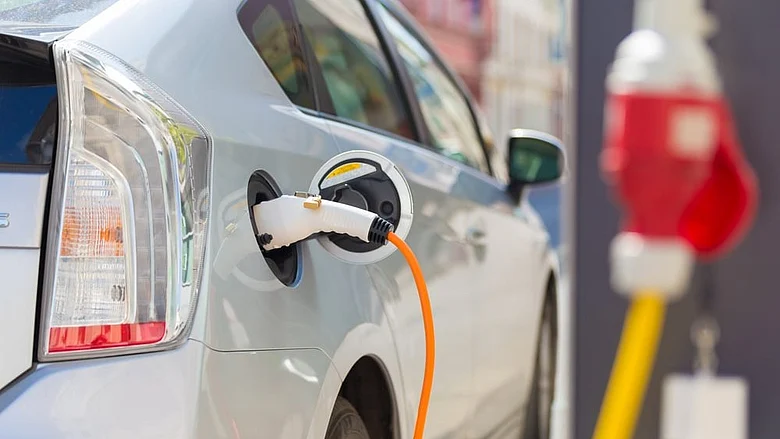

Nearly one in every two premium passenger vehicles registered in India this year is an electrified model
Carmakers including Mercedes-Benz, Volvo and BMW report growing EV adoption among luxury buyers
The shift is reshaping product strategies as manufacturers invest across multiple electrified powertrain options
Electrified vehicles are rapidly becoming the preferred choice among India's premium car buyers, with battery electric vehicles (BEVs), hybrids and plug-in hybrids accounting for nearly half of registrations in the country's high-end passenger vehicle market.
Electrified models made up 49.1% of registrations in the passenger vehicle segment priced above ₹30 lakh during January-May 2026, The Economic Times (ET) reported citing data from Jato Dynamics.

1 October 2026
Get the latest issue of Outlook Business

The share has risen sharply from roughly one in ten vehicles three years ago, highlighting one of the fastest shifts in consumer preference within India's passenger vehicle industry.




The trend comes even as the broader mass-market discussion continues to focus on ethanol-blended petrol, fuel efficiency and operating costs.
In contrast, buyers in the premium segment are increasingly choosing between different electrified powertrains instead of conventional petrol and diesel vehicles, the report said.

Technology, Ownership Costs Shape Decisions
The wider availability of battery electric and hybrid models, along with improvements in technology and growing consumer confidence, has accelerated adoption in the luxury segment.
Advertisement
Consumer preference for a powertrain depends on the latest technology and the total cost of ownership, said Santosh Iyer, MD and CEO, Mercedes-Benz India, as per ET.
He added that customers are doing the math, and if the total cost of ownership is lower than an internal combustion engine vehicle, they are willing to look beyond traditional ICE (internal combustion engine) technologies.
Electric vehicles now reportedly contribute around 14% of Mercedes-Benz India's sales, almost double their earlier share. However, Iyer said charging infrastructure and lower residual values continue to be the biggest barriers to faster EV adoption.
Volvo Car India is also seeing changing customer preferences. Jyoti Malhotra, MD of Volvo Car India, said that earlier an EV would be a second or third car in a household. "Today, we are seeing a remarkable shift where a luxury EV is proudly chosen as the primary, and often the only, vehicle in the household," as per ET.
Advertisement

He added that the conversation has shifted from 'Should I buy an EV?' to 'Which EV should I buy?'.
Premium customers are increasingly evaluating propulsion technologies based on performance, refinement, ownership experience and sustainability rather than simply choosing between petrol and diesel, according to Ravi Bhatia, President of Jato Dynamics India, per the ET report.
BMW India has also reported strong momentum. According CEO Hardeep Singh Brar, EV sales rose 78% year-on-year in the first half of 2026, while their share of the company's sales increased from 21% to 26%.
Manufacturers are now expanding portfolios across hybrids, plug-in hybrids and battery electric vehicles as the Indian luxury car market increasingly aligns with global trends.
Brar said there are several factors that shape customer experience, including expansion of product portfolio, evolving technology with enhanced range options, and the EV ecosystem in the country.
"Regulatory environment and the current geo-political scenario are also leading customers to opt for EVs," Brar remarked.