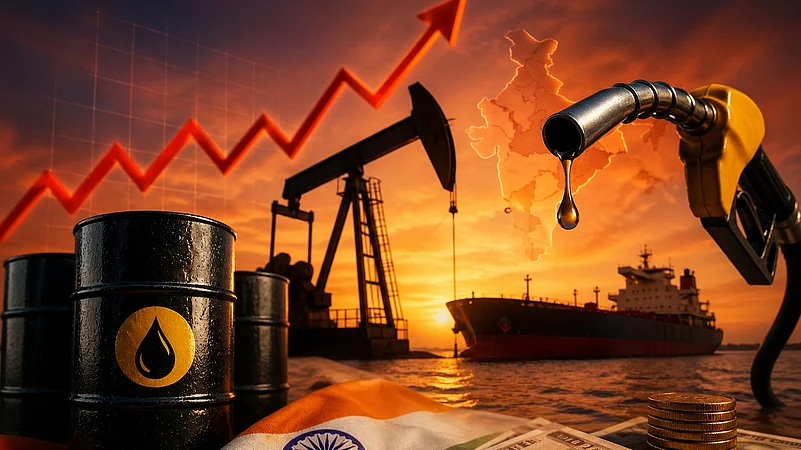
The global crude oil market has surged to its highest level since 2022, briefly touching $125 per barrel amid fears of military escalation in the ongoing US-Iran conflict. The war, now entering its second month, has disrupted trade and intensified supply chain concerns, with analysts warning of a potential global recession if it extends beyond mid-May.
Even if a resolution is reached soon—an outcome that currently appears unlikely—crude prices are expected to remain elevated. Persistently high oil prices could have significant implications for India’s macroeconomy, including interest rates and the rupee.
What Led to Oil Rally?
Brent crude was trading in the $60–$70 per barrel range before the war began on February 29. Since then, prices have consistently stayed above $90, putting pressure on India’s current account deficit and currency.

1 September 2026
Get the latest issue of Outlook Business

On Thursday, Reuters, citing Axios, reported that the US is preparing for a potential escalation in military action against Iran amid stalled negotiations. The move is aimed at pushing Tehran back to the negotiating table.
The first round of talks on April 11 failed to produce a long-term ceasefire, largely due to disagreements over Iran’s nuclear programme. The US demanded a complete halt to uranium enrichment along with a 20-year moratorium—terms Iran rejected as “excessive.”
Following the breakdown in talks, Washington imposed a naval blockade on Iranian ports and the Strait of Hormuz—a key chokepoint that handles nearly 20% of global energy trade—further worsening the global supply outlook. Iran has refused to resume negotiations unless the blockade is lifted.
Advertisement
Amid fears of further escalation, crude prices jumped nearly 6% on Thursday alone, with WTI touching $109 per barrel.
Oil Market Triggers Fear Across Markets
Soaring crude oil prices have significant impact across asset classes, especially for emerging-markets economy, as they feed into inflation expectations and impact equity valuation and currency depreciation.
An elevated crude oil price will increase input costs for companies, particularly for aviation, paints, logistics and chemicals. This can squeeze company margin and earnings outlook.
According to an HSBC report, a 20% rise in crude prices can shave off nearly 150 basis points from a company’s earnings outlook. Crude oil has surged 55% since the onset of the war.
Advertisement
Major broking giants including JPMogran and HSBC has downgraded Indian equities amid fears of weak earnings and heightened uncertainty.
On Thursday, Indian benchmark equities opened sharply lower tracking global cues and crude prices. The BSE Sensex opened 76,575.21 and tumbled 900 points in early trade. The Nifty 50 opened at 23,904.95 and slipped 267.15 points. The GIFT Nifty was down 73.50 points of 0.3% at 24,182.50.
Global markets are also experiencing the rippling effects of the war. Wall Street ended flat on Wednesday as investors awaited cues from the US Federal Open Market Committee meeting.
The US Fed maintained status quo, and held the FedFundsTarget range at 3.75-3.50%. Markets across Asia opened lower as well, with Japan’s Topix down 1% and Hong Kong futures declined amid risk-off sentiments amongst investors.
Rupee Continue to Take Brunt
The rupee was the worst performing Asian currency in 2025, the path doesn’t look different this year either. So far this year, the rupee has weakened nearly 11%, with the currency falling to a record low of 95.21 against the dollar on Thursday, driven by the surge in crude prices.
“Rupee makes a new low of 95.27 as rising oil prices keep dollar well bid while FPI outflows continue despite market moving up,” Anil Kumar Bhansali, Head of Treasury, Finrex Treasury Advisors said.
The rupee is being dragged down primarily by two forces – importers’ dollar demand, as importers especially oil traders, rush to purchase dollars amid fears of further rise in crude.
On the other hand, foreign portfolio investors continue to exit Indian markets as they seek safe haven assets amid heightened uncertainty and market volatility.
Increasing demand of dollars from investors and importers may compel the Reserve Bank of India to step into market with dollar sales more aggressively, but will significantly deplete foreign exchange reserves.
Macroeconomic Impact
Though fundamentals of India’s macroeconomic and financial conditions remain intact, the West Asia war will have rippling effects, seeping through policy constraints, higher inflation, and rise in government subsidies.
This will further impact on India’s current account deficit, the International Monetary Fund, in its latest report projects that India to run a current account deficit of $84.46 billion in 2026, the second highest in the past twenty years.
The rationale is primarily driven by an expected elevated price of crude oil, which is expected to average at $82.22 a barrel, compared to $67.74 a barrel the previous year.
Moreover, India receives significant remittance from West Asia, which helps fund the current account deficit and adds to forex reserves. A fall in it could imbalance household incomes, weaken the currency further and widen the CAD. The Central government has already reduced excise duty by ₹10 on petrol and diesel.
In an earlier report by IDFC First Bank, that the reduction in excise duty on petrol and diesel is expected to result in a revenue loss of around ₹1.8 trillion over a 12-month period for the Centre.
Oil Sees $150?
The oil first hit a multi-year high of $119 per barrel, triggering world wide panic. The US had to lift some sanctions on Russia and release Russian crude to manage oil supply which was disrupted in the strait of hormuz.
The Russian crude, which was once sold at a discount following the Western sanctions, is now being sold at a premium of $4-$7 per barrel. The International Energy Agency released its largest ever emergency crude reserves to prevent crude prices from hitting $150 per barrel.
This temporarily calmed the oil markets, however, the benchmark Brent found itself struggling to trade below $90. On Thursday, it marked its seventh consecutive week of gains.
Analysts have been warning that if the strait of hormuz remains shut for the rest of the year and the war prolongs, particularly a military escalation, could send oil prices to further rise.
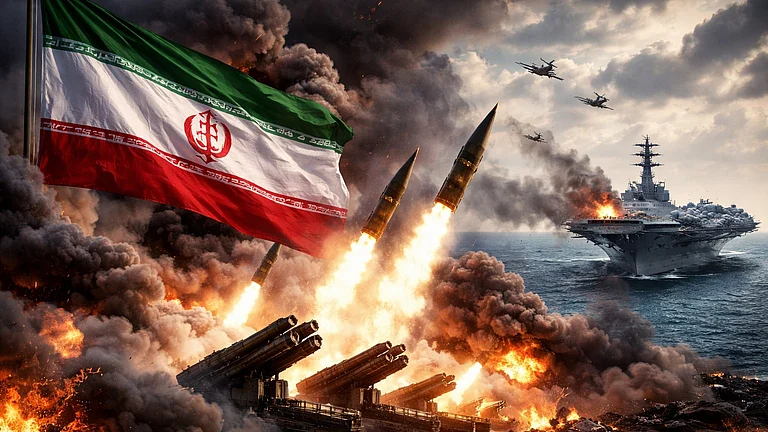



Analysts anticipate $150 per barrel case of prolonged escalation of war, which will trigger a global economic slowdown and increased inflation. This will further complicate policy decisions for governments and global central bank as they now have to tackle inflation amid slowing growth.
The RBI, in its minutes of the April Monetary Policy Committee, have flagged upside inflationary risks and downside pressure to economic growth.
According to the latest projection, inflation is seen averaging at 4.6%, slightly above the inflation target of 4%. The RBI has a target range of +/- 2%. Economic growth is projected at 6.9% for FY27, slowing from 7.6% in FY26.