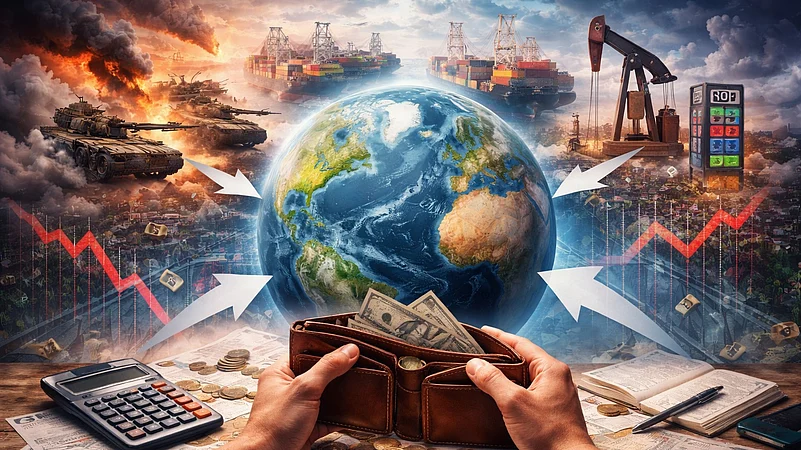
A consumer no longer needs to track global news to feel geopolitics. It shows up quietly — at the petrol pump when the bill feels a little heavier, in the sabzi mandi where prices creep up overnight, in a monthly budget that suddenly feels tighter.
What looks like a local price rise is often the aftershock of events unfolding far beyond India's borders. Take tensions in the Middle East. These are not just geopolitical flashpoints; they are economic triggers.
For a country that relies heavily on imported crude oil and key commodities, such disruptions translate almost immediately into higher costs.

1 September 2026
Get the latest issue of Outlook Business

The first and most direct impact is on energy. As crude grows more expensive, India's import bill rises, putting pressure on the rupee. A weaker rupee, in turn, makes imports costlier still. This double effect feeds straight into inflation, and what begins as a geopolitical event soon becomes a household concern.


But the story doesn't end with oil. Trade route disruptions, such as those seen in the Red Sea, stretch shipping timelines and push up freight costs. Goods take longer to arrive, insurance premiums rise and supply chains turn less predictable.
The effect reaches everything from fertilisers to metals to food. Higher fertiliser costs, for instance, raise the cost of farming, which eventually shows up in food prices. In a country where food forms a large share of household spending, this creates a deeper and more widespread inflationary effect.
Advertisement
Economists call this "imported inflation" — price pressure that originates outside the domestic economy. Unlike demand-driven inflation, which can be managed by reining in spending, imported inflation is far harder to contain. It is driven by forces beyond the direct control of domestic policymakers.
This is where the Reserve Bank of India comes in. Interest rates may be the most visible tool in the central bank's arsenal, but they are not always the most effective answer to an external shock.
Raising rates can cool domestic demand, yet it does nothing to lower global oil prices or ease a supply chain snarl. Recognising this, the RBI leans on a set of non-monetary tools to manage such situations.
Advertisement
The most critical of these is currency management. The RBI intervenes in the foreign exchange market to curb excessive volatility in the rupee. By selling foreign currency reserves when needed, it steadies the currency and limits how much rising import costs feed into domestic prices. This does not eliminate the impact, but it cushions it.
A second lever is liquidity management. Rather than tightening aggressively, the RBI keeps enough liquidity in the banking system to let credit flow smoothly. This matters during periods of global uncertainty, when it prevents the economy from slowing too sharply under an external shock.
There is also a broader layer of coordination between the RBI and the government. While the central bank manages monetary stability, the government can step in with fiscal measures — adjusting fuel taxes, or subsidising essentials such as fertilisers.
These absorb part of the cost increase and prevent a full pass-through to consumers. They carry their own trade-offs, but they are central to managing inflation in the short term.
Equally important, though less visible, is the RBI's communication. In uncertain times, expectations can drive behaviour as much as actual price movements.
By signalling its intent clearly, the RBI anchors inflation expectations and dampens panic — businesses raising prices too quickly, consumers cutting back unnecessarily.
These interventions have limits. If geopolitical tensions drag on, or oil prices stay elevated for too long, the pressure on the economy keeps building.
This is why the conversation is shifting from short-term management to long-term resilience.
India has begun diversifying its energy sources, investing in renewables and building strategic reserves to reduce its dependence on volatile regions. Efforts to diversify supply chains and cut over-reliance on specific trade routes are gaining ground too.
Inflation today is no longer just an economic issue; it is a geopolitical one. The distance between a conflict zone and an Indian household has effectively shrunk.
What happens in one part of the world no longer stays there — it travels through oil tankers, shipping lanes and currency markets, surfacing eventually in the prices we pay every day.
Disclaimer: This is an authored article. The views expressed are personal and do not necessarily reflect those of the publisher or the editorial team.
About the Author: The author is a former Chairman of the Bombay Stock Exchange and Promoter and Managing Partner at Ravi Rajan & Co. LLP.