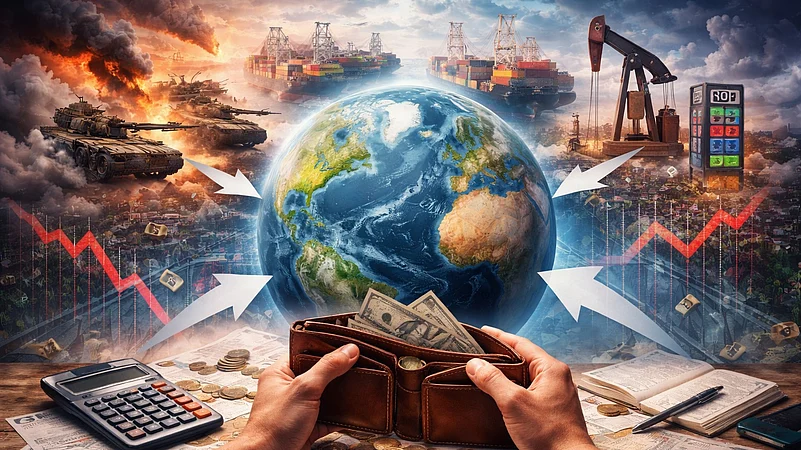

Conflicts in key oil-producing regions can raise crude prices, increasing transport costs and pushing up prices of everyday goods.
Changes in global interest rates affect capital flows, currency stability and loan EMIs for households and businesses in India.
Uncertainty in global markets often makes households more cautious, influencing spending, saving and investment decisions.
"When the world sneezes, emerging economies catch a cold." This old economic saying captures a simple truth about today's interconnected world. Events that take place thousands of kilometres away can quietly influence the everyday lives of people in India. From the price of petrol to the EMI on a home loan, global developments often travel much faster than we imagine.
Over the past year, global headlines have been dominated by rising geopolitical tensions. The ongoing conflict involving the US, Israel, Iran and the broader Middle East has created uncertainty across global energy markets. These tensions have raised concerns about disruptions to oil supply routes, especially through the Strait of Hormuz, one of the world's most important oil shipping channels.

1 September 2026
Get the latest issue of Outlook Business

Whenever conflict intensifies in this region, global oil markets react almost immediately. Prices begin to rise as traders and governments worry about potential supply disruptions. For oil-importing countries like India, this is not just an international story; it becomes a domestic economic concern. India meets the majority of its crude oil requirements through imports. When global oil prices rise, the country's import bill increases significantly.
Advertisement
Over time, this additional cost finds its way into the daily expenses of ordinary consumers. Fuel prices may rise, transportation costs go up, and the price of essential goods, from vegetables to household products, gradually increases. Most consumers may not consciously connect these price changes to global conflicts, but the link is very real. A disruption in the Middle East can quietly affect the cost of commuting to work, booking a flight or even buying groceries.
Interest Rates
At the same time, another global force plays a powerful role in shaping economic conditions in India: interest rates, especially those set by the United States Federal Reserve. The US Federal Reserve influences the global financial system more than any other central bank. When it raises interest rates, global investors often move their money into American assets because they offer higher returns with perceived safety. This movement of capital out of emerging markets such as India can weaken currencies and make stock markets volatile.
Advertisement
When large amounts of foreign investment leave emerging markets, currencies may weaken and stock markets can become volatile. For India, this can sometimes mean fluctuations in the rupee and unpredictable movements in financial markets. On the other hand, when US interest rates fall, global investors often look toward emerging markets again for better returns. Countries like India may then see increased investment in stocks, bonds and businesses. This inflow of capital can support economic growth and boost market confidence.
While this may sound like a purely financial story, its effects often show up in very practical ways. For example, when global interest rates rise, borrowing becomes more expensive across financial systems. Banks may increase lending rates, which means home loans, car loans and business loans can become costlier. For a middle-class Indian family planning to buy a home, this could mean higher monthly EMIs. For a small business owner, it might mean postponing expansion plans because the cost of credit has increased.
The Indian Consumer
Geopolitics and interest rates together create a powerful combination that influences consumer sentiment. When people hear about global conflicts, rising oil prices or uncertain financial markets, it can affect how secure they feel about the future. In such times, households often become more cautious. Families may postpone large purchases, delay travel plans or focus more on saving rather than spending. Businesses notice this shift in consumer behaviour, which can slow economic activity in sectors such as real estate, automobiles, retail and travel.
However, India's economic journey has also shown remarkable resilience in navigating global shocks. The country has experienced multiple international crises over the decades, including oil shocks, currency pressures and financial market volatility. Yet it has continued to adapt and grow through a combination of policy reforms, domestic demand and entrepreneurial energy.
Today, India remains one of the fastest-growing major economies in the world. Its large population, expanding middle class and growing infrastructure investments provide a strong foundation for long-term growth. Even so, global forces cannot be ignored. In an interconnected economy, decisions made in Washington, conflicts in the Middle East or shifts in global capital flows will always have some influence on India's economic landscape.
Understanding these connections helps us see that global economics is not an abstract concept discussed only by policymakers or financial experts. It is something that quietly shapes the rhythm of daily life, from the cost of living to the affordability of long-term dreams. In many ways, global economic forces operate like distant weather systems. A storm forming far away may not be visible immediately, but its winds eventually reach every shore.


For India, the challenge is not to avoid these global shifts but to prepare for them. Strong financial institutions, diversified energy sources and stable economic policies can help cushion the impact of global shocks. After all, in today's world, the distance between a geopolitical headline and an Indian household budget is much shorter than it used to be.
The author is a former chairman of the Bombay Stock Exchange (BSE) and the founder of Ravi Rajan & Company.
(Disclaimer: This is an authored article. The views expressed are personal and do not necessarily reflect those of the publication.)