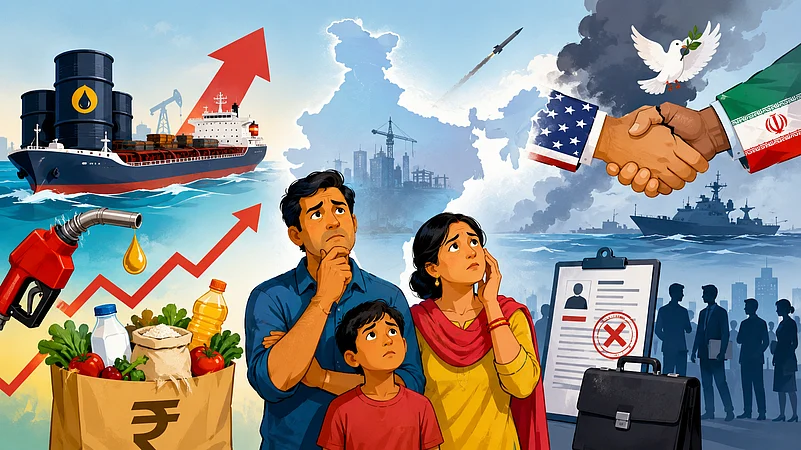

Oil prices have retreated, but the fragile ceasefire in West Asia continues to pose risks to Indian households
Economists and industry leaders warn that prolonged uncertainty could slow hiring, lift inflation and delay the recovery in consumer demand
With monsoon risks and geopolitical tensions persisting, households may face the twin challenge of weaker job prospects and rising living costs
Even as the Indian government, led by the Prime Minister, has projected confidence that the economic fallout from the West Asia conflict has been contained, it may be premature for Indian households to share that optimism. For them, the twin risks of weaker employment growth and higher inflation remain very much alive.
“India has shown remarkable stability during tough and testing times globally, despite our structural vulnerabilities,” said Prime Minister Narendra Modi in a LinkedIn post on Monday. “It has been achieved by ensuring macroeconomic stability over the last decade while making policy-making responsive and agile.”

1 September 2026
Get the latest issue of Outlook Business

The government's confidence stems largely from the sharp retreat in global crude oil prices, which have slipped back to near pre-war levels in recent weeks. Markets have responded positively to the fragile ceasefire between the United States (US) and Iran and to ongoing diplomatic efforts aimed at securing a more durable peace.
Brent crude, the global benchmark, has now fallen about 42 per cent from its April 30 peak of $126 a barrel.
Advertisement
Yet commodity strategists caution that financial markets may be reading too much into the recent decline in oil prices. They argue that current valuations underestimate the persistence of supply-side risks. Although shipping through the Strait of Hormuz has resumed after the US-Iran ceasefire, traffic is unlikely to return quickly to pre-conflict levels. Tehran, they contend, is expected to continue using its influence over the world's most critical oil chokepoint as strategic leverage.
That assessment finds support in remarks made by Iran's Parliament Speaker, Mohammad Bagher Ghalibaf, who recently declared that the Strait of Hormuz would never return to its pre-war operating framework. According to Ghalibaf, Tehran intends to oversee the strategic waterway under a new arrangement while continuing to comply with international regulations.
Advertisement
"Everyone should know that the administration of the Strait of Hormuz will never go back to the way it was before the war," he said.
Reflecting on this, Nikos Petrakakos, managing director of investments at Tufton Investment Management, told CNBC's Europe Early Edition, "Even though there is some more motion going on, in general, we are nowhere near being back to where it was."
Beyond tensions surrounding the Strait of Hormuz, the ceasefire itself has done little to prevent fresh military confrontations. Both sides have accused each other of violating the interim agreement, setting off a fresh cycle of tit-for-tat military action that threatens to derail ongoing diplomatic efforts and the economic stability that was promised after the deal.
Although current estimates project crude oil to average $80–90 a barrel in 2026–27, DBS Bank has warned that "any protracted re-escalation in tensions" very well remains as a key risk.
Job Concerns
What this essentially suggests is that while the immediate threat of a recession may have receded—easing fears that intensified after Prime Minister Modi urged citizens to support the economy—Indian workers are not yet out of the woods. Unless conditions in West Asia stabilise decisively, they may have to brace for a gradual, sector-specific moderation in hiring and salary growth.
"If the conflict persists and leads to prolonged high crude oil prices, inflationary pressures or supply chain disruptions, companies in sectors such as logistics, aviation, construction, hospitality, consumer goods and export-oriented manufacturing may adopt a more cautious approach by delaying discretionary hiring and moderating expansion plans," Balasubramanian A, Senior Vice President at TeamLease Services, a staffing company, tells Outlook Business.
Earlier in June, policy research and development consultancy IPE Global, in its newly published peer-reviewed study, Paving a Green Transition: A New Social Contract Amid West Asia Crisis, warned that 10–12 million livelihoods across key sectors in India are vulnerable to disruptions triggered by the conflict.
"The numbers tell a story India cannot afford to ignore. With 85 per cent of our crude oil imported, and 10 to 12 million livelihoods across agriculture, energy and industry exposed to a single geopolitical shock from West Asia, the fragility is real," says Abinash Mohanty, Head of Climate Change and Sustainability Practice at IPE Global and the study's lead author.
Beyond the direct threat of rising price pressures pushing up costs for companies and farmers, Balasubramanian argues that the more consequential risk to the labour market over the longer term is the uncertainty that has clouded business decision-making over the past year and a half.
"Business uncertainty is likely to have a greater impact than price pressures," says Balasubramanian. "While higher costs can weigh on margins, it is uncertainty around demand and future business conditions that typically prompts companies to slow hiring and moderate wage growth."
In comes Inflation
Meanwhile, even as the threat of a slowdown in hiring and wage growth looms, Indian households may also have to contend with a renewed rise in inflation. Headline inflation, measured by the Consumer Price Index (CPI), rose to 3.93 per cent in May from 3.48 per cent in April, marking a 15-month high. Since inflation measures the year-on-year change in consumer prices, the latest reading also extends a streak of monthly increases throughout 2026.
Notably, food inflation, the usual suspect, contributed about 170 basis points (bps) to headline inflation, while the contribution from non-food items was higher this time at about 230 bps.
"Rising input costs for producers, reflected in the Wholesale Price Index inflation of 8.3 per cent in April, are now increasingly feeding into consumer prices," says Dipti Deshpande, principal economist at Crisil, adding that the impact of the West Asia conflict, which entered its fourth month in June, has begun to percolate through household budgets.


Adding to that is the growing threat of an El Nino, a climate phenomenon marked by the periodic warming of surface waters in the central and eastern Pacific Ocean that disrupts global weather patterns, weakening India's southwest monsoon and reducing rainfall. With forecasts pointing to below-normal rainfall this year, the risk of higher food prices has increased as well.
So, while the Reserve Bank of India (RBI), as per its latest estimates, expects headline inflation to average 4.2 per cent in April-June, it projects price pressures to intensify over the remainder of the year, forecasting inflation at 5.1 per cent in July-September, 5.9 per cent in October-December, and 5.4 per cent in January-March 2027.
Economists, however, warn that inflation could easily breach the upper end of the RBI's 2–6 per cent target band if price pressures coincide with a weak monsoon.
Taken together, a softer job market and rising inflation could undermine the consumption revival that the government has sought to engineer through a three-pronged stimulus of direct tax cuts, indirect tax relief and interest rate reductions over the past year. In fact, industry executives say much of the gains from these measures have already been eroded by the fallout from the ongoing crisis.
"The GST impact was very positive. But inflation now is two to three times what the GST benefits had offered because of the war," Mohit Malhotra, Dabur's global chief executive, told The Economic Times in May.
The Indian economy, therefore, may have to wait longer than anticipated to regain its footing. As long as uncertainty in West Asia persists, businesses are likely to remain cautious about hiring and investment, while households continue to grapple with rising living costs.