
It was a cold morning in Detroit in the late 1990s. Even colder was the reception Ratan Tata and his team received.
Tatas wanted to sell their loss-making car unit to American giant Ford Motor Company. What followed was a three-hour-long humiliation.
“You do not know anything about passenger cars. Why did you even start this division?” the Ford team asked the late industrialist. Tatas were told that Ford would be “doing a favour” by purchasing the struggling business.

1 September 2026
Get the latest issue of Outlook Business

Nearly a decade later, the script flipped. In 2008, when the Great Recession pushed Ford to the brink of bankruptcy, its iconic British luxury subsidiaries, Jaguar and Land Rover (JLR), were put up for sale.
Tata Motors bought JLR from Ford for $2.3bn in an all-cash deal. Ford was humbled. Its chairman Bill Ford told Tata, “You are doing us a big favour by buying JLR.”
Though the deal signalled the arrival of Indian companies on the global stage, outbound bets remained rare for years. Focus on the domestic market, weak balance sheets and high valuations abroad kept most Indian firms out of global M&A.
It wasn’t until 2025 that overseas acquisitions became the order of the day for India Inc.
India Inc spent $13.7bn on acquisitions last year, more than 2.69 times they spent in 2024, as per consultancy firm EY India. The momentum has continued into 2026, with $8.9bn worth of deals in the first six months alone, as per professional-services firm Grant Thornton.
Now, companies across pharma, information technology (IT), automobiles and industrials are looking overseas for acquisitions.

The Disrupting Trigger
The US is India’s second-largest trading partner, with a massive surplus in favour of Indian companies. For a long time, Indian companies, be it goods makers or services providers, have built their business models on producing at low-cost locally and selling in the US at a premium. The tariffs announced by US President Donald Trump threatened this model.
“I think last year saw a lot of corporates trying to hedge their bets because of macro uncertainty,” explains Xerxes Antia, partner at law firm BTG Advaya.
That uncertainty quickly translated into action. Even as tariffs were implemented in a staggered and at times confusing manner, India Inc continues to explore how they could mitigate future risks.
Indian companies flocked to buy manufacturing units in the US and countries with low tariffs to escape its impact. For instance, Zydus Lifesciences acquired Ameican drugmaker Agenus’s biologics facility on June 3, 2025, and Lupin invested $250mn to set up a plant in Florida.
Tariffs may have been the trigger, but it isn’t the only reason behind the acquisition spree. Every sector is confronting its own strategic challenge. For IT firms, artificial intelligence (AI) and slowing demand are reshaping the traditional outsourcing model.
Drugmakers want to move beyond low-margin generics into speciality medicines while strengthening manufacturing closer to key markets.
Automakers are looking at premium products and technologies that would otherwise take years to build.
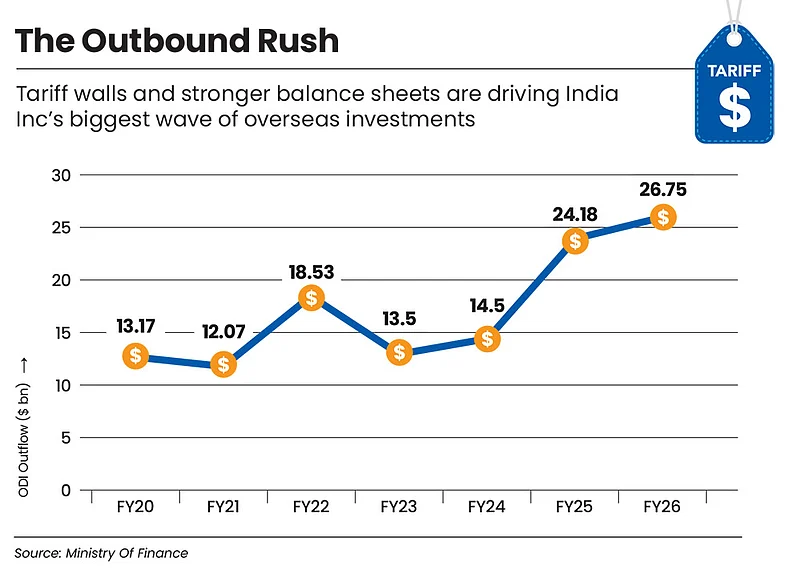
Indian companies made $26.75bn in overseas direct investment (ODI) in 2025–26, 10.6% higher than $24.18bn a year ago, according to government data. Of this, the second-largest chunk of about $4bn went to the US. In the first quarter of 2026–27 alone, ODI has already crossed $18.41bn.
The numbers point to strengthening sentiment among Indian companies for global investment. Also, acquiring capabilities have become a faster and less risky option. And this is why India Inc is increasingly looking overseas.
“Obviously, building something in the US would take years. Even M&A takes time, but people have started thinking in those directions,” observes Samir Sheth, managing partner at professional-services firm BDO India.
Buying Capabilities
Overseas acquisitions offer some-thing that organic expansion can’t: speed. It is especially vital for those under pressure to adapt quickly.
Take the case of the pharmaceutical industry. Overseas acquisitions are helping Indian drugmakers move beyond low-margin manufacturing into higher-value therapies and regulated markets.
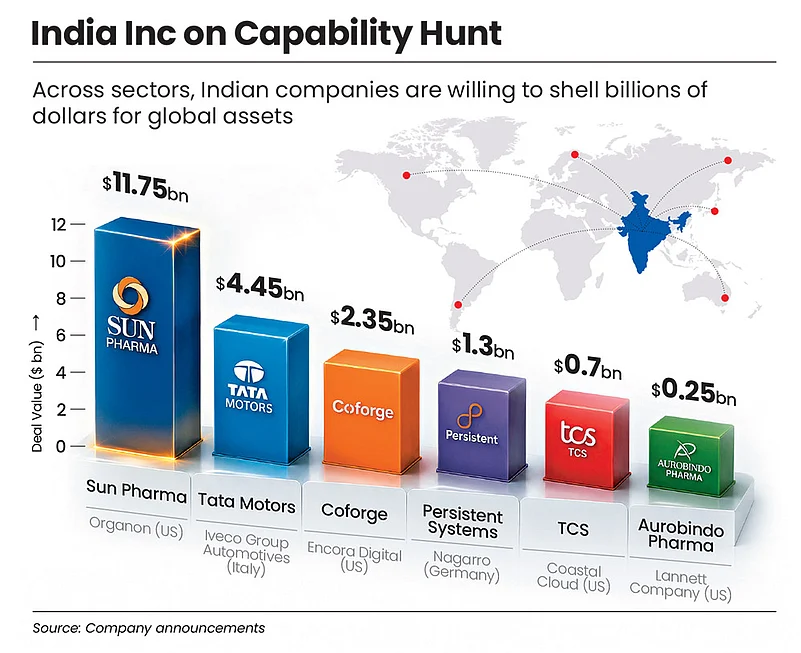
Buying US-based generics maker Lannett Company gives India’s Aurobindo Pharma access to a 425,000 sq ft facility in Seymour, Indiana, which can produce tablets, capsules, powders and liquids.
While the timing of the deal suggests a move to mitigate potential US tariffs, the fine print tells a deeper story. The acquisition gives Aurobindo entry into the $15bn attention-deficit/hyperactivity disorder (ADHD) medication market.
Similarly, Sun Pharma gains a stronger footing in women’s health and biosimilars through the $11.75bn deal to buy health-care company Organon. It also opens doors to markets like China and Brazil.
These deals show the urgency to move into the faster-growing and higher-value segments.
“Buying established foreign technology allows Indian firms to spend less or no time on R&D, fast-track innovation and focus on scaling their business,” observes Akila Agrawal, senior partner at law firm Cyril Amarchand Mangaldas (CAM).
For the IT sector, the challenges are different. AI is forcing firms to recalibrate and move beyond the traditional outsourcing model. Consulting, cloud, enterprise resource planning (ERP) and digital engineering have increasingly come into play.
For instance, Persistent Systems bagged Germany’s IT provider Nagarro for $1.4bn to enter the ERP segment, making it a designated implementation partner for ChatGPT-maker OpenAI. It also expands the IT firm’s footprint in Europe.
These deals also allow for expansion into North America and Europe. Coforge’s $2.3bn acquisition of Silicon Valley-born AI-native tech firm Encora and TCS’ $700mn purchase of US-based consultancy firm Coastal Cloud reflect the same strategy.
Automakers are in top gear too. Tata Motors’ $4.4bn Iveco buy gives it a stronger foothold in Europe and Latin America. It also adds technologies and capabilities that would have taken years to build.
“Indian companies are pursuing transactions where valuations are attractive, the geography fits, and there is a clear path to long-term growth,” notes BTG’s Antia.
The Means to Move
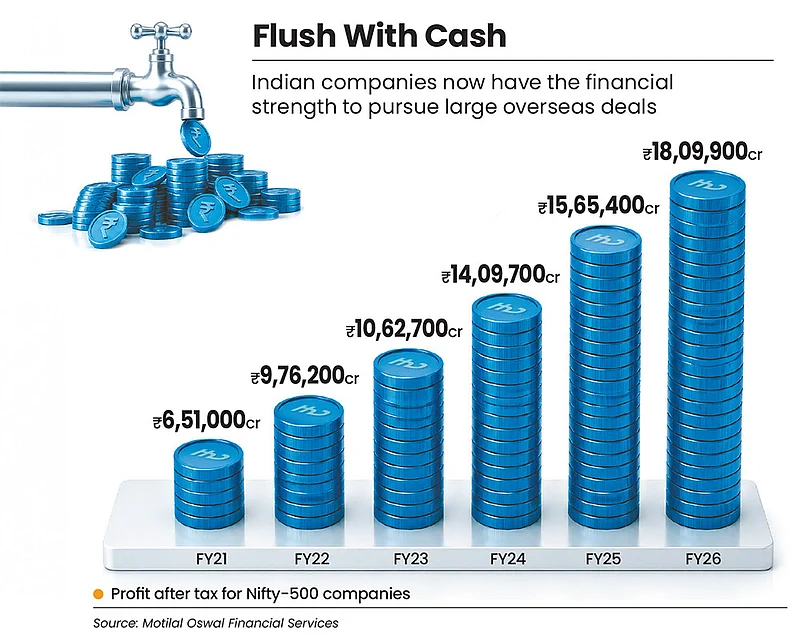
India Inc finally seems to have the firepower to pursue multi-billion-dollar overseas deals. Many domestic companies, especially those in the Nifty 500 universe, have seen a sharp rise in profits over the last six years.
By the end of 2025–26, Nifty 500 companies reported ₹18.1trn in profit after tax, nearly double compared to 2021–22, according to an analysis by brokerage firm Motilal Oswal Financial Services.
Corporate balance sheets have strengthened too. The debt-to-equity ratio has declined from about 1.1 times in 2014–15 to 0.5 times now, according to ratings firm Crisil Ratings.
Post-Covid slowdown in Europe and high interest rates in the US have lowered asset valuations
This means the company has borrowed just 50 paise for every rupee of shareholders’ equity.
“Indian companies have built cash reserves over time. So, naturally, they have internal funding capacity,” says BDO India’s Sheth.
As for external financing of such deals, Indian banks are also lining up. Government-owned State Bank of India (SBI) recently signalled this intent. In March, it partnered Japan-based MUFG Bank to explore opportunities in project structuring and financing.
SBI is reportedly evaluating a proposal to fund Sun Pharma’s Organon acquisition and may join global lenders to finance the deal.
“This indicates rising confidence on both sides: companies believe they can service the debt and banks are comfortable extending credit on viable terms,” says BTG’s Antia.
Considering all these tailwinds, experts believe that overall outbound M&A trend is likely to continue.
CAM’s Agrawal notes that geo-graphical diversification to access capital, supply chain and markets seems to be the mantra in these volatile times. “Indian conglomerates are also long term in their outlook. We expect to see a higher volume of mid-market deals,” she adds.
The Next Wave
This wave of rapid global expansion is expected to continue as markets in Europe and parts of the US offer favourable conditions. Experts believe that post-Covid slowdown in Europe and high interest rates in the US have lowered asset valuations.
“While exchange rate movements and financing costs remain important considerations, valuation corrections and an increase in distressed or non-core asset sales have made acquisitions more attractive,” notes Akshat Pande, managing partner at law firm Alpha Partners.
Most experts, however, argue that the recent wave of acquisitions is driven less by opportunism and more by the need to diversify geographically, access new technologies and build stronger global businesses.
That need may only become more pressing. While profits have surged, the pace of revenue growth appears to be moderating. The revenue growth of Nifty 500 companies stood at just 1.8% in 2025–26.
Experts believe overseas acquisitions can help companies find new avenues of growth by opening up international markets, adding products and technologies, and strengthening their competitive position.
“The next generation of entrepre-neurs that are choosing to settle abroad are leading to increased appetite for global growth,” says CAM’s Agrawal.
Backed by stronger balance sheets, better access to financing and a growing pool of overseas opportunities, outbound M&As are expected to remain an increasingly important part of India Inc’s growth strategy.
Overseas acquisitions have transitioned from rare, headline-grabbing gambles to a standard, strategic tool for Indian companies navigating a rapidly evolving global market.
While the long-term success of these deals remains to be seen, they have firmly established themselves as a routine method for scaling and adaptation.