
India and EU sign largest FTA in history, termed “mother of all deals.”
Agreement opens 144 EU sectors, 102 Indian sectors to trade and investment.
Deal cuts €4bn tariffs, supports MSMEs, exporters and sustainable technology adoption.
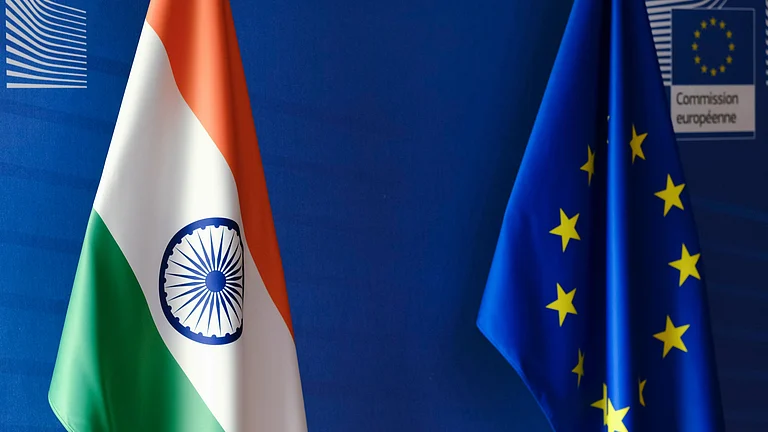
India and the European Union (EU) today announced the conclusion of negotiations for a long-awaited free trade agreement (FTA), describing it as the largest such deal ever struck by either side “the mother of all deals”, as officials termed it.
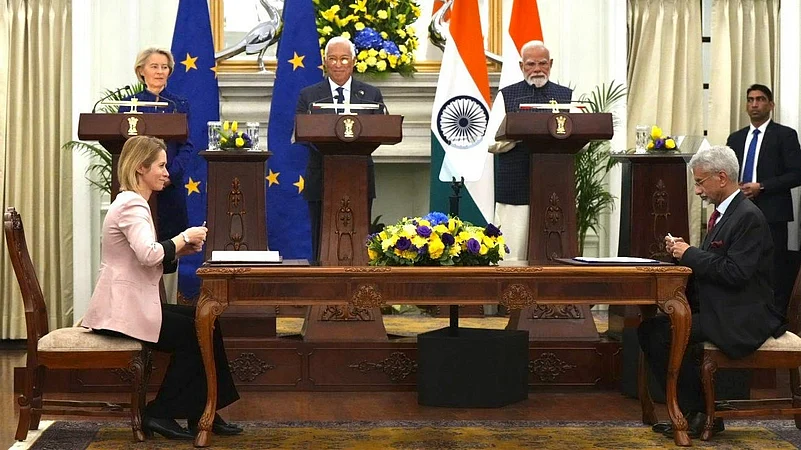
Prime Minister Narendra Modi, the President of the European Commission, Ursula von der Leyen, and the President of the European Council, António Luís Santos da Costa, witnessed the signing and exchange of the political declaration marking the conclusion of negotiations on the deal.

1 September 2026
Get the latest issue of Outlook Business

"Today, India has concluded the biggest Free Trade Agreement in its history. On 27th January, India signed this FTA with 27 European nations," said Modi.

"This will boost investment, form innovation partnerships and strengthen supply chains at the global level. This is not just a trade agreement, it is a blueprint for shared prosperity," he added.
The EU and India currently trade over €180bn worth of goods and services annually. The new agreement, forged between the world’s 4th- and 2nd-largest economies, together accounting for one-third of global trade, is expected to unlock fresh opportunities for businesses, MSMEs, women entrepreneurs, artisans, workers, students, skilled professionals, fisherfolk and farmers.
Advertisement
"As the world's largest democracies and champions of multilateralism, the European Union and India share the responsibility to uphold international law with the United Nations Charter at its core," da Costa noted.

Da Costa also underlined the significance of the parallel security and defence partnership, which is the first overarching framework of its kind between India and the EU. In an increasingly multipolar world, he said, prosperity cannot be separated from security.
“The European Union and India are working together to grow spheres of shared prosperity. But prosperity does not exist without security. We are strengthening our cooperation to better protect our citizens and our shared interests — countering the full range of security threats we face in the Indo-Pacific, in Europe and around the world — and reaching a new level of strategic trust,” he said.
Advertisement
Under the agreement, India gains access to 144 EU subsectors, while 102 Indian sectors will open to EU investment and high-technology engagement. With duties on leather and footwear slashed from 17% to zero, Indian MSMEs in these segments are expected to gain direct, competitive access to the vast EU market.
"A strong message [through this deal] that cooperation is the best answer to global challenges," von der Leyen remarked. "Strengthening our joint manufacturing power, it will cut up to around €4bn of annual tariffs for exporters of all sizes and it will create millions of jobs here in India and Europe."
She added that the deal would help both sides reduce strategic dependencies “at a time when trade is increasingly weaponised”.
The pact will also include financial support mechanisms to help Indian exporters reduce emissions and comply with the EU’s Carbon Border Adjustment Mechanism (CBAM).