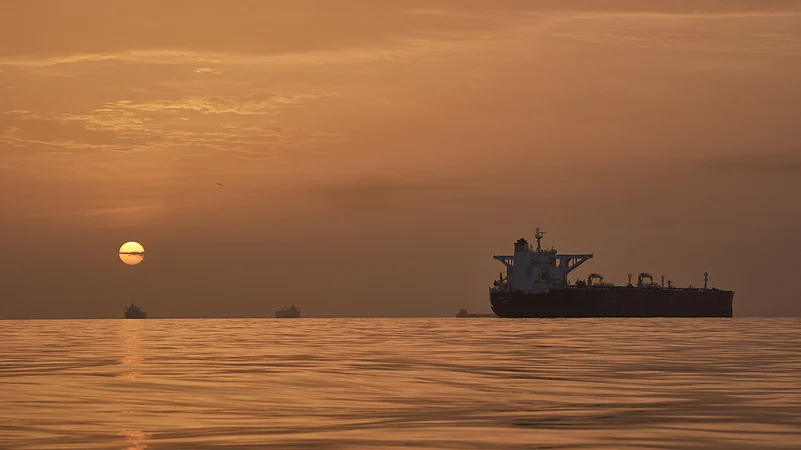

Citigroup warns oil could reach $110 if disruption lasts another month.
Inventory losses may exceed 1.3bn barrels amid prolonged conflict disruptions.
Even short conflict may leave global oil stockpiles at multi-year lows.
Oil prices are expected to increase to $110 per barrel if traffic in the Strait of Hormuz remains disrupted for another month, reported Bloomberg citing Citigroup.
Global crude and product inventory losses from the US war on Iran could rise to an estimated 1.3bn barrels should the vital shipping route remain blocked for another four weeks, the firm said.

1 September 2026
Get the latest issue of Outlook Business

Even if a ceasefire extension is signed this week and shipping through the strait, along with production, gradually resumes through May, total global crude and product inventories are expected to decline by roughly 900mn barrels. That translates to 500mn barrels already lost and another 400mn of anticipated losses stemming from ramp-up delays and conflict-related damages.
The bank further predicted that a preliminary agreement between Iran and the US will be signed or the ceasefire will be extended this week, and that could turn into a more comprehensive deal. “That said, we remain prepared to pivot toward a more protracted disruption scenario should negotiations falter,” Citigroup analysts led by Max Layton wrote in a note.

Oil prices are up 5% to trade above $95 a barrel in New York on April 20 after US President Donald Trump said that it’s “highly unlikely” he would extend a ceasefire and that the strait would remain blocked until an agreement is finalised. The ongoing energy crisis has triggered an unprecedented supply shock, intensifying inflationary pressures and weighing on worldwide economic growth.
Advertisement
The bank recommends rolling long positions in front-month crude as an effective hedge against upside price risks.
Another two-month disruption of Hormuz, however, could take approximately 1.7bn barrels offline and push prices to $130 a barrel, according to Citi.
Bloomberg citing Citigroup, said that even if the conflict ends this week, global crude and fuel inventories will be at their lowest levels in eight years by the end of June. The company said that it would probably take more than two years to rebuild those stockpiles, even if the market quickly returned to a surplus of one million barrels a day after the conflict.
Advertisement
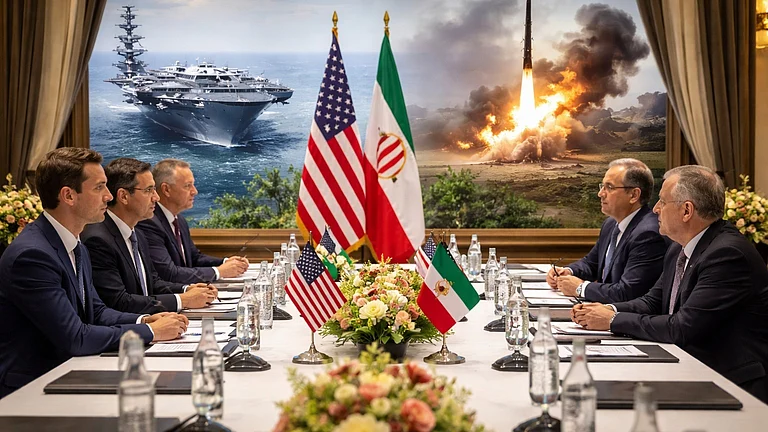
Oil Supply Disruption Risk
According to the US Energy Information Administration (EIA), the Strait of Hormuz, located between Oman and Iran and linking the Persian Gulf with the Arabian Sea—is one of the world’s most critical oil chokepoints. Around 20 million barrels per day, or roughly 20% of global petroleum liquids consumption, passed through the strait in 2024, with few viable alternatives if flows are disrupted.
The Strait of Hormuz, located between Oman and Iran, connects the Persian Gulf with the Gulf of Oman and the Arabian Sea. The strait is deep enough and wide enough to handle the world's largest crude oil tankers, and it is one of the world's most important oil chokepoints. Large volumes of oil flow through the strait, and very few alternative options exist to move oil out of the strait if it is closed. In 2024, oil flow through the strait averaged 20 million barrels per day (b/d), or the equivalent of about 20% of global petroleum liquids consumption. In the first quarter of 2025, total oil flows through the Strait of Hormuz remained relatively flat compared with 2024.
While the US EIA said it has not observed any sustained blockage of maritime traffic through the Strait of Hormuz so far, recent tensions in the region have still impacted prices. The price of Brent crude oil (a global benchmark) increased from $69 per barrel (b) on June 12 to $74/b on June 13. This highlights the importance of the strait to global oil supplies.
The US EIA report also warned that prolonged blockage could tighten markets further, with limited spare production capacity worldwide, amplifying price volatility and worsening inflationary pressures across energy-importing economies already facing economic slowdown risks.