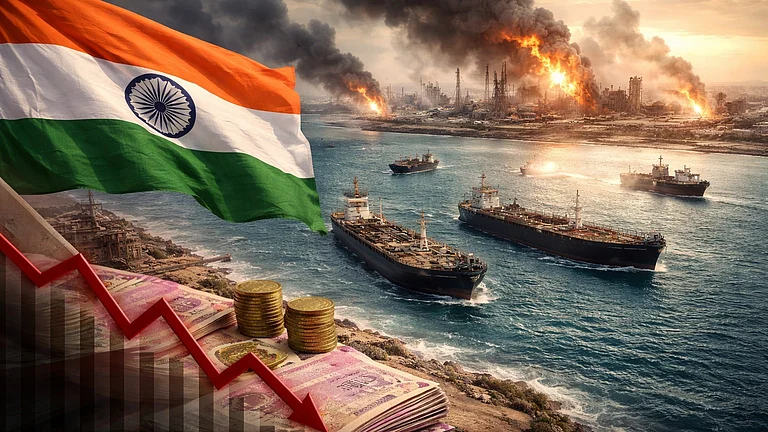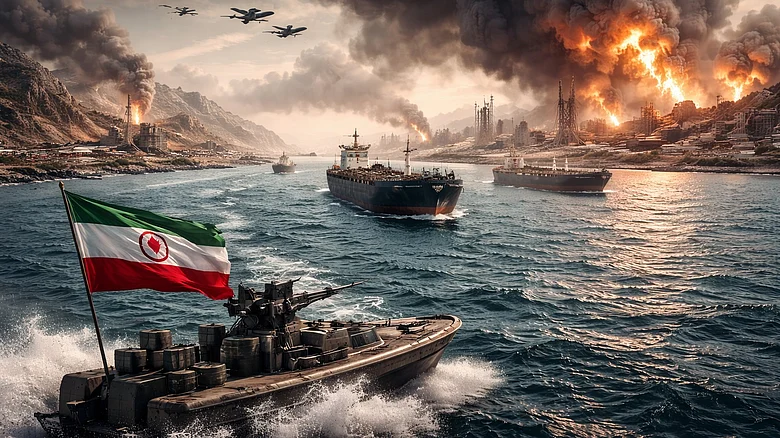

The Strait of Hormuz handles nearly 20% of global oil and significant LNG flows, making it vital to global trade.
A prolonged disruption could push crude above $100 per barrel and strain global LNG markets.
Insurance withdrawals, rerouting risks, and potential military confrontation raise fears of broader supply chain instability.
In one of the gravest escalations of geopolitical tensions in West Asia following the coordinated attack by the US and Israel, Iran has announced it will choke the global shipping route of the Strait of Hormuz. A shutdown, previously done only once in 1988 during the Iran-Iraq war, would potentially lead to massive delays in the flow of goods across the globe.
The Strait of Hormuz is a narrow channel in the Persian Gulf, situated between Oman and Iran, and is the lifeline of nearly 20% of the global supply chain. Around 40% of shipments to major Asian economies, including China, India, Japan, and South Korea, pass through this strait.

1 October 2026
Get the latest issue of Outlook Business

In times of geopolitical tensions, Iran has often used the threat of shutting down the Strait as leverage. A complete shutdown would be a rare move from Tehran and could lead to significant fallout for the global economy. The coordinated military strike by Washington and Tel Aviv over the weekend took the life of Iran’s supremo Ayatollah Ali Khamenei early Sunday.



Advertisement
Tensions further spiralled with Iran launching attacks across the West Asian region. Iran’s top security official, Ali Larijani, announced on the social media platform X that, “We will not negotiate with the United States.”
Although there have not been any international confirmations of the Strait being officially closed, ships have been stopped, some have been attacked, and many insurers plan to withdraw war-risk coverage for vessels entering the Persian Gulf, Bloomberg reported.
With Khamenei’s regime potentially coming to an end and a lack of an exit plan, the conflict in the region is likely to drag on, with rippling effects felt around the world, especially in the form of global supply chain disruption.
Advertisement
A Lifeline of Global Energy Trade
The Strait of Hormuz, spanning 161 km, connects the Persian Gulf to the Gulf of Oman. Historically significant as a lifeline of global trade, the strait serves as a route for supertankers carrying oil and gas from West Asia to the rest of the world.
Major oil producers, including Saudi Arabia, Iran, Iraq, Kuwait, and the United Arab Emirates, heavily rely on the Strait to export petroleum and crude to Asian and European markets.
According to reports citing the US Energy Information Administration, while alternative routes exist, “most volumes that transit the strait have no alternative means of exiting the region.”
The shutdown of the strait has already rattled global markets and pushed benchmark Brent crude up 7% on Monday, sending prices as high as $84 a barrel. As per available data, the strait carried nearly 16.7 million barrels of crude per day in 2025.
Beyond crude, liquefied natural gas (LNG) and liquefied petroleum gas (LPG) are also crucial energy commodities passing through the critical waterway. Nearly a fifth of global LNG supply passes through this channel. A disruption in LNG and LPG shipments through the Strait, and the rerouting of cargoes, would likely spike LNG prices and intensify production competition in other regions.
For India, nearly 60% of its LNG imports are shipped via the Strait. Unlike crude, India does not have strategic reserves for LNG or LPG. A prolonged choking of the Strait could challenge the fiscal math of the Centre, as the government would likely absorb the shock through fuel tax cuts and subsidies.
A Vital Waterway Like No Other
While regional powers have spent decades and billions constructing overland bypasses, these serve merely as relief valves rather than full alternatives to the Strait of Hormuz. Saudi Arabia has the East-West Pipeline, and the UAE has the Habshan-Fujairah link.
These pipelines can divert roughly 6.5–8 million barrels per day. However, a significant share remains without an alternative exit, as the Strait facilitates flows of nearly 20 million barrels per day.
Moreover, these alternate pipelines primarily carry crude oil. The Strait of Hormuz effectively holds a monopoly over LNG shipments from the region. A prolonged and complete shutdown of the Strait would likely lead to a ‘gas choke’ for major LNG exporters like Qatar, potentially triggering an energy crisis across global industries.
The Strait is also a critical route for aluminium producers, facilitating metal trade in and out of the region. It handles nearly 15% of global aluminium exports. Market analysts, according to Bloomberg, have warned that the aluminium market was already at risk of a major shortage even before the recent military escalation.
Can Iran Shut Down the Strait of Hormuz?
Under the United Nations Convention on the Law of the Sea, countries can exercise sovereignty up to 12 nautical miles (14 miles) from their coastline. They must allow ‘innocent passage’ of foreign vessels and must not impede innocent or ‘transit passage’ through straits used for international navigation. Iran has signed the treaty but has not ratified it in its parliament.
Could Hormuz Backfire on Iran?
Reports suggest that shutting down the Strait could backfire on Iran. Tehran may be choking the waterway in hopes of compelling the international community to accelerate mediation and conflict resolution. However, such a move also risks disrupting Iran’s own exports and could cripple its economy in a self-inflicted wound. Further, according to a report by Global Times, if Western countries begin providing armed escorts for commercial vessels, it could escalate into direct military confrontation between Tehran and the West.