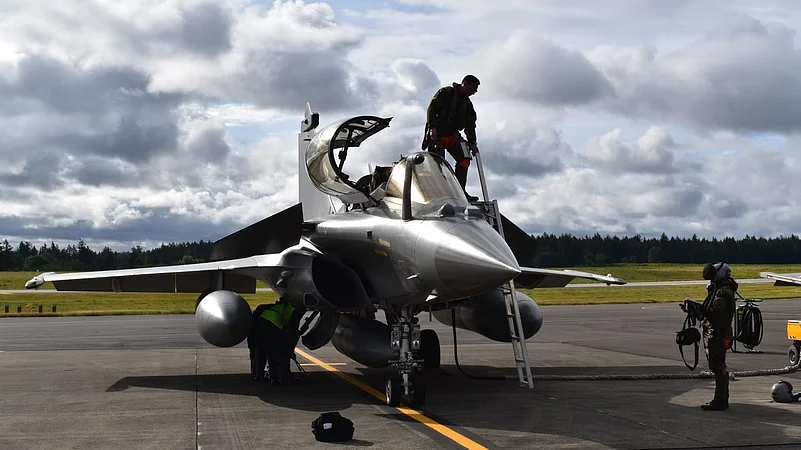

Dassault Aviation has formally submitted its proposal to supply 114 Rafale fighter jets to the Indian Air Force.
India will receive 18 jets in fly-away condition, while the remaining 96 aircraft will be assembled domestically, alongside technology transfer and an M-88 engine MRO facility in Hyderabad.
The acquisition is expected to strengthen the IAF as indigenous programmes such as Tejas Mk-2 and AMCA face longer development timelines.
French aerospace giant Dassault Aviation has formally submitted its technical and commercial proposal to India for the acquisition of 114 Rafale fighter jets in a deal valued at approximately Rs 3.25 lakh crore.
The proposal, received in response to India's Letter of Request issued in May, aims to expand the combat fleet of the Indian Air Force while deepening industrial cooperation with France..
1 September 2026
Get the latest issue of Outlook Business

The Defence Acquisition Council, chaired by Defence Minister Rajnath Singh, accorded an Acceptance of Necessity for the procurement in February.
Once all listed procedures are complete, the Cabinet Committee on Security, chaired by the Prime Minister, will clear the deal.
Production and Technology
Under the procurement terms, India will receive 18 aircraft in fly-away condition. The remaining 96 jets will be assembled domestically, meaning over 80 per cent of the induction will be built in India.
The Indian Air Force has specified a mix of 88 single-seat and 26 twin-seat variants. Dassault will partner with Indian private firms for assembly and systems integration.
Advertisement
India also seeks to integrate indigenous weapons and systems, including secure data links to connect the jets with local radars and sensors.
Indigenous content is expected to rise from an initial 30 per cent to over 60 per cent as the production line matures, eventually reaching 55 to 60 per cent once the technology transfer programme is complete.
The French proposal includes setting up a maintenance, repair and overhaul facility for Safran's M-88 engines in Hyderabad, a move expected to strengthen India's aerospace ecosystem.
Technology transfer will cover airframes, engines and avionics, with suppliers such as Safran and Thales participating.
Advertisement
Capabilities and Fleet
India is seeking the latest F-4 and upcoming F-5 variants of the Rafale. These models will feature an upgraded Advanced Electronically Scanned Array radar, enhanced self-protection suites, satellite links and artificial intelligence-based pilot assistance.
The Indian Air Force already operates 36 Rafales deployed across the Ambala-based 17 Squadron and the Hasimara-based 101 Squadron.
The new acquisition will raise India's total Rafale strength to 176 aircraft, with 150 airframes for the Air Force and 26 maritime variants already ordered by the Navy.
The Rafale's operational record during Operation Sindoor has bolstered its case. Armed with Meteor air-to-air missiles, SCALP cruise missiles and precision-guided munitions, the Rafale is positioned as the most advanced aircraft in India's fighter fleet.
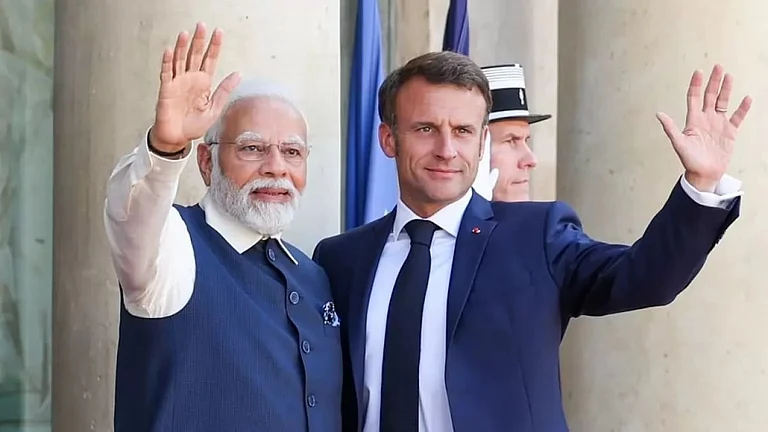
Bilateral diplomatic engagements have reinforced the acquisition. During his visit to France in June, Prime Minister Narendra Modi and French President Emmanuel Macron elevated the relationship to a Special Global Strategic Partnership.
Their talks underscored a shared commitment to co-design, co-develop and co-produce advanced defence platforms, with emphasis on next-generation technologies.
Prior to Modi's visit, Air Chief Marshal AP Singh also visited France. Singh met with General Jérôme Bellanger, Chief of Staff of the French Air and Space Force, and engaged with leading defence firms including Dassault Aviation, Thales, Safran and MBDA, which are pivotal to the production of the Rafale and its key components.
Bridging Capability Gaps
The Rafale deal is critical to bridge capability gaps due to delays in engine supplies and indigenous programmes such as the Tejas Mk-2 and Advanced Medium Combat Aircraft.
The AMCA project is unlikely to enter service before the mid-2030s. Until those platforms mature, the Rafale, Su-30MKI and Tejas Mk-1A aircraft will remain the backbone of India's fighter fleet.