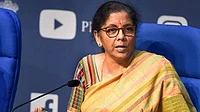
Shamika Ravi said a ₹100 rupee-dollar exchange rate is "just a number".
She urged policymakers to focus on inflation and supply-shock management.
Strong forex reserves and macroeconomic stability remain key buffers for India.
As concerns mount over the possibility of the Indian rupee weakening to 100 against the US dollar, Shamika Ravi, Member, Economic Advisory Council to Prime Minister, sought to downplay the significance of the milestone, arguing that policymakers should focus on managing the broader economic impact of global shocks rather than defending a particular exchange rate.
Speaking in an ANI podcast interview, Ravi said: "So what? 100 is just a number."

1 October 2026
Get the latest issue of Outlook Business

She argued that attempting to maintain the rupee at a specific level could create other economic distortions, particularly inflationary pressures.



"At the end of the day, what you do not want is to jump into this, try to keep the value at a certain level, which leads to inflationary pressures, which is going to have all kinds of other chaotic impacts," Ravi said.
Focus On Supply Shock
According to Ravi, the current challenges stem largely from a global supply shock, limiting the range of policy options available to governments.
Advertisement
She said policymakers should avoid unnecessary intervention in a market that is functioning normally.
"You do not want to intervene in a market which is working fine right now," she said.
Ravi linked this approach to the government's recent emphasis on austerity measures and reducing non-essential consumption.
"Which is why the austerity measures and the other kind of exhortations from the prime minister and now increasingly from different arms of the government, what we do not want is wasteful consumption," she said.
She acknowledged that higher prices are often part of the adjustment mechanism during supply-side disruptions.
"Our prices will rise because that is the best way to affect demand because this is a supply shock. You're not going to be able to do very much," Ravi said.
Advertisement
Forex Reserves And Energy Security
Ravi noted that India is already utilising its foreign exchange reserves to manage external pressures.
When asked how long the country could continue drawing down reserves, she replied: "As long as it is required."
She also highlighted the importance of international partnerships in strengthening India's external position over the longer term.
Referring to India's energy agreement with the UAE, Ravi described it as "a very major agreement" that could support both energy security and external stability in the years ahead.

'No Reason To Panic'
Ravi's remarks mirror views recently expressed by economist Sanju Verma, who argued that a rupee exchange rate of 100 against the dollar should not automatically be viewed as a crisis.
Writing in a recent Moneycontrol column, Verma said exchange-rate levels need to be assessed alongside broader macroeconomic indicators.
She pointed to India's fiscal deficit of 4.4%, current account deficit below 1% and retail inflation below 4% as signs of a relatively strong macroeconomic position.
According to Verma, a gradual depreciation of the rupee could also provide support to export-oriented sectors such as manufacturing, information technology, pharmaceuticals and agriculture, while encouraging tourism and domestic production.
She added that India's foreign exchange reserves continue to provide an important buffer against global volatility.