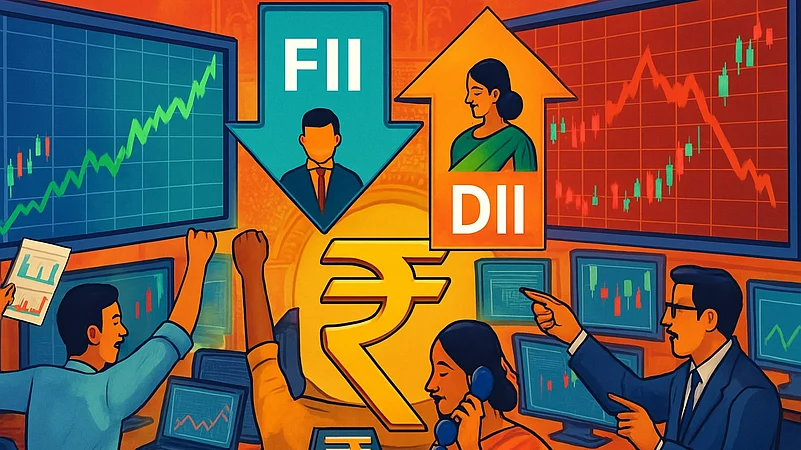

FII outflows near ₹2 lakh crore in 2026 as risk-off sentiment rises
DIIs absorb 90% selling, ownership rises to 20.9% in Nifty 500
H2 recovery likely as valuations ease and global flows stabilise
Foreign institutional investors (FIIs) have pulled out over ₹2 lakh crore from India's secondary markets in the first four months of 2026, marking one of the steepest phases of sustained selling in recent years. The magnitude of the outflow has already approached full-year levels seen earlier, highlighting the intensity of the ongoing risk-off sentiment among global investors.
According to NSDL data, FIIs sold nearly ₹1.98 lakh crore between January 1 and April 30. This compares with ₹2.4 lakh crore of outflows in the entire 2025 and ₹1.29 lakh crore in 2024, highlighting how quickly capital has exited Indian equities this year.

1 September 2026
Get the latest issue of Outlook Business

The sell-off has been largely driven by global macro factors. Higher US bond yields, offering returns above 4% in dollar terms, have made developed market assets more attractive relative to emerging markets. At the same time, rupee depreciation has further eroded returns for foreign investors, reducing the appeal of Indian equities.



Despite the heavy selling in secondary markets, FIIs have maintained interest in India's primary markets. Investments in IPOs stood at ₹1.21 lakh crore in 2024, ₹73,910 crore in 2025 and about ₹12,156 crore so far in 2026. IPOs have delivered stronger average returns of 37.1% compared to just over 7% in secondary markets, suggesting selective optimism.
Advertisement
"FII outflows of over ₹2 lakh crore in early 2026 is primarily driven by a 'risk-off' sentiment triggered by West Asia tensions pushing crude oil above $100, record-low rupee depreciation crossing 95 against the US Dollar, elevated US bond yields, and relatively rich Indian valuations prompting profit booking," said Aditya Agrawal, CFA, Chief Investment Officer at Avisa Wealth Creators.

Global Capital Rotates to Asia's AI Winners
A key driver behind the sustained outflows is not an outright exit from Asia but a rotation of global capital toward markets offering better relative returns and stronger thematic exposure, particularly in artificial intelligence.
Advertisement
Among Asian peers, Taiwan's stock market has surged nearly 40% in dollar terms so far in 2026, while South Korea's Kospi has rallied 62%. Japan's Nikkei has gained 18% and China's Shanghai Composite is up 7%. In contrast, India's benchmark indices have declined, with the Sensex and Nifty falling around 13% and 14%, respectively.
This divergence in performance has made markets like Taiwan and South Korea more attractive, especially given their deep integration with the global AI supply chain. Companies such as Samsung, SK Hynix and TSMC have emerged as key beneficiaries of rising AI-related capital expenditure, drawing a significant share of global investor flows.
"Capital is not leaving Asia, it is rotating within it. While Indian markets have corrected, Korea, Japan and Taiwan have seen strong rallies driven by the AI capex cycle," said Hemant Sood, Founder and Managing Director, Findoc Investmart.
Vikas Gupta, CEO and Strategist at OmiScience Capital, added that relative valuation and sector positioning have played a crucial role. "For global investors, Indian IT faces near-term disruption, while Taiwanese and Korean firms are at the core of the AI ecosystem. That shift in positioning has influenced allocation decisions," he said.
Domestic Investors Offset FII Outflows
Even as foreign investors pull back, domestic institutional investors (DIIs) have stepped in aggressively, reshaping the structure of Indian equity markets and providing a strong counterbalance to global volatility.
DII ownership in Nifty 500 companies has climbed to a record 20.9%, surpassing FII holdings, which have dropped to 17.1%, according to Motilal Oswal Financial Services. This marks a major shift from earlier cycles when FIIs dominated market ownership.
During the first quarter of calendar year 2026, DIIs invested $27.2 billion in equities, supported by steady inflows through systematic investment plans (SIPs). These consistent flows have helped absorb a large portion of foreign selling, cushioning the market from sharper declines.
"My read is that incremental FII selling is approaching exhaustion. DIIs have absorbed nearly 90% of the outflows through strong SIP-led buying. FII ownership is now at a two-decade low, below DII ownership," Sood said.
Prashant Mishra, Founder and CEO, Agnam Advisor, noted that this trend reflects a deeper structural shift. "Domestic investors should not equate FII selling with weakening fundamentals. Strong SIP-led inflows have reduced the market's dependence on foreign capital compared to previous cycles," he said.

Outflows May Stabilise
While near-term risks remain, experts believe the worst phase of FII selling could be nearing its end, with improving valuations and potential macro shifts setting the stage for a gradual return of flows.
India's valuation premium, a key reason for earlier outflows, has started to moderate following the recent correction. With Indian markets now trading closer to fair value relative to peers, the attractiveness for global investors is beginning to improve.
"With Indian markets trading at a price-to-earnings ratio of around 21 versus closer to 25 in other Asian markets, the chances of renewed FII inflows are increasing," Gupta said.
However, he cautioned that risks from elevated crude prices, geopolitical tensions and inflationary pressures could continue to weigh on sentiment in the near term. Any escalation could impact interest rates and earnings growth, delaying a full recovery in flows.
Mishra also expects a gradual improvement rather than an immediate reversal. "The worst of the outflow pressure may be behind us. If the US Federal Reserve turns accommodative and the dollar softens, emerging markets including India could see renewed allocations," he said.
Agrawal added that India's long-term fundamentals remain intact. "FII sentiment is likely to stabilise and reverse as earnings visibility improves and policy support strengthens growth. India's structural story—demographics, digitisation and capex—remains unmatched," he said.
As domestic capital continues to strengthen its role and global investors reassess valuations, Indian markets appear to be transitioning toward a more balanced and resilient structure, with the potential for renewed foreign interest in the second half of 2026.