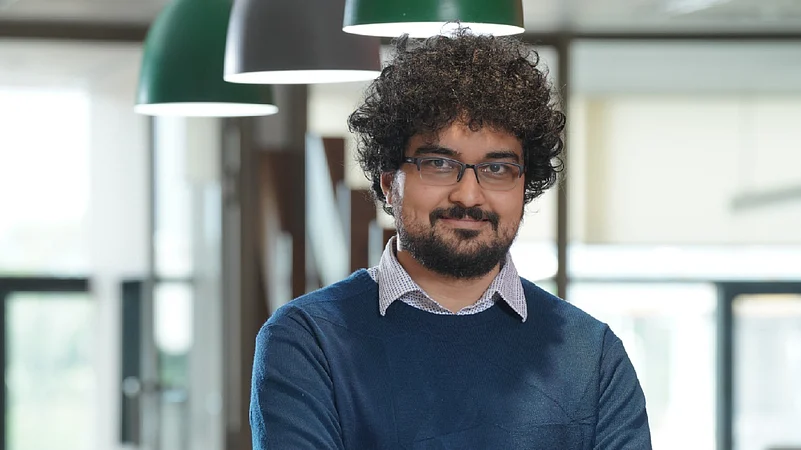

Pai talks about a shift in how founders think about capital, ownership, and long-term value creation
The changing role of domestic capital in a market once driven largely by foreign money
Why regulatory clarity and policy choices could influence the next wave of capital flows
Growth stage funding in India’s start-up ecosystem is no longer driven by easy capital and aggressive valuations. Founders are raising less frequently, focusing more on profitability, and considering IPOs earlier in their journeys, signalling a shift in the market.
In an interview with Outlook Business, Siddarth Pai, founding partner and CFO at 3one4 Capital, explains why this change reflects a maturing ecosystem instead of a slowdown. He also flags policy uncertainty, especially around taxation and regulatory clarity, as a factor that could shape investor confidence in the Indian venture ecosystem.

1 September 2026
Get the latest issue of Outlook Business

Edited Excerpts



You have completed 10 years in India and have recently seen exits. How do you see this momentum going forward?
If you go back into the history of Indian ventures, one of the biggest issues investors or LPs have had is that it is very hard to translate paper gains into hard currency. Many funds from the mid-2000s are still alive. Some are struggling to return capital. Some became zombie funds. That is why SEBI has done a tremendous amount of work to migrate older VCF regulations into the AIF framework.
What has changed over the last few years is exits. We have seen a large amount of exits ramp up, especially through public markets. Ever since Covid, public markets have become more receptive to loss-making companies with higher growth potential. Earlier, the prevailing notion was that IPO exits had to happen in the US or Singapore. There was a belief that Indian investors were hyper-fixated on short-term performance and would exit the moment companies became loss-making.
Over the last few years, mutual fund flows have been strong. Retail participation has increased. Capital has chased quality assets. Now companies are looking at IPO not as a possibility but as an inevitability. A number of companies that moved overseas have paid hefty tax bills just to return and list in India because they want access to domestic markets.
Domestic institutional investors have also changed. In 2016–17, when we were raising our earlier fund, it was impossibly hard to sell the India start-up story. People would ask, what are these start-ups, where are the cash flows, where will dividends come from. Today, many of the same investors are LPs in VC funds, doing pre-IPO rounds, and even raising their own VC funds.
They now realise that the pipeline to public markets flows through venture capital. The stronger the venture ecosystem, the stronger the capital markets. We have seen a tremendous number of IPOs in tech and new-age companies. More are lined up. This is a decade-long cycle. India has reached the phase where the new-age economy is no longer niche. It has become mainstream.
Advertisement
Global uncertainty is high - in terms of tariffs and wars. How are your global LPs reacting to this?
I would say it is more uncertainty than resentment. We have had six years where the word unprecedented keeps getting used. 2020 was Covid. 2021 was the recovery boom. 2022 saw drawdowns. 2023 was the bottom. 2024 saw geopolitical tensions. 2026 has already started to be volatile.
The good thing is that resilience has increased. Investors are also reassessing global options. In the US, a large part of the market performance is driven by a small number of stocks. Europe is struggling to grow. China is becoming more insular and geopolitically complex. The Middle East has its own issues. Japan is adjusting. Latin America and Africa need more fundamental work. Southeast Asia is fragmented.
India stands out as a large, cohesive, young market with sustained growth above 7 percent. Investors are saying the India growth story is actually playing out now. There is more cohesion in laws. Retrospective amendments are largely gone.
They also understand that India is not uniform. Some sectors barely grow. Some are flying. Manager selection matters. There is also a realization that you cannot understand India sitting in New York or Singapore. You need local expertise. That is why more capital is coming directly to Indian managers rather than through foreign platforms.
We saw this earlier in mutual funds. Global brands gave way to Indian houses. I see a similar trajectory in venture. Homegrown managers are proving the model works. Merit will determine outcomes.
Advertisement
China has strong state backed funding. India too, announced a ₹ 1 lakh crore deep tech R&D fund couple of years back. What is actually happening on that front?
China had a 30-year head start. It opened earlier. It absorbed Western capability. It has far more fiscal room. India is a democracy and that makes things slower but also more resilient.
Despite that, allocating one lakh crore to R&D is significant. R&D takes 15 years to show results. This is not like ecommerce where value gets created in five years.
The fund is active. They have reached out to fund-of-funds managers. RFQs and RFPs have gone out, and deployment should begin over the next six to twelve months.
Deep tech in India has always existed. We have invested in deep tech since 2016. Every one of our funds has had a double-digit allocation to deep tech. We have invested in antimicrobial drug discovery, EV fast charging, semiconductor-related areas. The difference is that these companies are harder to explain and they do not raise capital as frequently, so they get less attention.
India unfortunately tracks the ecosystem by how much capital is raised. That is not the right metric. Deep tech companies do not need to raise often. The R&D fund will be a game changer. It can crowd in four to five lakh crore of private capital. It is not only for startups. It supports companies across stages. It is a mature design. Results will take time but it strengthens supply chains and self-reliance.
There is a view that growth-stage funding has slowed in the past couple of years. How do you see that?
There is a lot of capital at seed and early stage. There is also significant capital near IPO through mutual funds. The thinner part is the middle. There are only a handful of funds operating in growth-stage. Capital is more selective.
Many companies also do not need to raise. They had large cash balances and have cut burn. There is also a valuation mismatch between founders and growth investors.
A lot of startups are now working on becoming profitable. Earlier they would raise every 18 months. Now it might be every 36 to 40 months. Some are choosing to go public earlier rather than stay private.
Founders have also become more sensitive to dilution. Many founders today hold single-digit ownership. In hindsight, they feel they raised too much capital. Tax parity between listed and unlisted has also changed the calculus. IPO is now a viable option much earlier.
The Tiger Global Supreme Court matter has created anxiety. How serious is the impact on investor sentiment in India?
There has been a lot of confusion. The Supreme Court did not confirm a tax assessment. It only said the petition was not admissible at that stage because prima facie it appeared to be an arrangement. Tiger can still litigate and prove commercial substance.
The court clarified that a tax residency certificate is not sacrosanct, that GAAR applies to arrangements, and that residency depends on place of effective management.
The bigger issue is uncertainty. What constitutes substance has not been clarified. Is it physical presence, board meetings, control, decision-making? No one knows. That uncertainty unsettles investors.
The government has said it does not intend to reopen older cases. But under current law, assessments can be reopened for up to six years. That covers a large number of exits since 2019. That is why clarity is essential.
This is now in the government’s court. They need to define substance and provide certainty. Investors do not want a situation where the rug is pulled years later. If the government clarifies this, capital will flow. If not, decision-making will slow.

What are your expectations from the Union Budget?
There are very practical asks. On ESOPs, exercise should be taxed at book value, not at the same price paid by investors. Employees do not have the same protections as investors. This is irrational. Second, founders should be allowed to receive ESOPs in their own companies if shareholders approve. That aligns incentives.
The startup definition also needs reform. The ten-year and one hundred crore threshold does not work for deep tech. These companies need fifteen to twenty years. The revenue threshold is also arbitrary across sectors.
There are two tax provisions that matter more than tax holidays. One is ESOP deferral, which today applies only to DPIIT-recognised startups. It should apply to all startups. The second is carry-forward of losses. Today, losses are wiped out if shareholding changes beyond a threshold unless the company is listed. That distorts M&A economics.
On the investor side, harmonising capital gains between listed and unlisted was a good move. What still needs work is institutional capital. Indian endowments are heavily restricted. Globally, endowments are major venture investors. In India, even when donors want to gift shares, institutions are forced to liquidate instead of benefiting from long-term compounding.
There are also operational frictions. India offers very limited fundraising instruments compared to global markets. We need parity. The ecosystem is asking for clarity and parity, not special treatment.
If artificial frictions are removed, domestic capital itself can support a much larger ecosystem.