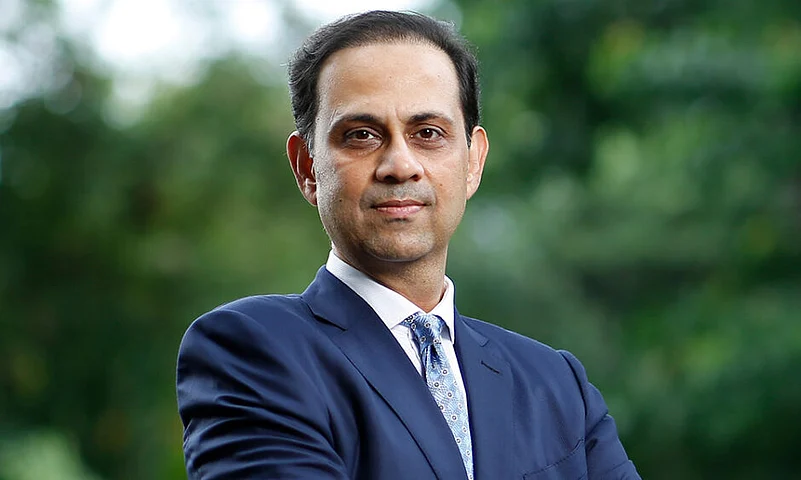

Sanjiv Bajaj said India’s edge in AI-led fintech and insurtech is rooted in its digital public infrastructure.
Speaking at the Black Swan Summit India in Bhubaneswar, he noted innovation was historically driven by geography, land and capital.
These factors, he said, helped Western economies scale faster than India for much of the past two centuries.
Sanjiv Bajaj, Chairman and Managing Director of Bajaj Finserv, believes India’s potential advantage in AI-driven fintech and insurtech is closely linked to the country’s digital public infrastructure, which he argued has reshaped the conditions for innovation.
Speaking at the 1st edition of Black Swan Summit India in Bhubaneswar, Bajaj said that for much of the last two centuries, disruption and innovation were shaped by factors such as geography, access to land and access to capital. These conditions helped industrialised economies in the West scale earlier than countries like India.

1 September 2026
Get the latest issue of Outlook Business

But the digital economy, he said, has altered those traditional levers.




“What the digital world does is change this dramatically,” Bajaj said, adding that “geography… access to large amounts of capital… is no longer enough to be able to succeed because those barriers get broken in the digital world.”
He pointed to India’s experience over the last two decades, saying that the government has driven digital public infrastructure as a public good, spanning digital identity, bank accounts, payments and KYC frameworks.
Bajaj said that digital payments have penetrated everyday commerce, noting that even small street-level transactions are now routinely conducted through QR codes.
Advertisement

“This scalable, secure architecture… is today processing over 650 million digital payments every day, more than the rest of the world put together,” he said.
He also cited India’s demographic and entrepreneurial base as part of what positions the country strongly in the global fintech landscape. Bajaj pointed to a large STEM-educated youth population, a middle class of around 500 million, and what he described as the world’s third-largest startup ecosystem with over 200,000 registered startups.
“All this put together is a heady combination for setting us apart,” he said.
Advertisement
However, Bajaj cautioned that maintaining this lead will require sustained effort.
“It’s a marathon. It’s not a 100-metre dash,” he said.
Bajaj’s remarks came during a Global Leaders’ Dialogue on Technology, Jobs and Growth on the opening day of the Black Swan Summit India 2026, which is being co-organised by the Government of Odisha and the Singapore-based Global Finance & Technology Network (GFTN) under the BharatNetra Initiative.
The two-day summit has brought together policymakers, financial services leaders, technologists and global investors to discuss how frontier technologies such as AI can shape digital finance, inclusion and employment outcomes.