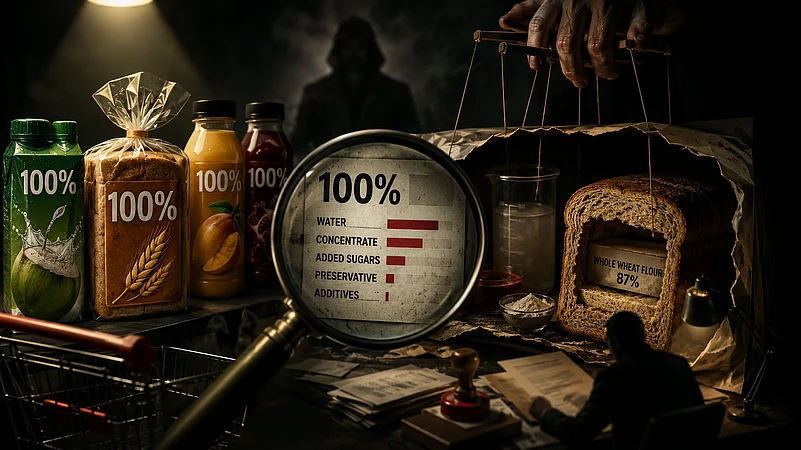

CCPA fined Storia Foods and Mrs Bectors ₹1 lakh each for using "100%" claims their products could not substantiate.
Storia's coconut water was reconstituted from concentrate; Mrs Bectors' "100% whole wheat" bread contained only 87% whole-wheat flour.
Experts warn the crackdown signals stricter scrutiny of absolute claims like "natural" and "preservative-free" across the FMCG sector.
Pick up almost any packaged food or drink in an Indian supermarket and chances are, something on the label is making a promise it cannot keep.
"100% Tender Coconut Water", "100% Whole Wheat Bread" or "Zero Maida" are bold claims. The fonts are bigger than the ingredient list and they are almost always on the front of the pack, where the eyes go first and the brain follows.

1 September 2026
Get the latest issue of Outlook Business

For years, food companies have leaned on these phrases to nudge health-conscious shoppers. Now, a government regulator is asking a simple question if the brands can actually prove that?


The Order
This June, the Central Consumer Protection Authority (CCPA) imposed ₹1 lakh penalties on two well-known food companies, Storia Foods and Beverages, which sells packaged juices and coconut water and Mrs Bectors Food Specialities, which markets bread under the English Oven label. Both were found to have used the term "100%" in ways their products could not support. Both were told to pull the claims immediately from packaging, websites and digital platforms.
Advertisement
"The term '100%' is a precise and absolute numerical expression and must correspond exactly with the factual composition of the product," the CCPA said.
It sounds like an obvious standard. The companies, apparently, did not think it applied to them.
What Was Actually Inside
Storia's "100% Tender Coconut Water" was not, it turns out, tender coconut water in any complete sense. It was coconut water concentrate reconstituted with water and the product also contained preservative INS 202. The fact that it was reconstituted appeared only in fine print on the ingredient panel. The accompanying claim of "100% Natural," the CCPA found, was simply untenable.
Advertisement
The juice variants — pomegranate, mango, guava chilli, mixed fruit — were marketed as "100% Juice" but contained varying proportions of water, fruit concentrates and pulp.
The Mrs Bectors case is perhaps more striking. During proceedings, the company itself acknowledged that its "100% Whole Wheat Bread" contained 87% whole-wheat flour. Mrs Bectors argued that "100% Atta" only meant wheat flour was the sole grain source, not that the product was made entirely of wheat flour. The CCPA was not persuaded. Advertisements, it said, must be assessed from the perspective of a reasonable consumer, not through the legal fine print a company reaches for only after a regulator comes knocking.
Why '100%' Is Not Just a Word
The legal problem with these claims runs deeper than careless marketing. Under the Consumer Protection Act, 2019, a claim becomes misleading when it falsely describes a product's nature, substance or quality, or conceals important information. Nihal Bhardwaj, Counsel at SKV Law Offices, said the issue is straightforward. "The vice lies in the gap between what the label promises and what the product actually contains."
The CCPA treats "100%" as a figure that leaves no room for approximation. In practice, Bhardwaj said, "an absolute claim demands effectively complete substantiation, which is a standard most processed or reconstituted products simply cannot meet." A shortfall as small as the 13-percentage-point gap in the bread case was, by itself, enough to sink the claim entirely.
Some companies have tried to argue that such phrases are mere puffery, the kind of cheerful exaggeration, like "the tastiest bread you'll ever eat," that no reasonable consumer takes literally. The CCPA shut that door. "100%" is not an opinion. It is a number that can be tested against a product's actual composition. Bhardwaj added that the CCPA has also held that if a representation is capable of misleading consumers, the advertiser's intention is irrelevant, closing off the good-faith defence as well.
Rohit Jain, Managing Partner at Singhania & Co, pointed out that FSSAI has explicitly stated that the term "100%" is "undefined and potentially misleading" when used on food labels or promotions. Terms like "natural," "fresh" and "original" are permitted under FSSAI's Advertising and Claims Regulations only under specific conditions and with required disclaimers. "Thus, '100%' claims remain particularly vulnerable," Jain said. "Such restrictions are primarily aimed at restricting an open-ended use of these words by food businesses on frivolous grounds."

What This Means for the Industry
The CCPA's action is more than a pair of isolated orders. Alay Razvi, Managing Partner at Accord Juris, said regulators typically use enforcement actions as a wider signal. "Terms like 'natural,' 'immunity-boosting' and 'preservative-free' are already vulnerable because they can imply a health, purity or functional benefit that may need careful substantiation. The likely result is stricter review of front-of-pack wording, ad copy, websites and influencer scripts."
Rishi Agrawal, CEO and Co-Founder of TeamLease Regtech, said the compliance bar has fundamentally shifted. "Claims can no longer be treated as marketing constructs alone. They now require legal, scientific and regulatory validation before they enter the market." He said companies will increasingly need to build internal clearance workflows where marketing cannot finalise a claim without regulatory sign-off, and that for larger FMCG players, this means treating compliance as a continuous function rather than a one-time approval.
Beyond packaging reviews, the legal consequences for companies that do not course-correct extend well past a ₹1 lakh fine. Bhardwaj noted that the broader framework provides for escalating penalties on repeat violations, bans on endorsers of misleading advertisements and criminal liability — including imprisonment — for manufacturers responsible for false advertising. A misleading food claim can also attract parallel action under the Food Safety and Standards Act, covering penalties, licensing action and product recall.
Are the Penalties Enough?
That ₹1 lakh figure has drawn its own scrutiny. Bhardwaj said the fine is modest relative to the scale of the companies involved and may not function as a strong deterrent. He pointed to a structural gap: there is no pre-clearance mechanism for high-risk claims, which means regulatory action only follows after consumers have already been exposed to the misleading material. In these cases, the disputed claims had reportedly already drawn over 50 lakh views online before the orders were issued.
Agrawal agreed that deterrence depends less on the size of any single penalty and more on whether enforcement is consistent and visible over time. "Stronger deterrence will likely come from a combination of faster enforcement cycles, clearer guidance on acceptable claim boundaries, and more systematic market surveillance," he said. "Penalties alone can correct isolated behaviour, but sustained behavioural change requires regulatory certainty."
Both experts pointed to the same direction of reform: statutory definitions of what absolute claims can and cannot say, turnover-linked penalties that scale with a company's size and closer monitoring of digital and influencer advertising, where such claims increasingly reach consumers before any regulator can intervene.
Until those reforms arrive, the next time a package tells something is 100% anything, it may be worth flipping it over and reading the fine print first.