


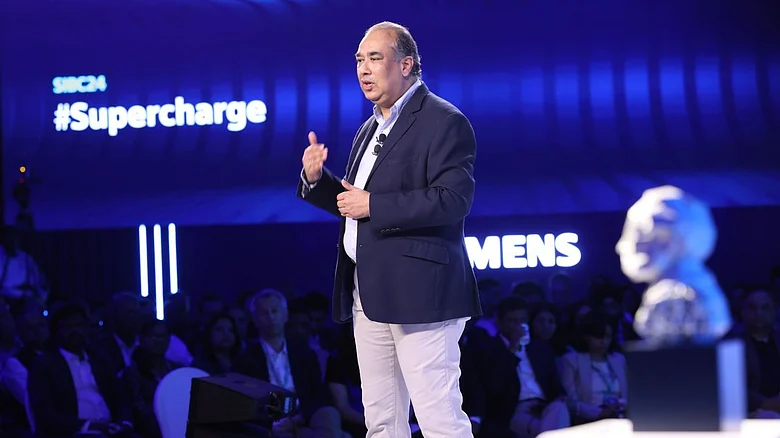

A meaningful revival in private capex depends on continued public investment push, says Siemens India MD and CEO Sunil Mathur.
RBI estimates private-sector capex to rise to ₹3.2 trillion in FY27 from ₹2.6 trillion in FY26.
Mathur says Infrastructure spending execution has improved significantly, with 80–85% of budgeted expenditure being realised.
Since the second half of 2025, there has been an uptick in investments by Corporate India. However, a meaningful revival in private capital expenditure hinges on the government continuing its public investment push, according to Sunil Mathur, managing director and chief executive officer of Siemens Ltd. The Reserve Bank of India’s (RBI’s) September bulletin estimates that private sector capital expenditure will rise to ₹3.2 trillion in FY27, compared with ₹2.6 trillion in the previous financial year (FY26).
Mathur points out that annual government spending has risen from around $39–40 billion to $140 billion, with higher allocations for the railways and other infrastructure projects. More importantly, this spending is now translating into execution, with 80–85% of budgeted infrastructure expenditure being realised, compared with 30–40% earlier. Mathur believes this momentum must continue to encourage companies to commit capital of their own.

1 November 2026
Get the latest issue of Outlook Business

In an interview with Outlook Business, Mathur discusses India’s transition from conventional manufacturing towards more complex, technology-intensive production. From semiconductors and data centres to batteries, fuel cells, aerospace, defence and space technologies, he sees new manufacturing opportunities emerging across sectors. However, sustaining this momentum will require investments in technology as well as resilient domestic supply chains. We also discuss the impact of AI on Siemens’ overall business with its global CTO, Dirk Didascalou.
Advertisement
Siemens’ growth in India is closely linked to India's growth. What is your near-term outlook for Indian companies, particularly manufacturers?
Sunil Mathur: It has already started. Semiconductor manufacturing and data centres are happening, as are fuel cells, batteries, space technologies, aerospace and defence.
We are moving from conventional serial production towards more complex manufacturing. That requires these technologies, so I think the trend will continue.
At the same time, the country needs resilience in its own supply chains. We are importing too much, and the government is looking at ways to localise production and build supply-chain resilience within the country. That will create an additional requirement for private-sector spending. So, yes, this is happening and will continue.
Advertisement
Are data centre investment announcements in India translating into orders for Siemens?
Sunil Mathur: Very clearly. For all of us—Siemens and our peers—data centres account for a large and increasingly significant share of our volumes. If you look at our results, you can see it. We are listed companies, and you can also look at the disclosures made by our peers.
How do you expect the grid-upgrade cycle to play out?
Sunil Mathur: Grid renewal, from transmission to distribution, has already started. We are installing 765-kV HVDC systems in India. We also have substations at 440 kV and 220 kV. It is a matter of time before the transmission and distribution grids are in place.
We have to double our generation capacity in the next three to five years. A large number of generation projects have been announced. Pumped storage is coming up, solar is growing rapidly and wind is also increasing. All of this can make the grid unstable, which is why we need technologies to stabilise it across transmission and distribution.
We will also need to manage the grid, particularly at the distribution level, taking into account demand and weather conditions. That is where forecasting becomes important. We also have grid-scale batteries.
I believe the next three to five years will be important. The energy cycle is a 10-year cycle, and India will double its energy requirements in five years, as the government has said publicly. It will double them again five years after that.
We are moving from around 256 GW or 300 GW of capacity today to more than 520 GW by 2030, and then to 1,000 GW by 2040. That is a massive expansion. It translates into transmission capacity increasing from 500,000 circuit kilometres to more than one million circuit kilometres, along with expansion across the entire distribution chain.
We are looking at a 10- to 15-year cycle in the energy sector.
The Budget announcements are just around the corner. What are your expectations in terms of public capex?
Sunil Mathur: Public capital expenditure has continued, and I expect the government to continue spending on it. There is still a lot to be done in infrastructure, and I think the government recognises that.
Unless the government continues with public capital expenditure, private capital expenditure is unlikely to pick up meaningfully. Until the middle of last year, public capital expenditure was a key driver of India's growth.
Annual spending increased from around $39–40 billion to $140 billion. Allocations for the railways have also risen substantially. The difference now is that projects are moving beyond announcements and are actually being implemented.
If 80–85% of the capital expenditure announced in the Budget is realised in infrastructure spending, that is a good outcome. Earlier, the realisation rate was around 30–40%.
There has been a massive change in the Indian market. Fifteen years ago, we were moving at a completely different speed. Today, that speed has become a sprint. I think that has translated into Siemens’ growth story in India.
As you said, Siemens’ story in India mirrors India's story overall, and that has been the beauty of it. Over the last five years, the pace at which new technologies have emerged has opened up further avenues for growth for Siemens in the country. I think the best is yet to come.

Siemens received a massive locomotive order in 2023. How is that progressing?
Sunil Mathur: The contract is for 1,200 locomotives over 11 years, with 30 years of maintenance. We had to deliver the first 40 by March last year, and we did so on time.
This is a first-of-its-kind technology anywhere in the world. A 9,000-horsepower electric locomotive had never been built before. We had never built one in India, but we were able to transfer the technology from the parent company, adapt it in India and manufacture it here with 99% localisation.
The locomotive was homologated successfully the first time, and the RDSO (Research Designs and Standards Organisation) approved it at the first attempt. That had never been done before. None of this could have happened without using these tools.
Do you expect such large orders to continue to come out of India?
Sunil Mathur: It is a continuous process. There are opportunities in Vande Bharat and in metros across cities. Every city in the country will need metro systems—not just one line, but multiple lines. We have not even begun to tap the full potential in the country.
Dirk Didascalou: It is also important to note that much of this technology is developed in India. For example, the Indian collision-avoidance system is specific to India, and it is developed here by Indian engineers for Indian Railways. End-of-line detection is also developed in India.
There are many innovations that are specific to the Indian railway system. It is so complex and large that some technologies have to be developed here; they would not necessarily be developed elsewhere. Siemens has engineers around the world, but India is one of our biggest engineering hubs.
How is AI helping Siemens India become more efficient across its verticals?
Dirk Didascalou: Our strategy is to scale industrial AI by connecting the real and digital worlds. In the past, in infrastructure and industry, the amount of money you had and the assets you owned made you successful. You built something to last for 40 years, and perhaps faced a disruption once every 10 or 20 years. Now, you have 10 or 20 disruptions a year. That changes what makes a company successful.
What will make you successful in the future is being faster than anybody else: faster to understand, faster to act and react, and faster to move. Speed matters disproportionately.
How do you get faster? That is where connecting the real and digital worlds comes in. If you go digital and move at the speed of software, you can model your assets, factories, products and processes digitally. You are no longer constrained by the physical limitations of the real world; what you can do is limited by the computing power and data available to you. I can simulate an impeller 10, 100 or even 10,000 times faster than I could test it in the real world.
If you put AI on top of that, you can do things that no human would have been able to do, even with simulation, because some patterns and relationships are simply too complex to identify at that scale. That is our starting point.
Our mission has always been to transform the everyday for everyone with technology. Today, that technology is industrial AI.
A little about what we mean by industrial AI: we use it across industry, infrastructure and mobility. It is AI applied to the physical world. If something goes wrong in a computer game, you click a button and restart. But if AI is guiding locomotives, managing electricity grids or controlling robots, it has to be safe. There is no reset button for a robot in a factory.
You need these systems to be repeatable, explainable and safe. Those requirements have to be built into the different domains in which we operate—manufacturing, infrastructure, engineering and mobility—so that AI can be used safely, repeatedly and explainably for the benefit of customers.
The common principles are similar, but the domains and constraints can be very different. What you need in a rail system, for example, may be very different from what you need in a factory or in robotics. That is the broad context. We can now look at each of the three verticals, what AI we offer and what we are building.