
Strong demand for key medicines helped Pfizer beat analysts' forecasts despite continued weakness in COVID-related products
The drugmaker also lifted its full-year revenue outlook while reaffirming its 2026 earnings guidance
The company is banking on newer therapies and acquisitions to offset looming patent expiries
Pfizer delivered better-than-expected second-quarter earnings, helped by strong demand for its blood thinner Eliquis and recently acquired medicines, while announcing a further $2.5 billion in cost reductions as it works to strengthen long-term growth.
The US-based drugmaker said it now expects total net savings of $9.7 billion through 2029, up from earlier targets, as it continues restructuring efforts to counter falling revenue from its COVID-19 products, as per Reuters.

1 September 2026
Get the latest issue of Outlook Business

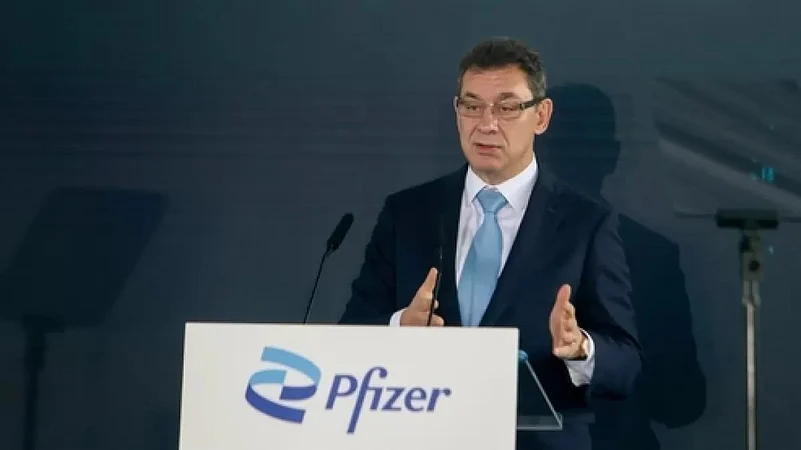
Chief Executive Officer Albert Bourla said the company's "launched and acquired products performed well" in the quarter. "Our obesity program is advancing with meaningful momentum," he added, as per the report.


Pfizer expects to return to stronger growth after 2028 and is increasingly relying on newer therapies to reduce dependence on ageing blockbuster medicines.
Investors are also closely monitoring whether the company's $10 billion acquisition of Metsera will strengthen its position in the rapidly expanding obesity treatment market, as per Reuters.
Obesity Pipeline, Cancer Drugs In Focus
Pfizer's obesity programme remains a key area of interest for investors. Its once-monthly weight-loss injection berobenatide, acquired through the Metsera deal, delivered weight loss of up to 12.3% in patients without diabetes during a clinical trial, although questions remain over its tolerability.
Advertisement
In June, the treatment demonstrated a side-effect profile comparable to Novo Nordisk's Wegovy in a mid-stage study.
The company is also searching for a new Chief Financial Officer ahead of the departure of Dave Denton later this month.
Revenue Outlook Improves
Sales of Eliquis, which Pfizer markets with Bristol Myers Squibb, climbed around 21% to $2.43 billion during the quarter, comfortably ahead of analysts' expectations of $1.93 billion, Reuters reported.
Cancer therapy Padcev generated sales of $667 million, exceeding market estimates of roughly $634 million and helping offset weaker demand for COVID-related products.

Advertisement
Pfizer reported a net loss of four cents per share after recording acquisition-related charges and a $3.8 billion impairment linked to experimental lung cancer therapy sigvotatug vedotin.
The drug reportedly failed to improve overall survival in a late-stage trial announced in June, although the company continues to test it in other treatment settings, including in combination with Merck's Keytruda.
On an adjusted basis, Pfizer earned 77 cents per share, beating analysts' expectations by nine cents, Reuters reported.
The company also raised its full-year revenue forecast to $60.5 billion-$62.5 billion from its earlier guidance of $59.5 billion-$62.5 billion.
It reaffirmed its 2026 adjusted earnings outlook of $2.80-$3.00 per share despite a $650 million upfront payment under its licensing agreement with China's Innovent Biologics.