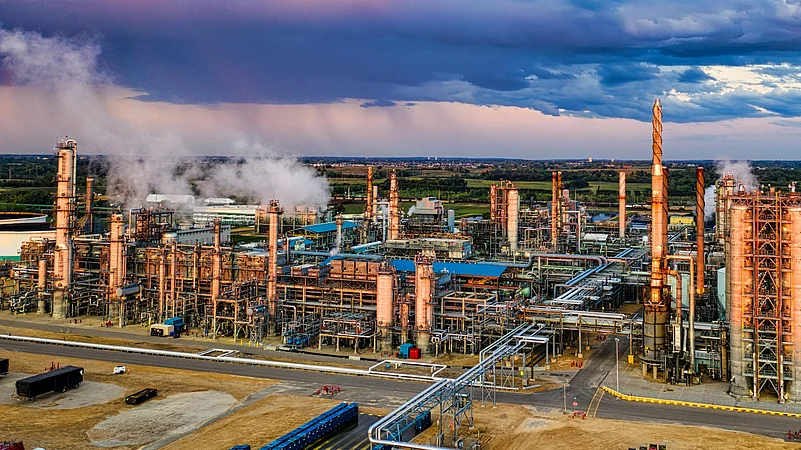

Under-recoveries on petrol sales by state-run OMCs fell to ₹3 per litre as of June 15, nearly half the level recorded a week earlier, following a decline in crude oil prices.
Diesel under-recoveries eased to ₹27 per litre, but losses on domestic LPG sales continue to remain high at around ₹700 per cylinder.
According to a Business Standard report, analysts expect OMCs, aviation, logistics, automobiles, cement and paints companies to benefit if crude prices remain subdued and energy markets stabilise.
A sharp decline in global crude oil prices following the US-Iran peace agreement has significantly reduced fuel marketing losses for India's state-run oil marketing companies (OMCs), offering relief after months of pressure from elevated energy costs and supply disruptions.
According to a Business Standard report, under-recoveries on petrol sales by public sector OMCs fell to around ₹3 per litre as of June 15, nearly half the ₹6 per litre recorded a week earlier.

1 September 2026
Get the latest issue of Outlook Business

Diesel under-recoveries also eased to ₹27 per litre from ₹30 per litre over the same period.
However, losses on domestic liquefied petroleum gas (LPG) sales remain elevated at approximately ₹700 per cylinder, according to Sujata Sharma, Joint Secretary at the Ministry of Petroleum and Natural Gas (MoPNG).
The improvement comes after benchmark Brent crude prices fell about 5% to around $82 per barrel following the announcement of a ceasefire agreement between the US and Iran.
Advertisement
The development raised hopes of the eventual reopening and normalisation of shipping through the Strait of Hormuz, a critical energy transit route that handles nearly one-fifth of global oil and LNG trade.
"If the peace deal between the US and Iran follows through, India's energy supplies through the troubled waters are expected to improve," Sharma said during a media briefing.
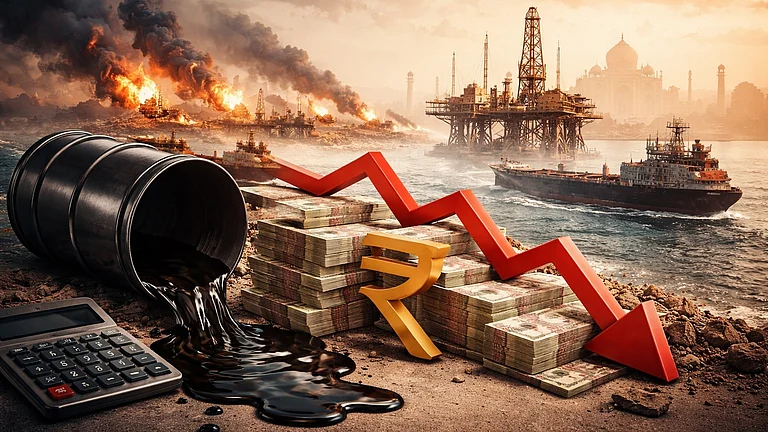
The decline in crude prices is expected to benefit Indian refiners and fuel retailers that have faced rising input costs since the conflict began. In May, state-run OMCs were reportedly incurring under-recoveries of nearly ₹1,000 crore per day on the combined sale of petrol, diesel and LPG.
Advertisement
To partially offset these losses, fuel retailers raised petrol prices by ₹7.38 per litre and diesel prices by ₹7.52 per litre beginning May 15, marking the first increase in retail fuel prices in four years.
Despite the recent correction, analysts remain cautious as crude prices rebounded slightly on Tuesday amid uncertainty over the implementation of the ceasefire and the timeline for restoring normal shipping activity in the Strait of Hormuz.

Oil Market Outlook
Industry experts said a sustained decline in crude oil prices could improve the profitability of oil marketing companies (OMCs) while easing inflationary pressures across the broader economy.
According to a separate Business Standard report, brokerage Bernstein expects OMCs to be among the biggest beneficiaries of lower crude prices.
The brokerage also identified aviation, travel and companies with exposure to the Middle East and North Africa (MENA) region as potential beneficiaries of stabilising energy markets.


The report added that Bernstein has maintained a year-end Nifty target of 26,000, implying an upside of more than 8% from current levels.
Citing Anirudh Garg, Partner and Fund Manager at INVasset PMS, Business Standard reported that oil-sensitive sectors such as OMCs, aviation, logistics, cement, paints, automobiles and select financial stocks could benefit if the US-Iran ceasefire holds and energy markets stabilise.
However, despite the recent correction in crude prices, significant under-recoveries on domestic LPG sales continue to remain a key challenge for state-run OMCs.