
Bajaj Auto to expand capacity by up to 20% as EV demand outpaces supply
The company sold over 14.38 lakh two- and three-wheelers in Q1 FY27
“Demand continued to outpace capacity,” the company said
Two-wheeler major Bajaj Auto on Tuesday announced plans to expand its production capacity by up to 20% by the end of the current financial year, as demand continues to outpace supply, especially in the electric vehicles segment. The company sold over 14.38 lakh units of two-wheelers and three-wheelers between April and June 2026, up 29% from the same period last year, according to its Q1 FY27 results.
“Demand continued to outpace capacity, reflecting the growing strength of the brand and product proposition,” Bajaj Auto said in an exchange filing.

1 October 2026
Get the latest issue of Outlook Business

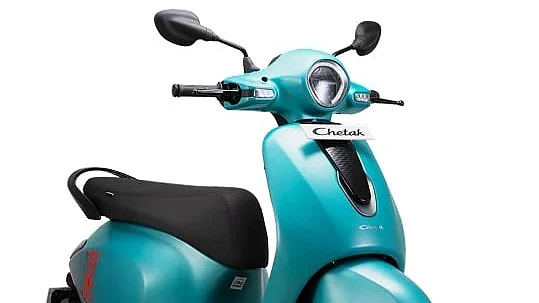
Expanding on this, Chief Financial Officer Dinesh Thapar told reporters that the company is “most capacity constrained” in commercial vehicles, including both ICE and electric three-wheelers. He added that following the West Asia crisis, which began in late February, demand for its Chetak EV has also picked up, while domestic and export demand for its motorcycles has strengthened.



“Across the breadth of our business, a capacity expansion of about 10% will take place in the next three to four months, followed by another 10% by the end of the financial year—resulting in about a 20% increase across the board,” Thapar said during a post-earnings press conference.
Advertisement
The expansion will be implemented at the company’s commercial vehicle plant in Waluj and its Chetak facility in Akurdi, Maharashtra.
Bajaj Auto currently produces about 50,000 units of the Chetak EV per month. Its overall production capacity stands at 600,000 units per month.
In Q1 FY27, Bajaj Auto sold 5,86,547 two-wheelers, including its electric scooter brand Chetak, up 11% from 5,29,344 units in the same quarter last year. Notably, Chetak recorded its highest-ever quarterly sales.
At the same time, the company sold 1,19,531 three-wheelers, up 13% from 1,05,464 units. Exports saw stronger growth, rising 54% to 7,32,173 units in Q1 FY27 from 4,76,429 units in the corresponding quarter last year. Two-wheeler exports stood at 6,36,005 units (up 52% from 4,19,447 units), while commercial vehicle exports rose 69% to 96,168 units from 56,982 units.
Advertisement
The company delivered more than 1.5 lakh electric vehicles during the quarter across electric two-wheelers (E2Ws) and electric three-wheelers (E3Ws), reflecting double-digit volume growth.
Riding on this performance, Bajaj Auto reported standalone revenue from operations of ₹17,244 crore, up 37% year-on-year, marking a record high. Standalone net profit rose 42% to ₹2,983 crore. Alongside capacity expansion, the company is rolling out one of the most comprehensive product revamps in its history.
Over the next six weeks, Bajaj Auto plans to significantly refresh its portfolio by introducing 10 additional models. Two of these will be entirely new motorcycles in the 125–150cc segment under the Pulsar brand. The strategy aims to strengthen its presence in the country’s largest motorcycle segment while capitalising on the strong traction of the Pulsar franchise. The company said in its earnings presentation that recent upgrades across the Pulsar range have helped it gain share in the sports motorcycle category, with further improvements expected to enhance competitiveness.
In parallel, Bajaj Auto is also strengthening its leadership team to support its next phase of growth.