




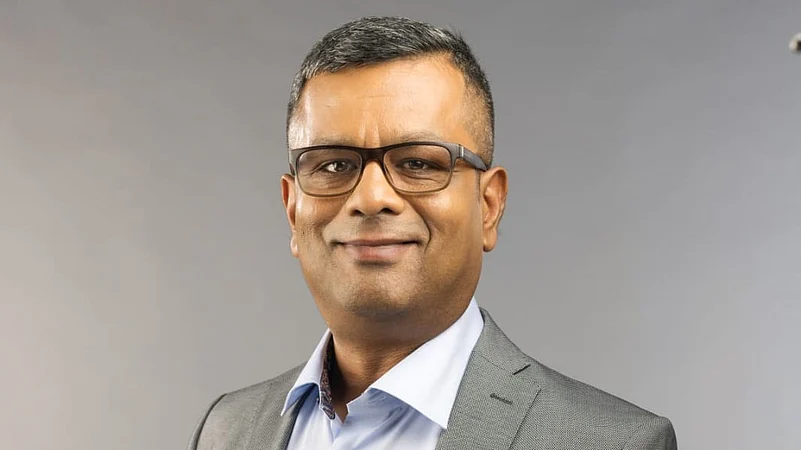

Indian telecom sector is shifting focus to network performance, efficiency, and monetisation, says Ericsson India MD Nitin Bansal.
AI is being embedded into networks to improve efficiency, spectrum utilisation and service differentiation in this next phase, he adds.
This comes as Reliance Jio, Bharti Airtel, and Vodafone Idea (Vi) push to monetise heavy investments in 5G deployment.
As the Indian telecom industry moves beyond the peak phase of 5G network rollout, the focus is shifting from large-scale deployment to enhancing network performance, efficiency, and monetisation, according to Ericsson India Managing Director Nitin Bansal. He said that in this next phase, artificial intelligence (AI) is being used to “improve efficiency, spectrum utilisation, and service differentiation”.
His comments come amid efforts by telecom operators Reliance Jio, Bharti Airtel and cash-strapped Vodafone Idea (Vi) to monetise their massive spending on acquiring 5G spectrum and deploying it across the country. As of March 2025, the telecom industry is shouldering a debt of ₹6.45 lakh crore, data from ICRA’s November 2025 report shows. It notes that operators are expected to spend another ₹3 lakh crore over the next 4–5 years to improve connectivity, which would keep total debt elevated. Many in the sector have also expressed their frustration over the slow monetisation of 5G networks due to a lack of use cases.

1 September 2026
Get the latest issue of Outlook Business

Advertisement
“In the near term, we are seeing progress through fixed wireless access, premium consumer offerings, and early enterprise deployments. At the same time, AI is increasingly being embedded into networks to improve efficiency, spectrum utilisation, and service differentiation, supporting both cost optimisation and new revenue opportunities,” Bansal said in an interview with Outlook Business. He also leads the networks business of, Swedish firm in South East Asia, Oceania and India.
Bansal pointed to India’s already extensive 5G coverage, with a base of 394 million users as of 2025, and high data consumption.
Explaining the role of AI in networks, he said that the larger opportunity lies in scaling AI-driven enterprise and industrial use cases, including areas such as digital twins, XR, and automation, where 5G becomes a platform for business transformation.
Advertisement
The Ericsson India MD also discussed the Swedish giant’s plans to further expand manufacturing and research and development opportunities in India.
Here are the edited excerpts from the interview:
How important is India to Ericsson’s overall growth?
India is a key market for Ericsson, both as a large-scale market and also as a critical capability hub. We have our largest employee base here, with over 21,500 professionals, including around 2,300 in advanced R&D - reflecting how deeply research and innovation are embedded in our India operations.
From a business standpoint, India is seeing rapid 5G adoption, with subscriptions expected to scale significantly over the next few years, alongside some of the highest mobile data usage globally.
This creates a clear opportunity as operators look to enhance network performance, efficiency, and enterprise monetisation. We are supporting this shift through our advanced radio portfolio, cloud-native core, and automation platforms, alongside long-term partnerships with leading operators and industry players.
From an R&D perspective , we have R&D centers in Chennai, Bengaluru, and Gurugram, spanning domains such as packet core, transport, OSS/BSS, cloud, and AI, with around 2300 R&D professionals based in India.
Last year we announced an expansion into ASIC development in Bengaluru, strengthening India’s position within the global semiconductor ecosystem.
We have also established a new Radio Access Network (RAN) Software Research & Development (R&D) unit in Bengaluru. The new R&D unit will initially focus on developing 5G and 5G Advanced features for the Ericsson 5G baseband. The work will be carried out in close collaboration with the company’s global RAN software teams.
Academic collaborations with IIT Kharagpur, IIT Madras, and the Indian Statistical Institute are advancing research in compute technologies and bias-aware AI.
In addition, our local manufacturing footprint – the Pune factory and Manesar antenna facility, are supporting large-scale deployments domestically and contributing to global exports.
Overall, India is not just a key market for Ericsson, it is a strategic hub for innovation, talent, manufacturing, and long-term growth.
After a long phase of capex investments by telecom firms for the 5G rollout, the pace is expected to moderate in the near term. How do you plan to offset that?
As the industry moves beyond the peak phase of 5G rollout, the focus is shifting from large-scale deployment to enhancing network performance, efficiency, and monetisation.
The next phase of growth is being driven by AI-powered networks, automation, and increased programmability, enabling service providers to improve operational efficiency while creating more differentiated services for consumers and enterprises.
The rapid rise of AI is reshaping network requirements, with more dynamic and data-intensive workloads across devices, sensors, and the cloud. This is accelerating the need for intelligent, adaptive, and software-driven networks, and reinforcing the importance of advanced connectivity.
In markets such as India, with large-scale 5G deployments and strong data consumption growth, this is translating into continued momentum as operators focus on innovation, productivity gains, and new use cases.
Overall, the opportunity is evolving from network build-out to long-term value creation through efficiency, innovation, and AI-led growth.
Can you talk about the company’s manufacturing plans for India, especially in light of the new Telecom Policy 2025 draft that pushes for indigenous gear?
India is a strategically important market for Ericsson, and manufacturing is a key part of our long-term commitment to the country.
Our immediate priority has been to support India’s nationwide 5G rollout, with locally manufactured equipment focused on meeting the requirements of Indian telecom operators. Our Pune facility has played a critical role in enabling large-scale deployments across the country.
At the same time, we see India evolving beyond a domestic manufacturing base. We are manufacturing passive antennas in India and marked an important milestone last year with the first export of an antenna model manufactured in India, reinforcing the country’s potential as a hub for global supply.
In the context of the draft Telecom Policy 2025 and its focus on indigenous capabilities, we are actively working with the government and ecosystem partners to increase local value addition and strengthen the component supply chain. This includes encouraging our global supplier base to expand their presence in India.
Overall, our approach is to support both domestic priorities and global delivery, positioning India as a competitive manufacturing and export hub within Ericsson’s global network.
There is frustration among Indian telecom firms regarding the lack of substantial monetisation of 5G. By when do you see that changing, especially with a focus on AI use cases?
India has already built a strong foundation for 5G monetisation, with extensive coverage, about 394 million 5G subscriptions by end-2025, and some of the highest data consumption globally driving demand for advanced services. The focus is now shifting toward deriving greater value from these investments.
In the near term, we are seeing progress through fixed wireless access, premium consumer offerings, and early enterprise deployments. At the same time, AI is increasingly being embedded into networks to improve efficiency, spectrum utilisation, and service differentiation, supporting both cost optimisation and new revenue opportunities.
The larger opportunity lies in scaling AI-driven enterprise and industrial use cases including areas such as digital twins, XR, and automation where 5G becomes a platform for business transformation.
With India’s strong 5G base, growing ecosystem, and high data usage, monetisation is expected to build progressively as these use cases mature and scale.

In January, your parent company announced a restructuring with some headcount cuts. Was there any impact on India operations?
India operations remain largely unaffected by the global restructuring, reflecting the country’s strategic importance within Ericsson’s overall operations.
India continues to be a key hub for talent and innovation, with over 21,500 professionals and a strong presence across R&D, services, and manufacturing. We have ongoing investments in areas such as RAN software, semiconductor design, and advanced network development, which reinforce this position.
Overall, India remains central to Ericsson’s strategy, both as a growth market and a critical capability hub supporting innovation in areas such as AI-powered networks and 5G evolution.









