

India invites global investors to fund $300–350bn clean energy expansion.
Pitch made at World Energy Forum 2026 in Davos, targeting long-term capital.
Investment aims to accelerate renewables, energy transition and climate commitments.
India pitched investments of $300–$350bn in the clean energy sector by 2030 by presenting the country as one of the world’s largest and most investment-ready markets for clean energy at the World Economic Forum (WEF) 2026, reported Down To Earth.
Union Minister for New and Renewable Energy Pralhad Joshi, who attended the forum in Davos, said India’s energy transition offers speed, scale, stability and long-term returns at a time when global investors are seeking predictable growth opportunities, according to an official statement.

1 September 2026
Get the latest issue of Outlook Business

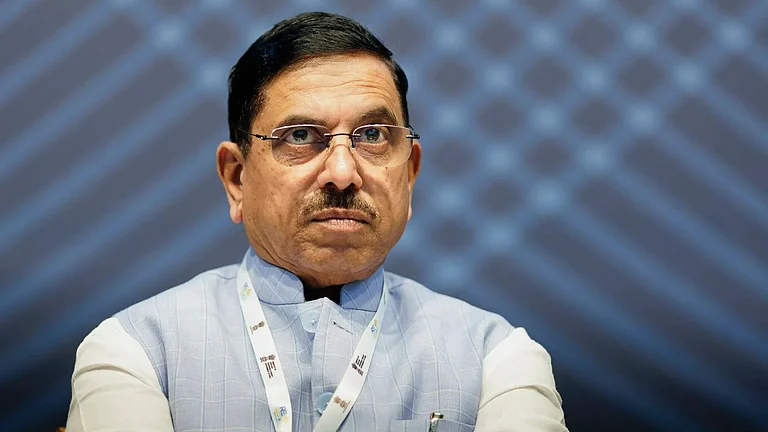
The minister, while speaking at several sessions and investor meetings, said India has already built 267 GW of non-fossil fuel capacity as of December 2025 and is on track to meet its 2030 clean energy targets. “India today combines great demand, competitive tariffs and a stable policy framework. This creates a compelling case for patient global capital looking for long-term growth,” Joshi said during multiple sessions and bilateral meetings at WEF. India's pitch coincides with challenges to global clean energy investment, including rising interest rates, geopolitical fragmentation and slowing deployment in some regions of Europe and the US. In light of this, Indian officials aimed to present their nation as a reliable anchor for manufacturing, energy security and climate finance. So far, India has already added 267 gigawatt (GW) of non-fossil fuel capacity as of December 2025. The country is also on track to meet its 2030 clean energy targets, including a rapid scale-up of solar, wind, battery storage and green hydrogen, the minister said. Non-fossil sources now account for nearly half of India’s installed power capacity. The minister underscored that clean energy is no longer peripheral to India’s climate commitments but central to its economic strategy. “Renewables, storage and green hydrogen are becoming cost-competitive and integral to India’s growth, industrialisation and energy security,” he said.
Advertisement

India Targets Energy Transition
India's power sector data clearly shows the country's clean energy boom.
According to government data cited by PTI, non-fossil fuel sources like nuclear and renewable energy now account for nearly half of the nation's installed electricity capacity, or about 235.7 GW out of 476 GW as of June 2025.
This significant advancement indicates strong momentum in the country's transition to sustainable energy and supports India's goal of 500 GW of renewable and non-fossil capacity by 2030. As a result of policy emphasis on diversifying the power mix and luring climate finance, solar and wind continue to lead capacity additions.
Advertisement
(With inputs from PTI.)