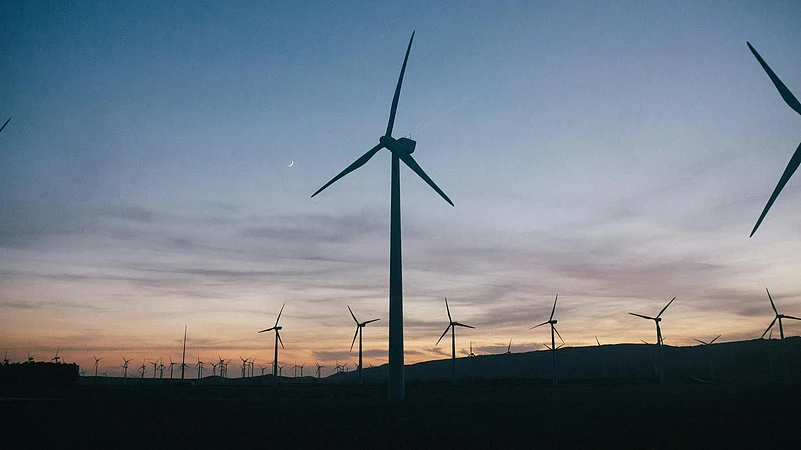

India achieves 50% non-fossil power capacity, five years ahead of 2030 taget.
Renewable capacity additions surge, driven by solar growth, policy support and investments.
Scaling infrastructure and financing remain critical as India targets 500 GW non-fossil capacity.
India achieved a major climate milestone by securing 50% of its power generation capacity from non-fossil fuel sources, five years ahead of its 2030 target under the Paris Agreement signed in December 2015, reported PTI.
The country now has a total installed generation capacity of about 510 gigawatts (GW), comprising 247 GW of fossil-fuel sources and 262 GW of non-fossil fuel sources (including 254 GW from renewable energy sources).

1 September 2026
Get the latest issue of Outlook Business

India added around 50 GW of renewable energy capacity in 2025, backed by investments of nearly ₹2 lakh crore, taking its total non-fossil fuel capacity to about 262 GW. The government expects to sustain a similar pace of capacity addition in 2026, even as challenges related to land acquisition, right-of-way issues and delays in signing power purchase agreements continue to constrain fresh projects.
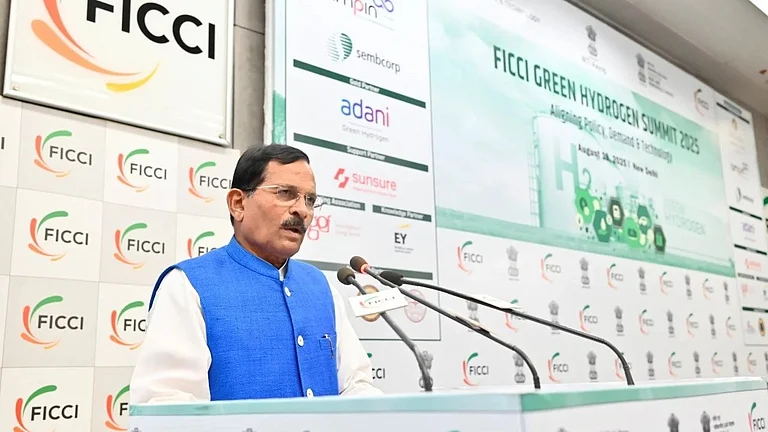
Union Minister for New and Renewable Energy Pralhad Joshi told PTI that India witnessed record growth in 2025, with about 45 GW of renewable capacity added between January and November, led by nearly 35 GW of solar installations.
Advertisement
"By the end of December, we will touch nearly 48-50 GW. The future is sunny and will be powered by renewables," he said, adding that momentum is expected to continue in 2026.
Industry estimates put investment requirements at around ₹4 crore per MW, implying ₹2 lakh crore for every 50 GW of capacity.
According to an IREDA study, India will require investments of about ₹30.54 lakh crore between 2023 and 2030 to meet its 500 GW non-fossil fuel target. Public sector financial institutions have already deployed about ₹10.79 lakh crore into renewable projects since 2014, including ₹2.68 lakh crore in 2024-25 alone.
Advertisement

Renewables Drive Energy Shift
According a report published by Economic Times on December 17, the Solar Energy Corporation of India (SECI) and the Global Energy Alliance for People and Planet (the Alliance) have signed a Statement of Intent (SoI) to accelerate India’s energy transition. This partnership aims to unlock crucial investments and provide technical assistance to propel India toward its ambitious climate targets.
The collaboration comes as India seeks to meet rapidly rising power demand while greening its economy to achieve its net zero target by 2070. Having surpassed its initial Paris Agreement commitments ahead of schedule, the country now faces the challenge of scaling up renewable energy capacity and supporting infrastructure at an unprecedented pace to sustain its transition.
(With inputs from PTI.)