It was a year ago when Chief Economic Adviser V Anantha Nageswaran rose, as tradition demands, to present the Economic Survey. The document ran into hundreds of pages, much like it does every year, cataloguing familiar challenges that return with predictable regularity.
One line, however, stood out. Globalisation, he said, was on the retreat. Trade was fragmenting. The world was becoming more uncertain.
At the time, the remark may have felt abstract to some. But then the year unfolded.
1 September 2026
Get the latest issue of Outlook Business

Donald Trump’s return to the White House had already made clear that many American voters were unhappy about being left out of the gains of globalisation. So, President Trump did not hesitate to draw first blood, imposing tariffs not just on rivals but on partners as well. Despite the warmth often on display between Prime Minister Narendra Modi and Trump, India was not spared, and its small businesses and export growth prospects took a hit. With that, so did the investor sentiment.
Only China could respond to Uncle Sam’s bullying. It tightened controls on exports of heavy rare earth elements, materials that sit deep inside electric vehicles, defence systems and advanced electronics. India, once again, was in the line of fire. All its high-tech manufacturing ambitions and talks of self-sufficiency were suddenly under scrutiny. Supply chains were disrupted. Both governments and investors took notice. The leverage was unmistakable.
An Uncertain World
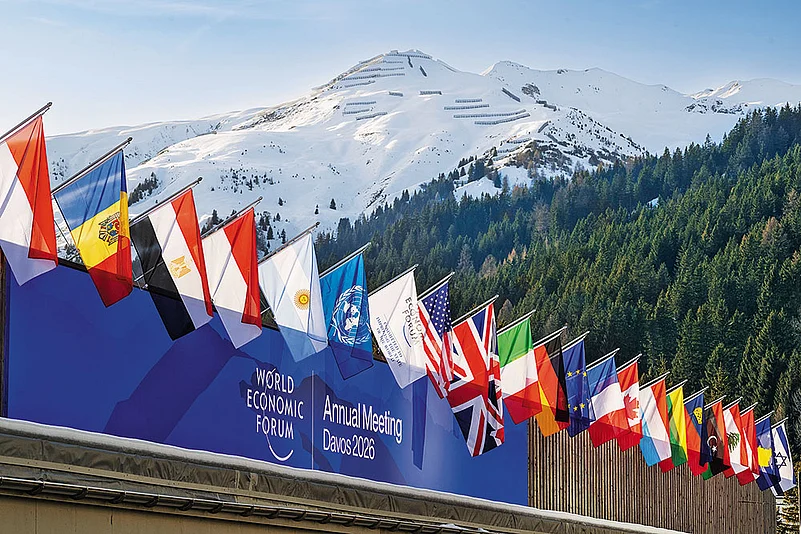
By the time political and business leaders began preparing for the World Economic Forum’s (WEF) annual meeting in Davos this January, its promise of a “spirit of dialogue” seemed divorced from reality. In a media call ahead of the summit, Børge Brende, WEF president said the world was facing its most complex geopolitical environment since 1945. The comment summed up a year of cascading shocks that Nageswaran had perhaps warned about.
These shocks matter because, despite years of high headline growth, India continues to appear vulnerable, much like other emerging markets. Income growth remains uneven. Private investment has yet to find its footing. At the same time, decisions taken in Washington, DC and Beijing are now increasingly shaping India’s economic choices.

No wonder India is trying to find a way out of this new mess and preserve its Viksit Bharat vision in a more hostile world. Its large presence and engagements at Davos this year reflected that effort and desperation.
Although it would be wrong to say the year leading up to the Davos summit was entirely bleak for India. While the two superpowers from the opposite sides of the world disrupted global trade, smaller economies are finding ways to lean on each other. India signed a historic trade deal with the UK, securing bilateral trade worth nearly $56bn, with a joint goal to double that figure by 2030.
The deal provides unprecedented duty-free access for 99% of India’s exports to the UK. Negotiations with other economies including the US are also underway.
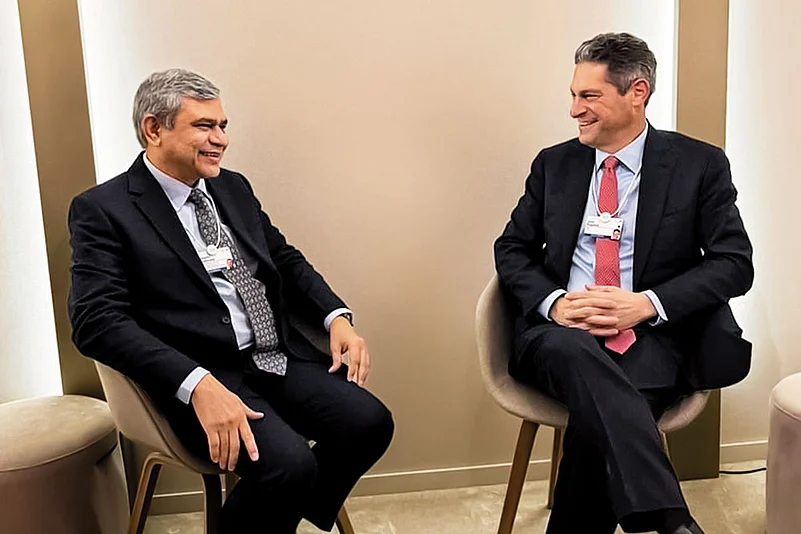
Union minister Ashwini Vaishnaw, who spoke confidently at the summit about India’s ability to attract $100bn in new investments through the upcoming India AI Impact Summit, also, in a discussion, underlined that the country is engaging simultaneously with multiple markets to pursue what he described as “good, balanced, healthy and mutually complementary trade agreements”.
New Partners
European Commission President Ursula von der Leyen and European Council President Antonio Costa were in India as Republic Day guests. The EU and India signed a trade deal, dubbed as “mother of all deals” by some, to slash tariffs on most goods.
Interestingly, President Trump, who has been continuously giving India a tough time in cracking the much-awaited deal with the US, took a jab at the bloc in his Davos speech. “I love Europe and I want to see Europe go good. But it is not heading in the right direction,” he said.
Making new and stronger friends—countries equally disturbed by the bullies on the block—is a strategy that has also been proposed by Indian policymakers. For a low-income country with a large population, fully shutting off from the external world is never an option and India has to get things right on that front.
Because, despite an impressive average annual GDP growth of 6.3% between 2000 and 2023, India has struggled to match China, which leveraged the peak years of globalisation to grow at an average annual rate of 8.5% over the same period. From the 1990s onward, China rode the wave of increasing global trade, which surged from 39% of world GDP in 1980 to 60% by 2012.
Despite years of high headline growth, India continues to appear vulnerable. Income growth remains uneven. Private investment has yet to find its footing
In India, income growth, at present, is insufficient to support both consumption and savings required for higher investment. “Aggregate consumption and savings often pull in opposite directions,” said Ram Singh, external member of the Reserve Bank of India’s Monetary Policy Committee, in a recent interview with Outlook Business.
“This underscores the need for us to explore alternative sources of demand and savings. We need to promote exports through the diversification of product lines and overseas markets. Similarly, we need more FDI [foreign direct investment] to supplement domestic savings and investment,” he added.
A closer look at the proceedings in Davos shows that India is, in fact, trying to do exactly that. Signalling to the world that its trade prospects remain very much alive, even as deglobalisation becomes the prevailing refrain, is a central part of its strategy.
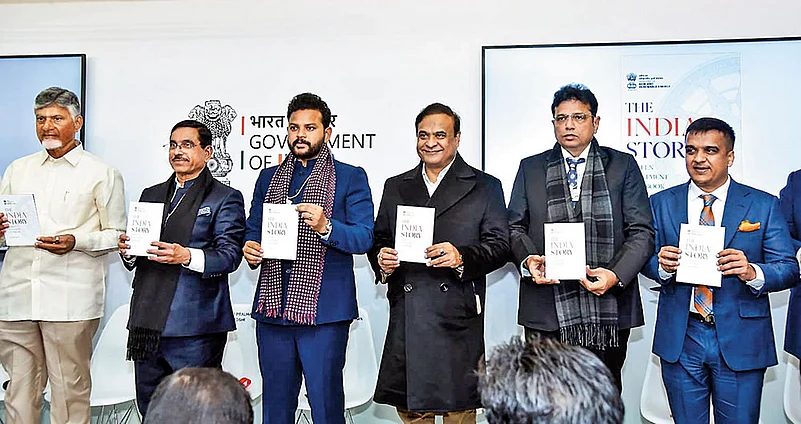
The other pillar of India’s outreach is the hunt for foreign investment. Delegations from nearly a dozen states including Maharashtra, Andhra Pradesh and Uttar Pradesh fanned out across the summit, pitching their regions to global businesses gathered at the event, each promising land, incentives and policy stability in a fiercely competitive race for capital.
India for Investments
India’s race for capital is as intense as its push for trade, and as much driven by desperation as by competition. Economists point out that while some historically advantaged states may be seeing up an uptick in investments, India collectively has so far failed to capitalise meaningfully on the global FDI reallocation. That shortfall has begun to spill over into portfolio flows as well, with foreign investors appearing less convinced about India’s long-term growth trajectory.
In 2025, foreign portfolio investors pulled out nearly $19bn from Indian equities on a net basis, the worst outflow on record. Gross FDI inflows, meanwhile, have remained stuck at around 1.7% of GDP since early 2023, well below the roughly 3% recorded in the mid-2000s. “In the context of global uncertainty, the share of foreign capital may decline,” warned S Mahendra Dev, chairman of the Economic Advisory Council to the Prime Minister, in an earlier interview with Outlook Business.
It is also difficult to fault foreign investors for their caution when domestic investment sentiment itself remains subdued. That reality perhaps explains why 2025 had turned into a year of course correction—marked by tax reforms aimed at boosting demand, interest-rate cuts to lower the cost of capital and the long-pending notification of the labour codes to make India more attractive to investors. With so many levers finally being pulled at once, India’s large presence at the Davos summit begins to make more sense.
Uncharted Territories
But the picture is far from straightforward. Even as India pushed through these corrections, the economy was exposed to the risks of a hostile neighbourhood.
A direct confrontation with long-time rival Pakistan and the absence of strong diplomatic backing, showed the fragility of the moment.
In 2025, FPIs pulled out nearly $19bn from Indian equities on a net basis, the worst outflow on record. Gross FDI inflows have remained stuck at around 1.7% of GDP
“FDI investors usually do not like conflict zones,” Ajit Ranade, economist and senior fellow at the think tank Pune International Centre, had told Outlook Business in an earlier interview. Beyond external pressures, experts also point to internal risks. Gita Gopinath, Harvard professor and former deputy managing director of the International Monetary Fund, who was part of the same discussion as Vaishnaw, suggested that India should be more concerned about the level of pollution in its cities than about tariffs imposed by other countries.
“From an international investor’s point of view, if you are considering setting up operations in India and have to live there, an environment that poses risks to your health can be a serious deterrent,” she said.
Observers believe it will take a dual strategy of economic and social delivery at home and steady diplomacy abroad to help India navigate the uncharted terrain ahead. In that context, the continued relevance of platforms such as the WEF, even in an increasingly inward-looking world, matters for an emerging economy like India that still has much convincing and learning to do.
This is the new world order—one in which India cannot afford to fall behind or be seen as falling behind.
The India-US trade deal was announced by the time this story went to press.