
WEF 2026 designates 2026 as ‘Year of Water’ highlighting global water challenges.
$58 trillion annual value of water ecosystems underscores need for innovative financing.
Blue Davos focuses on freshwater management, ocean protection, and blue food security.
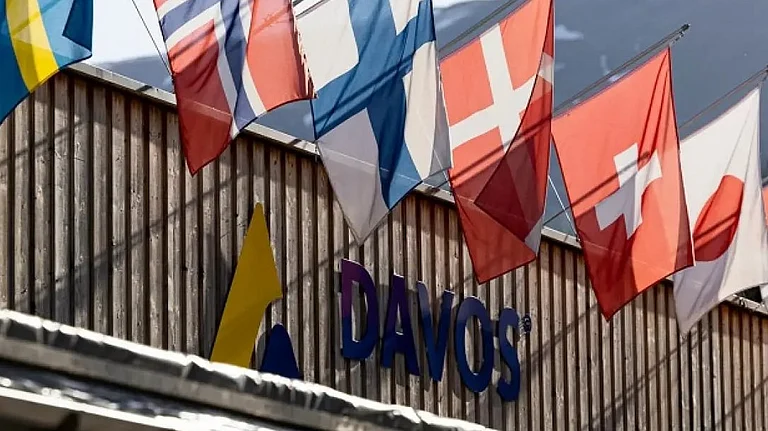
The 'Blue Davos' label is emerging at the World Economic Forum’s annual meeting 2026 in Davos, Switzerland along with the intensifying climate extremes.
In response to worsening climate extremes, the WEF has designated 2026 as the ‘Year of Water’, underscoring a shift toward treating water security as fundamental to economic stability, climate resilience and international collaboration.

1 September 2026
Get the latest issue of Outlook Business

What Is Blue Davos
Blue Davos signifies that water-related issues have taken centre stage in the international discourse and are no longer marginalised. The water bodies such as rivers, oceans, glaciers and groundwater as stressed systems are receiving more attention.
According to a World Economic Forum report, the World Economic Forum is focusing on three areas to protect freshwater, i.e., fit-for-purpose finance; basin-level partnerships; and innovation. Through a host of dialogues, thought leadership and partnership efforts, these priority action areas are showing signs of momentum.
WEF acknowledged that water also bears an economic weight that must be addressed. The WEF report revealed that the annual economic value of water ecosystems estimated at $58trn, underscoring the role that finance plays in providing funding for water resilience. However, the report emphasises the critical need for creative financing mechanisms, enhanced valuation frameworks, and efficient risk-sharing models to address the growing global water crisis, given that the World Bank estimates that only 2-3% of global water investment comes from the private sector.
Advertisement

Why 2026 Is Called the Year of Water
As the rate of ocean warming has quadrupled since the 1980s, according to a University of Reading report published in January 2025, cascading impacts have hit the world including melting ice, rising sea levels and acidification.
The year 2025 has been dotted with many instances of floods, storms, rising seas, droughts, scarcity and drying rivers and increasingly, water polluted beyond safe levels, at large, Earth’s water cycle is becoming out of balance.
WEF has designated 2026 as the ‘Year of Water’ to move water from just a small footnote to climate policy to a developmental issue that deserves to be discussed widely. While flooding, drought and pollution are vital considerations when supply chains, energy systems and cities are concerned. Including freshwater and oceans in the same conversation reflects a more general scientific belief that changes in one area of the system often have repercussions elsewhere, sometimes far from the source.
Advertisement
The ‘Year of Water’ concludes with the third-ever UN Water Conference which will take place between December 2 and 4 in UAE, as reported by WEF, in nearly 50 years bringing the world at a critical moment when political will is expected to match the scale of the crisis.

How Blue Davos Impacts Global Water Policy
Among some of the notable developments in September 2025 include the formal ratification of the High Seas Treaty after reaching the threshold needed to enter into force and officially became a law on January 17. It is the first legally binding agreement that protects marine life beyond natural jurisdiction, covering two-thirds of ocean area previously missing comprehensive protections.
In October 2025, the IUCN World Conservation Congress adopted a motion to protect the mesopelagic zone, or 'twilight zone' (200-1,000 metres deep), which contains 600 million metric tons of biomass and plays a critical role in climate regulation through the "biological pump" that moves carbon to ocean depths.
The ‘Blue Davos’ label at the World Economic Forum’s Annual Meeting 2026 aims to build on this momentum convening leaders to spur progress across three critical dimensions, which include freshwater access and management, blue food security and ocean protection.