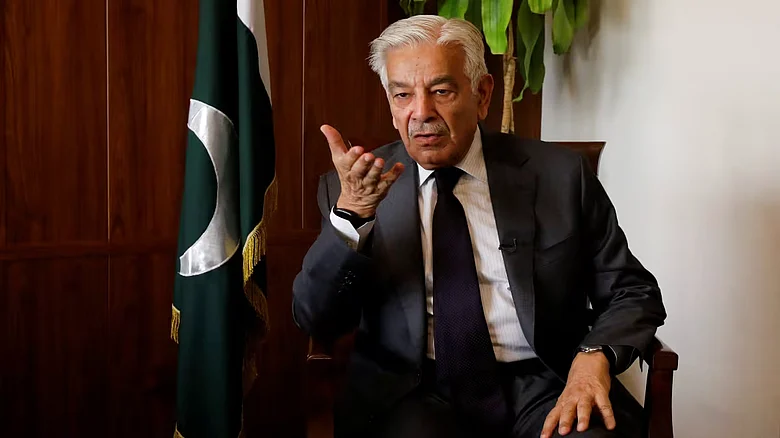

Pakistan has requested a $10 billion Bilateral Exchange Stabilisation Support Facility from US Treasury Secretary Scott Bessent.
If approved, the facility could help boost Pakistan's foreign exchange reserves, stabilise the rupee and reduce reliance on multilateral financing.
The request comes after Pakistan's diplomatic role in facilitating talks over the Iran conflict.
Pakistan has sought a $10 billion Bilateral Exchange Stabilisation Support Facility from US Treasury Secretary Scott Bessent, Reuters reported. If approved, the proposed arrangement would provide Islamabad with access to dollar liquidity for up to five years and help strengthen its external finances.
Reuters, citing a source familiar with the matter, reported that this is the first time details of Pakistan's request have been made public.

1 October 2026
Get the latest issue of Outlook Business

Pakistan's Finance Ministry did not immediately respond to Reuters' request for comment, while the US Treasury declined to comment on the matter.
What Is the Proposed Facility?
The proposed support mechanism is aimed at reinforcing Pakistan's foreign exchange reserves, stabilising the rupee and reducing the country's dependence on multilateral lenders.
The request comes after Pakistan played a diplomatic role in facilitating talks related to the Iran conflict, a development that has enhanced its geopolitical significance and fuelled expectations that it could seek greater economic cooperation from Washington and other international partners.
If granted, the facility would provide an additional financial cushion as Pakistan continues efforts to stabilise its economy.
Advertisement
A Rare US Treasury Support Mechanism
Exchange stabilisation facilities are uncommon financial arrangements administered through the US Treasury's Exchange Stabilization Fund (ESF).
These facilities typically provide dollar liquidity, swap arrangements or financial guarantees to help countries strengthen foreign exchange reserves and stabilise their currencies during periods of economic stress.
Unlike the Federal Reserve's permanent dollar swap lines with selected major central banks, these facilities are designed as temporary support mechanisms.
According to Reuters, the most recent such arrangement was extended to Argentina in 2025, while Uruguay received similar assistance in 2002. Mexico also maintains a long-standing exchange support arrangement with the United States.
Advertisement
Pakistan Continues Economic Recovery
Pakistan remains under a $7 billion International Monetary Fund (IMF) programme, which requires fiscal consolidation, tax reforms and tighter public spending.
The country has also secured a separate $1.3 billion IMF loan to improve resilience against climate-related disasters.
Although Pakistan narrowly avoided a sovereign default in 2023 through a $3 billion IMF standby programme, its economy continues to rely heavily on external financial support, including loans, rollovers and deposits from countries such as China and Saudi Arabia.
The country's financial vulnerabilities were highlighted earlier this year when it repaid around $3.5 billion to the United Arab Emirates—equivalent to roughly one-fifth of its foreign exchange reserves—before receiving fresh financial support from Saudi Arabia.



Despite these challenges, Pakistan's central bank has projected that its foreign exchange reserves could rise to around $20 billion by the end of 2026, approaching the record levels seen in 2021, Reuters reported.