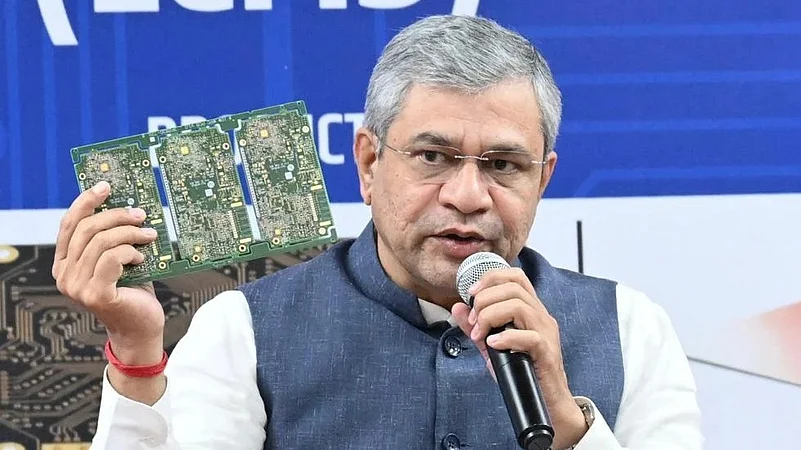

Minister Ashwini Vaishnaw rejected the IMF's "second-tier" classification of India's AI status
India ranks 3rd in AI preparedness and 2nd in AI talent according to Stanford Index
$150bn investment in infrastructure is projected by end-2026, including data centers and chips
India’s Minister of Electronics and Information Technology Ashwini Vaishnaw on Wednesday pushed back against the International Monetary Fund’s characterisation of the country as a “second-tier” AI player. In a World Economic Forum panel Vaishnaw stated India belongs among the leading nations shaping global AI adoption. He rejected the notion that strategic advantage flows only to countries that own the largest frontier models, arguing instead that India is building depth across the entire AI value chain.
India’s Standing in Five Layers of AI Architecture
The minister outlined what he described as a five-layer AI architecture spanning applications, models, chips, infrastructure and energy. India, he said, is investing simultaneously across all five layers rather than concentrating narrowly on model scale. This approach, Vaishnaw argued, positions the country to deploy AI widely and affordably, with practical impact across sectors rather than symbolic leadership based on model size alone.

1 September 2026
Get the latest issue of Outlook Business

To counter the IMF’s assessment, Vaishnaw pointed to external benchmarks, citing Stanford University’s Global AI Vibrancy rankings, which have placed India among the top three countries on measures such as AI penetration, preparedness and talent availability. These indicators, he said, better reflect real-world adoption and readiness than headline comparisons of compute or parameter counts.


Advertisement

India’s Focus on Small Efficient Alternatives
Vaishnaw also made the case for smaller, more efficient systems, telling the Davos audience that “95% of the work” that generates economic value can be handled by models in the 20–50 billion parameter range. India already has what he described as a “bouquet” of such models being deployed across use cases, reinforcing his argument that diffusion and efficiency matter more than chasing trillion-parameter systems.
On infrastructure, the minister said India is drawing significant capital into AI-related build-out, including data centres, semiconductors and power capacity. Officials at Davos flagged that cumulative investment across these areas could reach as much as $150 billion by the end of 2026, as the country works to secure compute, storage and energy at scale for domestic and regional AI demand.
Advertisement

India’s AI Narrative
Vaishnaw’s remarks reframed India’s AI story from one of catch-up to one of strategic diffusion. By emphasising sovereign models, lower-cost compute and broad-based deployment, New Delhi is signalling that it intends to be not just a large market for AI services, but also a developer of locally relevant models, hardware and infrastructure.
The exchange drew attention because it sits at the intersection of technology and geopolitics, touching on questions of who controls leading AI systems and whether that control translates into durable economic power. In the near term, observers will be watching for follow-through, including announcements at India’s upcoming AI Summit and evidence that pledged infrastructure investments and sovereign model initiatives are translating into commercial services and exports.