ISM 2.0 to prioritise chip design capabilities
Aim to nurture around 50 major design startups
Part of ECMS outlay to be used to localise production of electronics manufacturing machinery
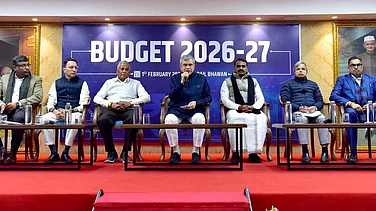
As the Union Budget 2026–27 proposes the next phase of the India Semiconductor Mission (ISM 2.0), it will focus on strengthening the country’s chip ecosystem and building globally competitive domestic companies on the lines of AMD, Intel, and Qualcomm, said Ashwini Vaishnaw, Minister of Electronics and Information Technology, while interacting with the media on Sunday.
“Under ISM 2.0, we also aim to strengthen the design ecosystem. As mentioned earlier, we want around 50 major design startups to emerge in the country. Ideally, one or two of them will grow into global leaders like Qualcomm, AMD, or Intel,” said Vaishnaw.
1 September 2026
Get the latest issue of Outlook Business

The Union Minister also said that the increased budget outlay of ₹40,000 crore for the Electronics Component Manufacturing Scheme (ECMS) will focus on developing domestic manufacturing of machinery used to produce electronic components.
He said that the government has identified six systems that can be used to design almost any electronic system in the future.
“Once we develop complete chipsets for these subsystems, they can be used across sectors—strategic, transportation, electric vehicles, consumer electronics, and more,” he added.
The Finance Minister has proposed a tax holiday until 2047 for foreign companies offering global cloud services through data centres based in India.
Advertisement
When asked about the high consumption of land, water, and natural resources by data centres and the rationale behind granting them long-term tax benefits, Vaishnaw said that several innovations are helping reduce energy and resource usage.

“Recently, I met a startup that has reduced energy consumption by 35%. Another startup is working on a micro nuclear power generator that can fit on a rack. Each rack could potentially have its own micro nuclear generator,” he said.
The Union Budget 2026–27 proposed expanding the “safe harbour” tax benefit, which was earlier available only to IT and IT-enabled companies with a turnover of up to ₹300 crore. Under the new Budget, this limit has been increased to ₹2,000 crore.
Advertisement
On this, Vaishnaw said that for the fifth industrial revolution and the AI-driven economy, the most important requirement is a strong AI infrastructure within the country, accessible to the Indian IT industry so it can serve clients worldwide.
Union IT Minister Ashwini Vaishnaw described the Budget 2026–27 as historic, saying that its announcements on manufacturing and infrastructure will attract significant investment and generate a strong multiplier effect.


“It will drive investment and create demand for many activities related to data centres. As I mentioned earlier, AI server manufacturers are now looking to set up plants in India, chip manufacturers want to add value domestically, and in the future, even chip fabrication could take place here,” he added.