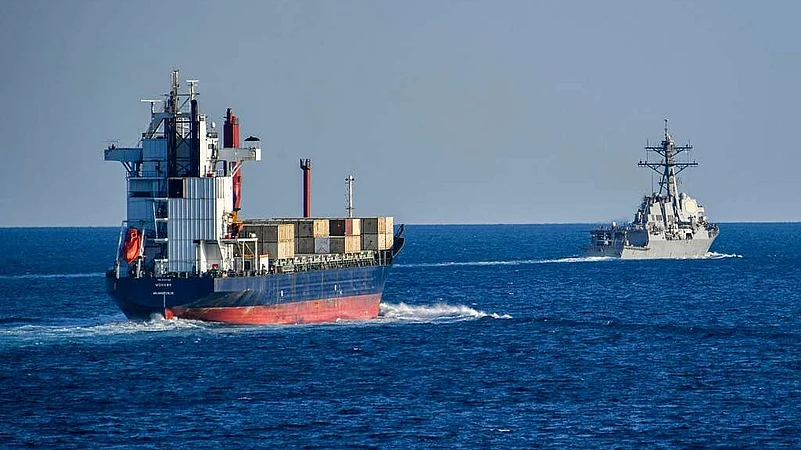

Iran and Oman are negotiating a maritime agreement that would route commercial vessels through Iranian territorial waters while Tehran seeks a 5-7% transit fee, according to Reuters and other reports.
Analysts estimate a 7% toll on pre-conflict shipping volumes could generate over $100 billion annually, making it one of Iran's largest potential revenue sources without increasing oil production.
Even as negotiations continue, vessel traffic through the Strait of Hormuz has slowed, while maritime intelligence firm Kpler has flagged growing operational risks, including shadow-fleet activity, dark transits and attacks on commercial shipping.
Iran and Oman are negotiating a new maritime arrangement that could reshape commercial shipping through the Strait of Hormuz, with Tehran seeking greater control over vessel movements and a transit fee on cargo passing through the strategic waterway.
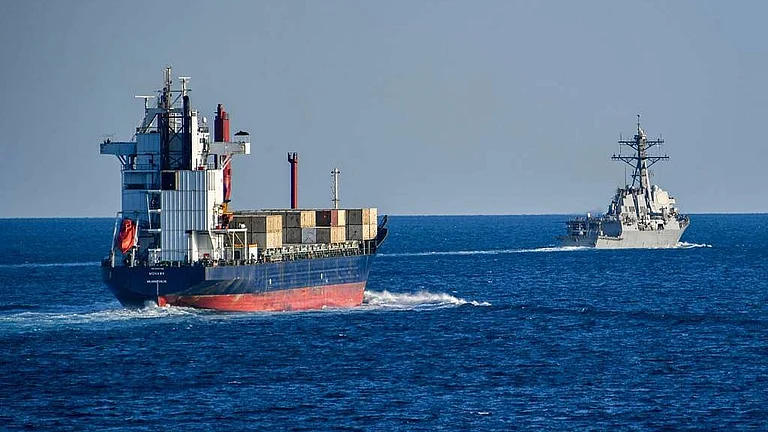
According to Reuters, the proposed agreement would require commercial ships to sail through Iranian territorial waters while entering and exiting the Gulf.

1 September 2026
Get the latest issue of Outlook Business

The talks come amid heightened geopolitical tensions and renewed focus on one of the world's most critical energy chokepoints, through which roughly one-fifth of global oil supplies pass.

Iranian Deputy Foreign Minister Kazem Gharibabadi told state-run IRNA that vessels would transit through Iranian waters in both directions.
He also said Tehran had received indications that the United States was prepared to revive understandings reached under the Memorandum of Understanding (MoU) signed in June.
Disagreement Over Transit Fee
A key point of negotiation remains the proposed transit charge.
Advertisement
According to various reports, Iran is seeking a toll of 5-7% of the cargo's value, while Oman has proposed a lower 3% levy. Although discussions are ongoing, the proposed fee has significant financial implications given the volume of global trade that passes through the Strait of Hormuz.
A Potential Multi-Billion-Dollar Revenue Stream
Analysts estimate that a 7% transit fee, based on pre-conflict shipping volumes, could generate around $385 million a day, translating into more than $100 billion annually.
For example, a fully loaded Very Large Crude Carrier (VLCC) transporting about 2 million barrels of crude oil could generate roughly $11 million in toll revenue under a 7% fee structure.
Advertisement
Because the administrative cost of collecting transit charges is relatively low compared with producing or exporting crude oil, analysts say most of the revenue would flow directly to Iran.
At that scale, annual earnings from Hormuz tolls could rival the profits reported by some of the world's largest multinational companies and would exceed one-third of Iran's annual GDP. The projected revenue would also surpass the highest annual toll collections historically generated by the Suez Canal.
Shipping Patterns Already Changing
Even as negotiations continue, vessel movements through the region are shifting.
Maritime intelligence firm Kpler said only eight vessels transited the Strait of Hormuz on August 4, with shipping increasingly concentrated around the Iranian Unilateral Scheme.
Meanwhile, traffic through the Bab el-Mandeb Strait rose to 34 vessel crossings.
However, Kpler flagged growing operational risks, including vessels switching off tracking systems, continued shadow-fleet activity linked to sanctions, and a confirmed attack on the commercial ship Minoan Pioneer.
According to Kpler, shipping companies are now paying closer attention to route transparency, vessel behaviour and security risks than to traffic volumes alone as geopolitical tensions continue to reshape global maritime trade.