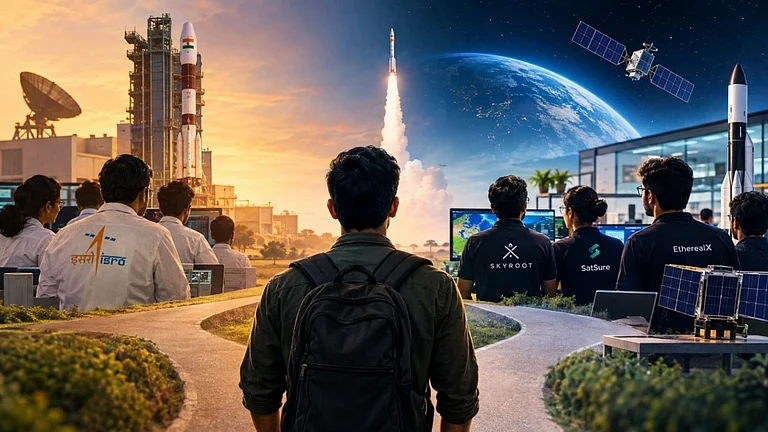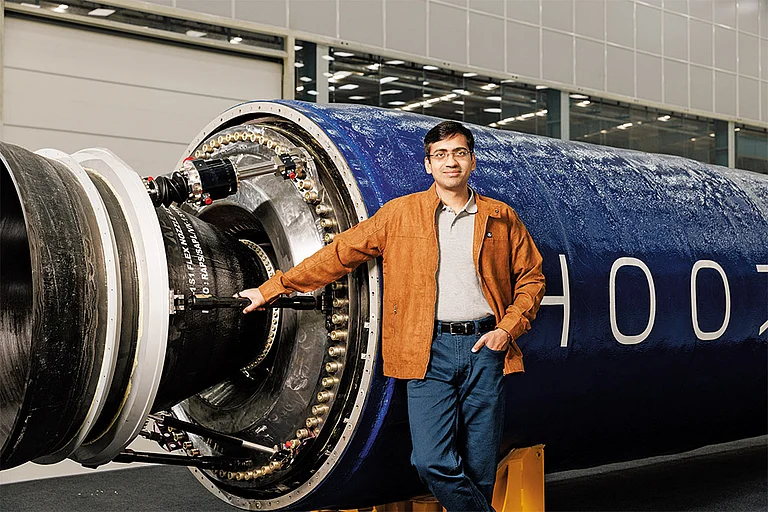

Skyroot Aerospace has launched Vikram-1, India's first privately developed orbital-class rocket, from Sriharikota.
The mission aims to place the rocket into low-Earth orbit and demonstrate technologies for future commercial satellite launches.
A successful mission would make Skyroot the first private Indian company to place a rocket into orbit.
Hyderabad-based Skyroot Aerospace on Saturday launched Vikram-1, India's first privately developed orbital-class rocket, marking a major milestone for the country's private space sector.
The mission, designated Mission Aagaman, lifted off from the Satish Dhawan Space Centre (SDSC-SHAR) in Sriharikota after an earlier countdown hold delayed the scheduled launch. The Indian Space Research Organisation (ISRO) is supporting the mission.

1 October 2026
Get the latest issue of Outlook Business

The flight aims to place the rocket into low-Earth orbit (LEO), where most Earth observation and communication satellites operate. A successful mission would make Skyroot the first private Indian company to place a rocket into orbit.
How Vikram-1 Works
Vikram-1 is a four-stage launch vehicle that stands about seven storeys tall and is designed to carry payloads weighing up to 350 kg into a 450-km low-Earth orbit with a 60-degree inclination.
The rocket uses solid fuel for its first three stages, while the upper stage is powered by liquid fuel and can be restarted in space. This allows the vehicle to deploy satellites into their intended orbits with greater precision.
Advertisement
The mission is primarily a technology demonstration rather than a commercial launch. It will evaluate the rocket's flight software, stage separation, guidance and navigation systems, propulsion performance and overall mission execution.
Vikram-1 is also carrying technology payloads from Indian and international partners to validate its satellite deployment capabilities for future commercial missions.
Skyroot's Journey
Skyroot Aerospace was founded in 2018 by former ISRO engineers Pawan Kumar Chandana and Naga Bharath Daka after the Indian government opened the space sector to private players.
The company's first launch, Vikram-S, successfully demonstrated around 80% of the technologies now integrated into Vikram-1 during its suborbital mission in November 2022.
Advertisement
Mission Aagaman marks Skyroot's transition from suborbital testing to full-fledged orbital missions.
Why the Mission Matters
A successful mission would make Skyroot the first private Indian company to place a rocket into orbit, strengthening India's growing commercial space ecosystem.
The launch could also provide satellite operators with a domestic launch option as India's private space industry continues to expand.
Thanking Prime Minister Narendra Modi after the launch, Skyroot Aerospace said the milestone was made possible by the government's reforms that opened India's space sector to private participation. "This historic milestone has been made possible by your vision for India's space sector and the transformative reforms that opened new frontiers for private space innovation in the country," the company said in a post on X.
For Skyroot, Vikram-1 is the first in a planned family of launch vehicles aimed at making satellite launches more frequent, flexible and cost-effective. The company says the programme will support India's ambition to become a larger player in the global space economy.