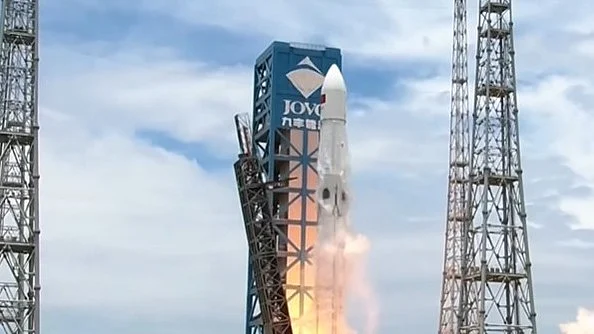

China successfully launched its reusable Long March 10B rocket on its maiden orbital flight from the Wenchang Commercial Space Launch Site on Hainan Island
The first-stage booster was recovered on an offshore sea vessel using a novel system of four hooks latching onto a suspended net instead of traditional landing legs
Eliminating landing legs reduces structural weight, allowing the Long March 10B to carry heavier payloads of up to 16 tonnes into low-Earth orbit
China successfully launched its reusable Long March 10B rocket on its maiden flight to orbit and recovered its first-stage booster. The operation marks China's first successful recovery of an orbital-class reusable rocket booster.
The engineering team recovered the booster using a sea-based platform. This milestone poses a direct challenge to the market dominance of its American competitor.

1 October 2026
Get the latest issue of Outlook Business

For nearly a decade, Elon Musk's SpaceX has dominated the reusable rocket revolution. The private company has made precision booster recoveries routine with its Falcon 9 programme.

A Novel Recovery Strategy
The Long March 10B lifted off from the Wenchang Commercial Space Launch Site on Hainan Island. It separated its first stage roughly three minutes into the flight. The booster then descended onto a sea-based recovery vessel around six minutes after launch, according to a Business Today report.
Advertisement
Instead of landing legs, the booster used four specially designed hooks to latch onto a suspended net mounted on an offshore platform. The design choices aim to improve payload capacity and operational efficiency.
The China Academy of Launch Vehicle Technology (CALT) stated that eliminating landing legs reduces structural weight, allowing the rocket to carry heavier payloads while simplifying refurbishment between flights.
The recovered booster is scheduled to fly again before the end of the year.
Chasing the SpaceX Model
SpaceX transformed spaceflight economics by routinely recovering Falcon 9 first stages to lower launch costs. This model continues to support its rapidly expanding Starlink satellite constellation.
Advertisement
The Long March 10B is designed to place approximately 16 tonnes into low-Earth orbit while recovering its first stage. This capability mirrors the commercial model established by its American rival.
China plans to use this reusability to support commercial satellite launches and future space infrastructure. The system will also play a key role in the country's planned crewed lunar missions later this decade.
Growing Space Race
The Long March 10B's success follows years of mixed results from earlier recovery experiments. Those earlier tests involved older reusable Long March variants and independent commercial providers.
State-backed organisations and private Chinese companies are now investing heavily in reusable systems. They aim to build mega-constellations to directly challenge the Starlink network.
However, SpaceX still maintains a significant lead, with hundreds of successful Falcon 9 landings. The company is currently focused on making its fully reusable Starship operational to further expand its technological lead.