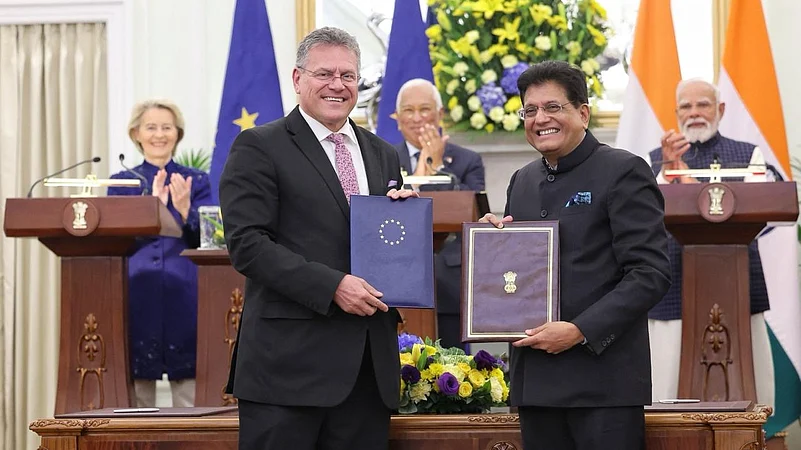

India and the EU concluded the "mother of all deals" on January 27, 2026, after 18 years
Luxury car tariffs will drop to 10% from 110%, while wine duties fall to 20%
A €500 million green transition fund was pledged by the EU for Indian industry
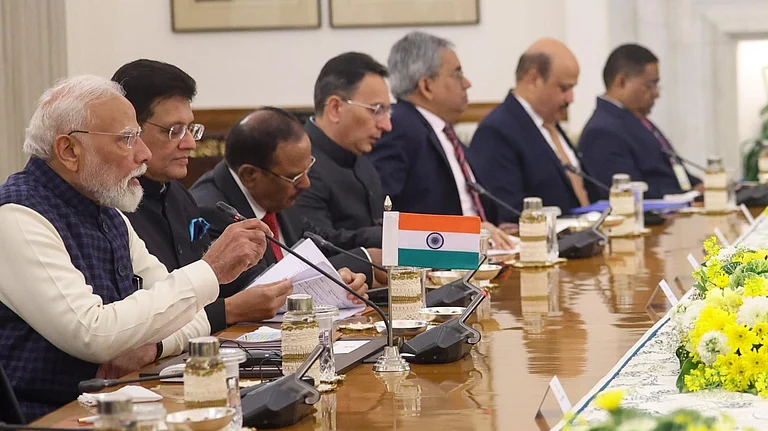
Prime Minister Narendra Modi and European Commission President Ursula von der Leyen on Tuesday announced the successful conclusion of negotiations for the India-EU Free Trade Agreement (FTA).
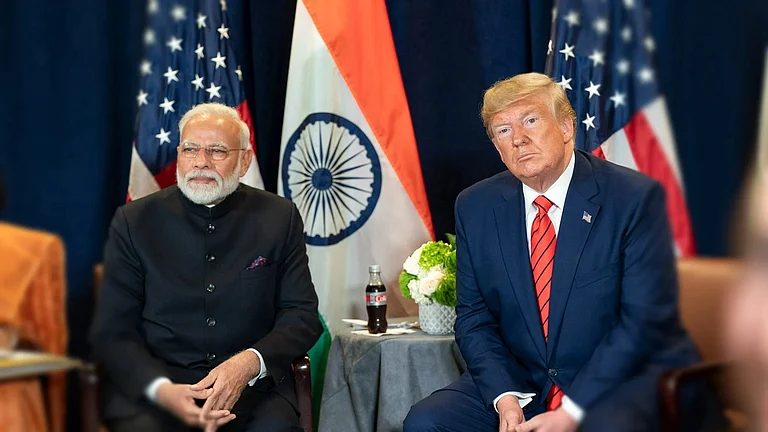
The announcement, made in the 16th India-EU Summit, signals a shift in economic alliances. It comes against the backdrop of US President Donald Trump’s tariff-heavy trade policies, including the imposition of 50% tariffs on Indian goods last year during trade negotiations between the two countries.

1 September 2026
Get the latest issue of Outlook Business

Trump had also threatened to escalate a trade dispute with European allies over their opposition to a proposed US takeover of Greenland, before later softening his stance.


Why Is It Called Mother of All Deals?
The finalised free trade agreement has been described as the “mother of all deals” because of its sheer scale, strategic importance and the complexity involved in negotiating it.
The pact marks the end of 18-year negotiations and links two of the world’s largest democratic markets. Together, India and the European Union account for about 25% of global GDP and nearly one-third of global trade.
It also creates one of the world’s largest free trade zones, covering close to 2 billion people by integrating India’s population of around 1.4 billion with the 27 countries of the European Union.
Advertisement
Even before the agreement was finalised, bilateral trade between the two sides was already substantial, exceeding $136 billion in goods and $83 billion in services in FY2024-25, underlining the economic significance of the deal.
Why Is Deal Not Signed Yet?
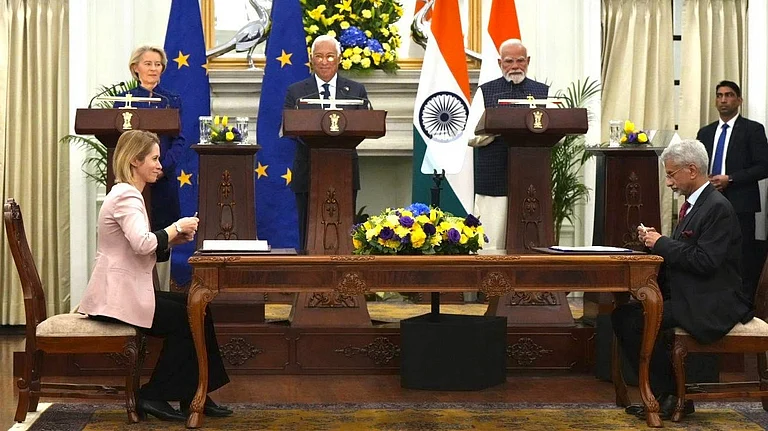
India and the European Union have only announced the completion of negotiations for their free trade agreement but the deal has not yet been formally signed, PTI reported.
While the conclusion of talks marks a defining milestone, the agreement will now undergo a standard process of legal scrubbing and translation into 24 official languages before formal signing and ratification.
Advertisement
Full implementation of the pact is expected by early 2027.
What Will India Gain from It?
For India, the deal provides duty-free access to a market of 450 million European consumers, particularly benefiting labor-intensive sectors like textiles, leather, and gems and jewelry.
On top of that, India’s concessions are matched by a reciprocal opening of the European market, where Indian exporters of specialized chemicals, machinery, and electrical equipment will now compete on a level playing field, stripped of the prohibitive costs that previously hampered their reach.
Beyond the exchange of physical goods, the FTA secures a transformative deal for the services sector, which remains the backbone of the Indian economy.
Indian professionals across 144 subsectors, including Information Technology, engineering, healthcare and education, will gain predictable and non-discriminatory access to the EU market.
A crucial component of the deal is the "Future-Ready Mobility Framework," which simplifies visa regulations for skilled and semi-skilled workers. This allows Indian tech talent and researchers easier entry into the European bloc, supported by the launch of a first-of-its-kind European Legal Gateway Office in India to facilitate talent flow.
Sustainability and climate action are also deeply embedded in the agreement. A dedicated chapter on Trade and Sustainable Development ensures that economic growth does not come at the expense of environmental standards or workers' rights.
To support this transition, the EU has pledged €500 million in financial support over the next two years to assist India’s industrial sectors in reducing greenhouse gas emissions.
What Will EU Gain from the Pact?
This deal is the most ambitious trade opening that India has ever granted to a trade partner. It eliminates or significantly reduces tariffs on over 96% of goods. European exporters stand to save an estimated €4 billion annually in duties, gaining unprecedented entry into the world's most populous nation.
India has committed to a phased reduction of its historically high import duties on European automobiles, which currently stand at 110%. Under the new terms, these tariffs will gradually slide to as low as 10% over five years for a specific quota of vehicles, making luxury European brands significantly more accessible to Indian consumers.
Duties on car parts will also be entirely abolished within a ten-year window, encouraging European manufacturers to deepen their local assembly and supply chain integration in India.
Similarly, in the alcoholic beverages sector, India will immediately slash its 150% import duty on European wines to 75%, with a roadmap to eventually reach 20%. Spirits and beers will see similar reductions, with duties on spirits lowered to 40% and tariffs on processed foods like pasta and chocolate being completely eliminated.
The EU has also secured privileged access to 102 services subsectors in India. This includes the most ambitious commitments India has ever made in financial services and maritime transport, sectors where European expertise is expected to drive significant infrastructure upgrades.
The agreement provides the EU a high level of protection and enforcement of Intellectual Property (IP) rights, including copyright, trademarks, designs, trade secrets and plant variety rights. It builds upon existing international IP treaties and brings Indian and EU intellectual property laws closer. This will make it easier for EU and Indian businesses that rely on IP to trade and invest in each other's markets.
How’s Industry Reacting to the Deal?
Industry bodies have broadly welcomed the India–EU free trade agreement, calling it a major boost for trade, investment and India’s long-term growth ambitions.
Chandrajit Banerjee, Director General of the Confederation of Indian Industry (CII), said the agreement marks a strategic breakthrough in India’s global trade engagement and significantly strengthens ties between two large democratic economies that together account for nearly 25% of global GDP.
He described the preferential access for over 99% of Indian exports to the EU as a game-changer, saying it would sharply improve competitiveness in high-value European markets and help Indian companies integrate deeper into global value chains.
“By delivering tangible gains for labour-intensive sectors and MSMEs, and by enabling a future-ready mobility framework for Indian talent, the agreement lays a foundation for sustained, inclusive, and globally competitive growth which is fully aligned with India’s vision of Viksit Bharat @2047,” he added.
FICCI President Anant Goenka also congratulated the government, calling the agreement one of strategic scale and long-term importance. He noted that the European Union is the largest and most high-potential market covered under India’s recent trade agreements.
Goenka said, “The India–EU FTA is poised to unlock substantial untapped trade and investment opportunities, enabling deeper market access, stronger value-chain integration, and enhanced export competitiveness across manufacturing and high-value sectors.”
Pankaj Mohindroo, Chairman of the India Cellular and Electronics Association (ICEA), said the finalisation of the FTA reflects sustained policy focus on positioning India as a globally competitive manufacturing and export hub. He noted that the agreement supports India’s shift towards export-led growth and deeper participation in global value chains.
“In electronics, the FTA creates a credible pathway to build exports of nearly USD 50 billion by 2031 across electronic goods including mobile phones, consumer electronics, and IT hardware, with the potential to exceed USD 100 billion in the following decade anchored in manufacturing depth, job creation, innovation, and India’s emergence as a trusted global supplier,” he added.