
Global glaciers lost 408bn tonnes of ice in 2025 study.
Ice loss contributed about one millimetre rise in global sea levels.
Scientists warn glacier melt is accelerating across major global regions.
Earth’s glaciers, excluding the continental ice sheets in Greenland and Antarctica, lost about 408 bn tonnes of ice in 2025. This melting caused global sea-levels to rise by about 1 millimetre, according to the European State of the Climate Report 2025 and the journal Nature Reviews Earth & Environment.
Regional area-averaged mass loss was largest in Western Canada, the United States, Iceland, and Central Europe. The largest anomalies from the 1991–2020 climate period were recorded in Western Canada, the United States, South Asia West, and Svalbard. High Mountain Asia, Alaska, and the Russian Arctic provided the largest regional contributions to global mass loss in 2025.

1 September 2026
Get the latest issue of Outlook Business

Global glacier mass loss has accelerated over the past 50 years. Between 1976 and 1995, annual mass loss averaged less than 100 Gt. This rose to approximately 230 Gt per year between 1996 and 2015, and reached 390 Gt per year during the 2016–2025 period. Six of the highest mass-loss years on record have occurred within the last seven years. Since 1975, total loss has reached 9,583 ± 1,211 Gt, equivalent to 26.4 ± 3.3 mm of sea-level rise.
Michael Zemp, Director of the World Glacier Monitoring Service (WGMS), stated that the 2025 melt rate would have filled five Olympic pools every second of that year. Mohd. Farooq Azam, a Senior Intervention Manager at ICIMOD, noted that while glacier monitoring in the Hindu Kush Himalaya (HKH) has improved, coverage remains limited. These glaciers sustain water security for nearly two billion people but are currently underrepresented in global datasets.
Advertisement
Azam emphasised that expanding long-term, standardised observations is essential to ensure accurate regional representation in global assessments and future climate risk projections. The WGMS estimates were produced by applying geostatistical modelling to combine annual anomalies from in situ observations with long-term trends from remote sensing.
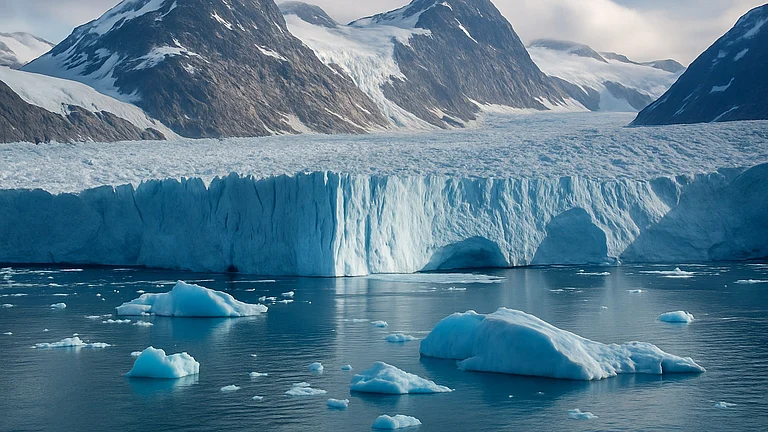
Glacier Loss Becomes Reality
Glaciers worldwide are shrinking at a faster pace due to rising global temperatures, with the Hindu Kush Himalaya region experiencing some of the most rapid ice loss. A 2025 United Nations study indicated that this retreat is accelerating in recent decades, contributing to rising sea levels and increasing risks for water security in downstream regions.
Advertisement
The Asia-Pacific region is home to some of the world’s highest mountains and most extensive glacier systems — and is among the most vulnerable to climate change. Spanning five mn square kilometres of high mountains, the region contains approximately 100,000 km2 of glaciers, reported Down To Earth.
The region’s glaciers are critical because they feed major rivers that support nearly two billion people, but scientific assessments warn that continued warming could lead to substantial long-term ice loss by the end of the century.