




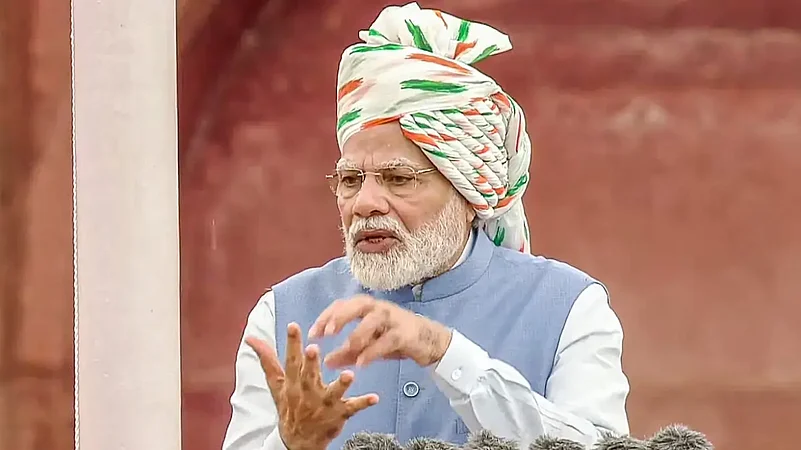

Modi warned of resource weaponisation, highlighting risks to India's energy security.
Strait of Hormuz disruptions exposed India's dependence on imported crude and LNG.
Government approved ₹84,084 crore for offshore oil and gas exploration.
Prime Minister Narendra Modi on Saturday warned that the weaponisation of resources and strategic sea routes by some countries poses risks to India's economic security, stressing the need for greater self-reliance in energy and critical resources.
Addressing the nation from the Red Fort on India's 80th Independence Day, Modi said geopolitical tensions had highlighted the risks of depending on external sources for critical requirements such as fuel, medicines, technology and minerals.

1 October 2026
Get the latest issue of Outlook Business

Without naming any country, Modi said resources were increasingly being used as instruments of geopolitical pressure, while strategic geographical routes were also being weaponised.
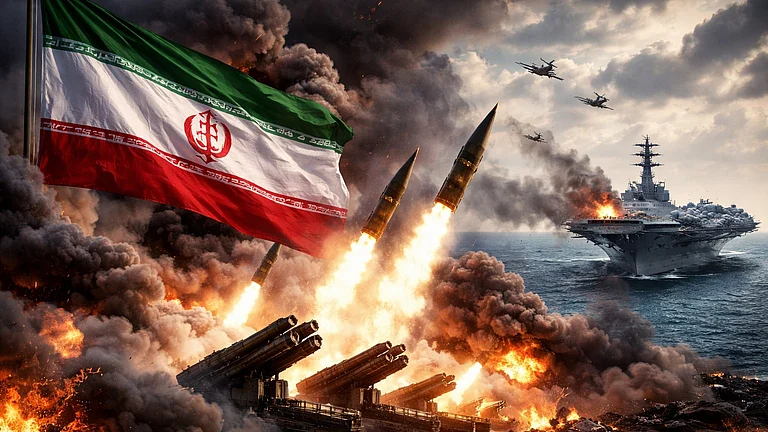


His remarks come against the backdrop of the U.S.-Israeli war with Iran and Tehran's retaliation, which has severely disrupted shipping through the Strait of Hormuz, a key route for global energy supplies.
The waterway between Iran and Oman handled around 20 million barrels per day of oil and petroleum products in 2025, equivalent to roughly a quarter of global seaborne oil trade, according to the International Energy Agency. It also carried almost 20% of global LNG trade, leaving major Asian importers exposed to prolonged disruptions.
Advertisement

India's Energy Vulnerability
The conflict has sharply reduced maritime traffic through the strait and pushed up energy and shipping costs, while renewed tanker attacks have complicated efforts to resolve the crisis.
For India, the disruption has underscored the risks associated with its dependence on imported energy. The country has sought alternative LNG supplies from countries including Oman, the United States, Nigeria and Angola, while Indian refiners have also moved to diversify crude purchases.
India now imports crude oil from 41 countries and LNG from 15, compared with 27 and six respectively earlier, as New Delhi seeks to reduce its exposure to geopolitical shocks.
Advertisement
The Strait of Hormuz remains particularly important for India because much of the energy passing through it is bound for Asia. The IEA estimates that India received nearly half of its crude oil transiting the strait in 2025. Almost two-thirds of India's LNG supplies also passed through the waterway.
India imports nearly 90% of its crude oil requirements and about half of its natural gas needs, making uninterrupted access to global energy supplies important for economic stability.
Modi Pushes Domestic Oil And Gas Exploration
Modi said the geopolitical conflicts had reinforced the need for India to become more self-reliant in energy.
As part of that effort, the government has approved the ₹84,084-crore Samudra Manthan National Offshore Exploration Scheme, aimed at accelerating oil and gas exploration in deepwater and ultra-deepwater areas over the next five years.
The programme will support seismic surveys, exploratory drilling and shared offshore infrastructure, while seeking to attract investment and technology into India's offshore basins.
Modi also said the government had opened 99% of India's sedimentary basins for oil and gas exploration and production, expanding access to areas previously largely unavailable for commercial exploration.
The push is aimed at unlocking domestic hydrocarbon resources and reducing India's exposure to global energy-price and supply shocks.
Solar Power, Gas Network Part Of Energy Push
Modi also highlighted the expansion of India's domestic energy infrastructure over the past 12 years.
Piped cooking gas coverage, he said, has expanded from 70 cities to 700 cities, with the fuel now reaching 1.75 crore households, compared with 22 lakh in 2014.
Solar power generation has also increased sharply, rising to 160 GW from 2 GW a decade ago, according to Modi.
Energy security has increasingly become a central component of the government's broader "Atmanirbhar Bharat" push, alongside efforts to expand domestic exploration of critical minerals and increase the role of nuclear and other non-fossil energy sources.
India's dependence on overseas energy also has a significant economic cost. In FY25, crude oil imports were valued at around $137 billion, while petroleum products and LNG imports were worth $24 billion and $15 billion, respectively.
The latest disruption through Hormuz has therefore brought energy security back into sharp focus, with the government seeking to reduce India's vulnerability to external supply shocks through diversification, domestic exploration and expansion of alternative energy sources.









