




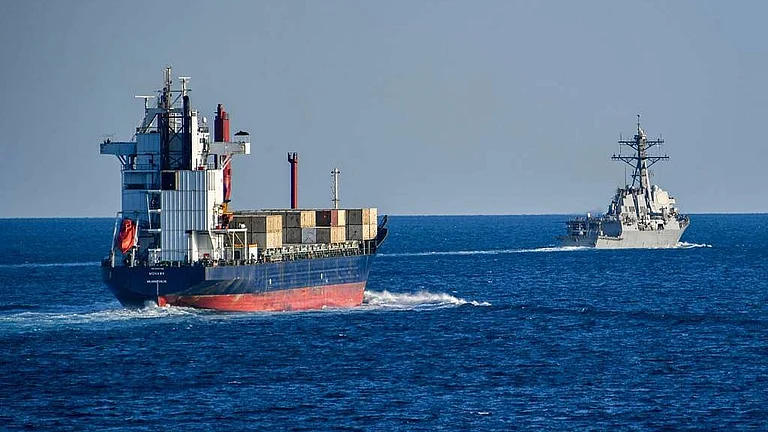
US Defence Secretary Pete Hegseth said Washington can sustain its naval blockade of Iran indefinitely by rotating ships through the region.
Strait of Hormuz traffic has plunged, with Iran refusing to fully reopen the key energy route until its demands, including sanctions relief, are addressed.
The standoff is threatening global oil supplies and economic growth, with the IEA now forecasting a 4.3 million-barrel-per-day decline in global oil supply this year.
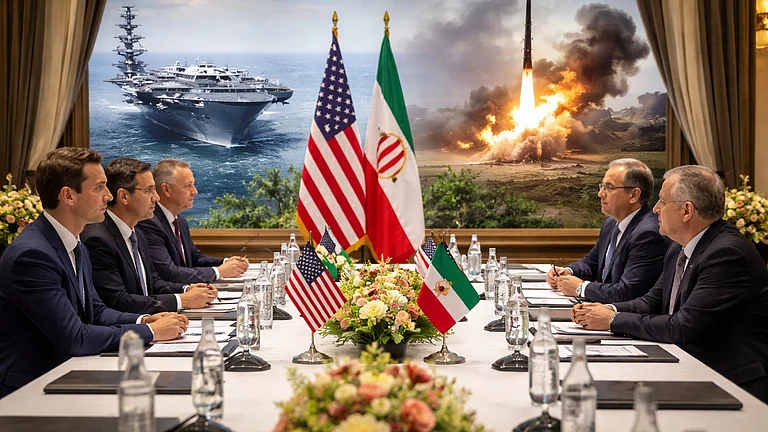
The United States can sustain its naval blockade of Iran indefinitely and plans to intensify economic pressure on Tehran as ceasefire negotiations falter, oil supplies tighten and tensions rise across the Middle East.
US Defence Secretary Pete Hegseth said Washington has enough naval capacity to maintain its presence in the region by rotating vessels in and out.

1 September 2026
Get the latest issue of Outlook Business

“Indefinitely the United States Navy can maintain a blockade like that because we'll rotate ships in and out, as we have, and we'll continue to,” Hegseth told reporters during a visit to Panama.

US Treasury Secretary Scott Bessent separately warned that Washington would introduce further measures aimed at damaging Iran's economy.
“We are going to apply measures like have never been seen in the history of economic isolation on a country,” Bessent said in an interview with Newsmax.
Advertisement
Strait Of Hormuz Becomes Key Flashpoint
The escalating standoff comes as a tentative June agreement to end the conflict has collapsed. Iran has sought to use its control over the Strait of Hormuz as leverage against Washington.
The strategic waterway carries a significant share of global energy supplies. Before the war began in February, roughly one-fifth of the world's oil and liquefied natural gas shipments passed through the strait.
Shipping activity has dropped sharply. Only eight vessels crossed the waterway on Tuesday, compared with a 10-day average of around 12 vessels and the 130-140 ships that typically transited before the conflict.
Advertisement
Iran has said it will not allow normal commercial traffic to resume until its demands are addressed, including the removal of economic sanctions and the release of frozen Iranian assets.
The situation escalated further on Thursday when two vessels operated by Abu Dhabi National Oil Company were targeted while transiting the strait, according to UAE state news agency WAM. The UAE government described the incident as an Iranian attack.
US Reimposes Pressure On Tehran
Washington temporarily lifted its blockade of Iranian shipping and ports for a month in mid-June before restoring it. The restrictions have cut off an important source of foreign currency for Tehran and compounded damage caused by attacks on Iran's energy infrastructure.
The US has previously indicated that restrictions could be eased if Iran and Oman reached an agreement to restore commercial shipping through the strait.
However, negotiations have made little progress.
President Donald Trump has repeatedly claimed that the US has “total control” over the Strait of Hormuz, a statement Tehran has strongly rejected. Iran maintains that it controls the waterway and has threatened restrictions on US and Israeli vessels.
Trump Faces Pressure Over War
The prolonged conflict is also creating domestic political difficulties for Trump. Rising fuel prices are weighing on his approval ratings and could hurt Republicans ahead of the November midterm elections.
Trump has repeatedly threatened further military action against Iran but has so far avoided deploying ground forces or carrying out some of the more extreme measures he has discussed, including attacks on strategic infrastructure.
More recently, he has indicated that economic pressure could play a larger role in forcing Tehran back to negotiations.
Bessent's warning of unprecedented sanctions suggests that Washington may be preparing another escalation on the financial front.
Global Oil Supply Faces Fresh Risks
The confrontation is increasingly affecting the global energy market.
The International Energy Agency said global oil supply could decline by 4.3 million barrels per day this year, equivalent to around 4% of global supply. That is higher than its previous forecast of a 3.7 million-barrel-per-day decline.
Oil prices nevertheless fell more than 2% on Thursday as investors focused on weaker demand expectations and rising US crude inventories.
Fresh reports of attacks continued to unsettle markets, however. Yemen's Iran-backed Houthi movement was reported to have targeted a Saudi Aramco refinery with drones, reviving concerns that the conflict could spread across the region.
Economists have warned that a prolonged war could significantly weaken global growth and potentially push some economies into recession.
Washington Rules Out A Retreat
Hegseth declined to say whether agreeing to the earlier ceasefire had been a mistake. The April truce had halted intensive US bombing of Iran in exchange for negotiations aimed at ending the conflict.
Those talks have since stalled.
Asked about the strategy, Hegseth said Washington's objective remained unchanged.
“We're doing exactly what we need to, to ensure that Iran never has a nuclear weapon.”









