
UPI’s monthly transaction value rose from the equivalent of 27% of currency in circulation in early 2022 to 70% by July 2026, reflecting its growing role in everyday payments.
Merchant transactions now account for 64% of UPI transaction volume, while the average transaction value has fallen from ₹648 in mid-2021 to ₹425 in Q2 2026.
The share of India’s top 10 districts in UPI transaction volume fell from 25.2% in Q3 2019 to 17.4% in Q2 2026, highlighting the spread of digital payments across the country.
Over the past decade, the Unified Payments Interface (UPI) has evolved from an experiment in interoperable banking into the backbone of India’s retail payments system.
According to data based on Reserve Bank of India (RBI) and PhonePe metrics, UPI has processed a cumulative transaction value of around ₹314 trillion, making it one of the world’s largest digital payments networks.

1 October 2026
Get the latest issue of Outlook Business

But UPI’s significance goes beyond transaction volumes. Its rapid adoption has changed how Indians use cash, how frequently they make digital payments and where those payments take place.


From neighbourhood shops to rural markets, UPI has gradually turned digital payments into an everyday habit.
From Cash-First To Digital-First
For decades, cash was the default payment method for Indian households. Digital payments were largely associated with online shopping, bill payments or relatively large transfers. UPI has significantly changed that pattern.
Advertisement
In early 2022, monthly UPI transaction value was equivalent to around 27% of the currency in circulation (CIC). By July 2026, that ratio had risen to 70%.
The shift does not mean cash has disappeared. Instead, UPI appears to have reduced the need to use physical currency for everyday transactions.
An RBI study, Impact of UPI on Cash Demand—Evidence from National and Subnational Levels, found that greater digital adoption has contributed to a structural moderation in demand for cash.
Annual growth in currency in circulation has slowed to around 4-6% in recent years, while ATM cash withdrawals relative to GDP have also declined.
Advertisement
Cash increasingly functions as a reserve or fallback rather than the default medium for every purchase.
How UPI Made Small Payments Digital
Perhaps the biggest behavioural change has been the digitisation of low-value spending.
Person-to-merchant (P2M) transactions accounted for 64% of UPI transaction volume in 2026, compared with 37% in mid-2021. At the same time, the average transaction value fell from ₹648 to ₹425.
That combination is important. UPI is not simply being used for larger payments that could previously have been made through cards or bank transfers. Increasingly, it is being used for tiny, frequent purchases.
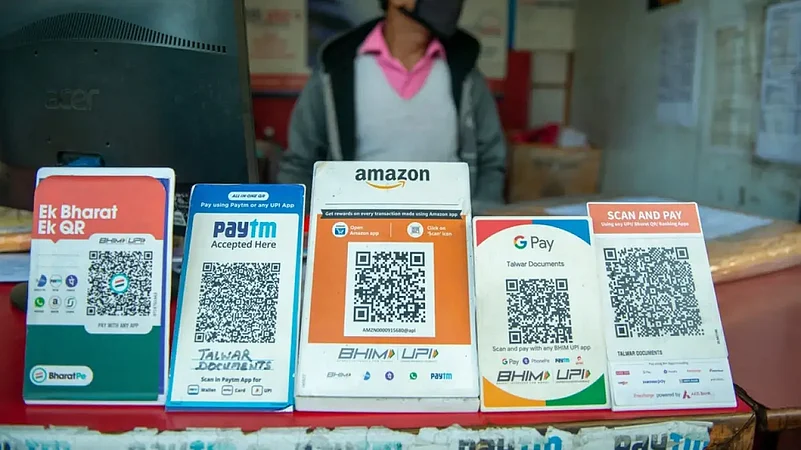
QR codes have made it possible for consumers to pay neighbourhood grocery stores, street vendors, small restaurants and other informal businesses without carrying cash or requiring card terminals.
This has effectively “sachetised” digital payments: transactions have become smaller, more frequent and deeply embedded in routine consumption.
The zero-cost nature of UPI has been crucial to this transition. When there is little or no friction attached to a digital payment, consumers have less reason to reserve digital transactions for larger purchases.
UPI Is Moving Beyond India’s Biggest Cities
UPI’s transformation has also been geographic. In its early years, digital payments were concentrated heavily in major metropolitan centres. PhonePe data, which covers roughly half of UPI transaction volumes, now shows a broader distribution of digital spending.
The combined share of India's top 10 districts in UPI transaction volume fell from a peak of 25.2% in Q3 2019 to 17.4% in Q2 2026.
Their share of transaction value also declined, from 32.5% to 19.8% over the same period.
The RBI's subnational analysis links this wider adoption to factors such as rising incomes and greater workforce formalisation across middle-income states.
UPI Has Changed Spending Psychology
The deeper impact of UPI may be behavioural rather than technological. Cash creates a physical and psychological limit on spending.
A digital payment, particularly one completed through a familiar QR code in seconds, removes much of that friction.
This has made digital payments suitable for transactions that consumers previously would not have considered worth digitising.
At the same time, small merchants have gained access to formal digital transaction records, potentially bringing more economic activity into the formal financial system.
UPI has therefore changed not just how Indians pay, but also what they consider worth paying digitally.
The Digital Habit Is Now Embedded
UPI’s evolution over the past decade reflects a broader transformation in how India transacts.
What began as a system designed to make bank-to-bank transfers interoperable has gradually become an everyday payment layer spanning large cities, small towns and rural markets.
The biggest shift has been the movement from occasional digital payments to habitual digital commerce.
Transactions have become smaller, more frequent and increasingly integrated into routine purchases, while the concentration of digital spending in India's biggest urban centres has steadily declined.
UPI has consequently changed the role of digital payments in the Indian economy.
It is no longer simply an alternative to cash for certain transactions; for millions of consumers and merchants, it has become the default way to pay.
The story of UPI is therefore not just one of technological adoption. It is the story of how a digital payments network became embedded in everyday economic behaviour, reshaping when, where and how Indians spend their money.