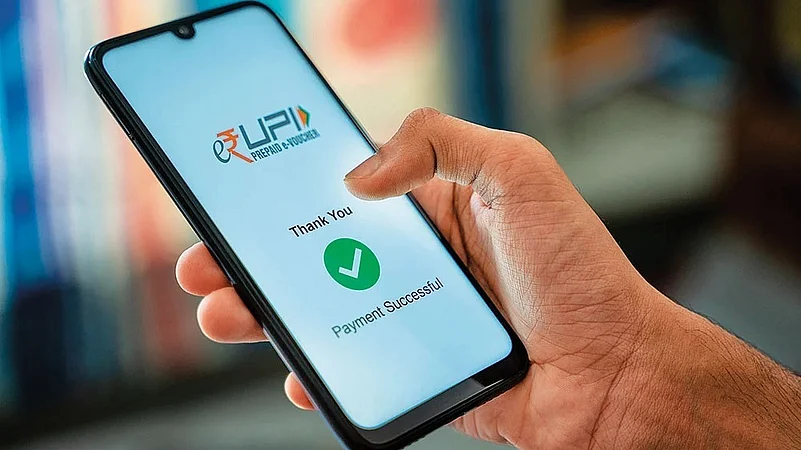

Governor Sanjay Malhotra said it is too early to determine who will bear the cost of UPI transactions, adding that "the costs have to be paid by someone" as policymakers debate a sustainable funding model.
The Centre is considering changes to the zero-MDR regime that could allow merchant charges on select UPI transactions, though no final decision has been taken on rates, thresholds or implementation.
The debate follows growing calls from banks, payment companies and Parliament's Standing Committee on Finance for a long-term revenue model to support investment in payment infrastructure, cybersecurity and the expanding UPI ecosystem.
The Reserve Bank of India (RBI) Governor Sanjay Malhotra on Wednesday said it is too early to determine who will ultimately bear the cost of Unified Payments Interface (UPI) transactions, as the government weighs changes that could allow Merchant Discount Rate (MDR) charges on select digital payments.
His remarks came after Finance Minister Nirmala Sitharaman introduced the Taxation and Other Laws (Amendment) Bill, 2026, which would give the Centre greater flexibility to decide which electronic payment modes should remain free of charges.

1 September 2026
Get the latest issue of Outlook Business

"It is very premature to talk right now. The costs have to be paid by someone," Malhotra said at the post-monetary policy press conference.
He noted that payment infrastructure is never free and that the cost is already borne indirectly. According to Malhotra, the burden could eventually be shared by the government, businesses or the broader economy rather than the individual consumer making a payment. The immediate priority, he said, is to ensure continued investment in India's digital payments infrastructure while determining a sustainable funding model.
Advertisement
What Is Being Proposed?
The government has not announced any MDR on UPI transactions yet. The proposed legislation neither mentions UPI specifically nor prescribes an MDR or a transaction threshold.
MDR is a fee paid by merchants to banks or payment service providers for processing digital payments. It is not a charge levied directly on customers making payments.
However, officials cited by Moneycontrol said the Centre is considering allowing an MDR of less than 0.5% on UPI transactions above ₹2,000 made to merchants. Person-to-person (P2P) transfers are expected to remain outside the proposed framework.
Separately, Reuters reported that policymakers are evaluating multiple models, including applying MDR based on transaction value or merchant turnover. One proposal under discussion would impose an MDR of 0.3%-0.5% on transactions above ₹2,000 for merchants with annual turnover exceeding ₹1.5 crore.
Advertisement
None of these proposals has been incorporated into the Bill.
Why the ₹2,000 Threshold Matters
According to a Times of India report, transactions above ₹2,000 account for only about 5% of total UPI transactions but nearly 65% of the total transaction value processed on the platform.
Such a threshold would therefore leave most low-value consumer payments unaffected while creating a potential revenue stream from larger commercial transactions.
UPI processed 23.66 billion transactions worth ₹29.88 lakh crore in July, according to National Payments Corporation of India (NPCI) data cited by Reuters.
What Changes in the Law?
At present, Section 10A of the Payment and Settlement Systems Act, 2007 prohibits banks and payment providers from charging MDR on specified electronic payment modes under the Income-tax Act, including UPI and RuPay debit cards.
The proposed amendment would remove this statutory linkage and instead empower the Central government to notify which electronic payment modes or transaction categories should continue to remain free of charges.
If enacted, the government would gain the flexibility to retain zero MDR for certain payments while allowing charges on others through subsequent policy decisions.
Until Parliament passes the Bill and the government issues fresh notifications, the existing zero-MDR regime for UPI and RuPay transactions will continue.
Why the Debate Has Intensified
The government abolished MDR on UPI and RuPay debit-card transactions in January 2020 to accelerate digital payments and financial inclusion. It later introduced an incentive scheme to partially compensate banks and payment companies for processing eligible low-value transactions.
However, the debate over UPI's long-term financial sustainability has intensified.
In its March 2026 report, Parliament's Standing Committee on Finance recommended introducing a sustainable, tiered revenue model, arguing that government incentives covered only a small portion of the industry's actual costs.


.jpeg?auto=format%2Ccompress&fit=max&format=webp&w=768&dpr=1.0)
Banks and payment companies have echoed similar concerns, saying they require a viable revenue model to continue investing in technology, cybersecurity and payment infrastructure as UPI scales further.