




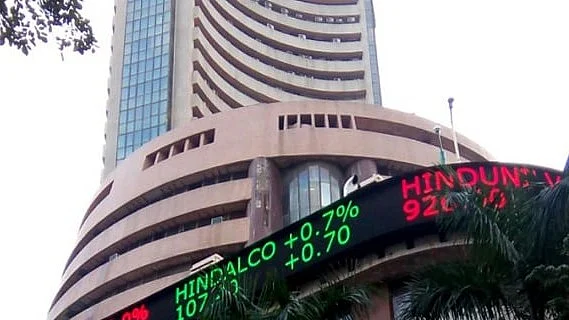

Indian stock markets are shut on January 15 due to municipal corporation elections in Mumbai.
Trading on BSE and NSE has been suspended, as both exchanges are headquartered in Mumbai.
Maharashtra has declared a public holiday for local body elections across several civic areas, including Mumbai.
Stock markets in India are closed today, January 15, due to municipal corporation elections in Mumbai. As both the BSE and the National Stock Exchange (NSE) operate out of Mumbai, trading on these exchanges has been suspended for the day.
The Maharashtra government has also declared a public holiday for local body polls across several civic areas, including the state capital.

1 October 2026
Get the latest issue of Outlook Business

This holiday was not included in the original 2026 trading calendar of the BSE and NSE but was added earlier this week. In separate circulars, both exchanges confirmed that January 15 would be observed as a trading holiday in view of the elections.



As a result, there will be no activity in the equity and equity derivatives segments today. Normal trading will resume on Friday, January 16.
Nithin Kamath, founder and CEO of India’s largest discount stockbroker Zerodha, has slammed the exchanges for their decision to close the market today.
“The fact that our exchanges, which have international linkages, are shut down for a local municipal election shows poor planning and a serious lack of appreciation for second-order effects,” he wrote on his X handle.
Advertisement
A second-order effect refers to the indirect or follow-on impact of an event beyond its immediate reaction. An unplanned market holiday does not move prices directly, but it can intensify volatility, distort liquidity, and amplify global cues when trading resumes.
Kamath added, “The holiday exists because no one who matters has any incentive to oppose the market holiday. It also tells you how far we have to go before global investors take us seriously.”

On January 14, the BSE Sensex closed lower at around 83,382.71, registering a modest decline amid broad-based market weakness.
Advertisement
“The index came under selling pressure due to heightened geopolitical uncertainties, continued foreign fund outflows, and renewed tariff-related concerns, which weighed on investor sentiment throughout the session,” said Hitesh Tailor, Technical Research Analyst at Choice Broking.
He added that with the session ending below recent highs yet comfortably above key support levels, the short-term structure points to a cautious trading approach, with selective accumulation on declines, as broader macroeconomic and geopolitical uncertainties continue to shape market sentiment.
Currency markets are also closed today. However, trading in commodity derivatives will be partially operational.
The Multi Commodity Exchange of India (MCX) has announced a closure for the morning session. Trading in commodity futures, including gold and silver, will restart in the evening session from 5 pm.
In a circular issued on Monday, MCX said the exchange would remain closed for trading between 9 am and 5 pm due to the municipal elections in Maharashtra. The evening session will be open from 5 pm to 11:55 pm, while trading in select agricultural commodities will continue until 9 pm.
According to the stock market holiday calendar, Indian bourses will observe 16 trading holidays in 2026. Following today’s closure, the next market holiday will be on January 26 for Republic Day.
March will see three trading holidays, while April and May will have two each. June and September will have one holiday each, October and November will record two holidays each, and December will have one. In addition, four market holidays in 2026 will fall on weekends.









