

Reliance Industries reported a record quarterly profit of ₹29,550 crore for July-September, up 33.8% YoY, while revenue rose 27.8% to ₹3.62 lakh crore.
O2C EBITDA surged 67.9% to ₹25,203 crore, supported by higher global fuel margins, while Jio Platforms reported 16.6% growth in EBITDA.
Reliance Retail's profit declined 24.3% to ₹2,611 crore, making it a relative weak spot in an otherwise strong quarter.
Reliance Industries Ltd posted a record quarterly profit of Rs 29,550 crore for July-September, up 33.8 per cent from a year earlier, as its oil-to-chemicals business rode a surge in global fuel margins and growth in its telecom arm offset the relatively subdued performance in retail.
Profit after tax, including share of associates and joint ventures, in the same period last year was Rs 22,092 crore. Net profit attributable to owners of the company was up 40 per cent at Rs 25,548 crore.

1 October 2026
Get the latest issue of Outlook Business

Consolidated revenue rose 27.8 per cent to Rs 362,268 crore, and EBITDA climbed 23.9 per cent to a record Rs 62,409 crore.



The latest profit also surpassed the previous quarter's Rs 23,196 crore, making it a record for the country's largest listed company by market capitalisation.
The strong earnings were driven primarily by a sharp recovery in the oil-to-chemicals (O2C) business, where elevated transportation fuel cracks and improved petrochemical margins boosted profitability. Growth in digital services also supported the performance, partly offsetting weaker earnings in retail.
Advertisement
The oil-to-chemicals (O2C) business, which houses the company's oil refineries and petrochemical units, was the largest driver of growth, with EBITDA up 67.9 per cent to Rs 25,203 crore on revenue of Rs 231,601 crore, up 44.2 per cent.
Supply disruptions tied to the West Asia conflict, including in the Strait of Hormuz, and attacks on refining infrastructure in the region and Russia pushed fuel cracks up 3.0-3.7 times from a year earlier. Dated Brent averaged USD 97 a barrel, up 40.6 per cent.
The performance came despite disruptions in West Asia, higher crude premiums and elevated freight costs. Reliance said its ability to diversify crude sourcing and optimise product placement helped it capture better margins.
Advertisement
The company said the earnings were held back by higher crude premiums, elevated freight and insurance costs, SAED-related costs and under-recoveries in domestic fuel retail. It achieved record crude runs by shifting sourcing towards the Americas and the Mediterranean, and redirected exports to higher-netback markets.
It said the first-half performance is tracking annualised O2C EBITDA of more than Rs 80,000 crore, with new energy projects set to contribute from fiscal 2028.
"Our O2C business has delivered its best ever quarterly performance amid a highly volatile and challenging global environment. It is a sound testament to our operational resilience," said Executive Director Anant Ambani.
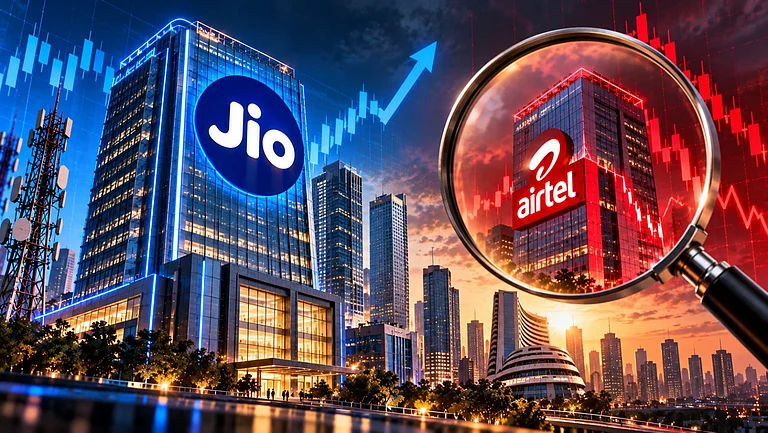
Digital services continued to provide a strong earnings contribution. Jio Platforms reported an EBITDA of Rs 21,879 crore, up 16.6 per cent year-on-year, while profit after tax rose 13.7 per cent to Rs 8,387 crore.
Jio Platforms posted an EBITDA of Rs 21,879 crore, up 16.6 per cent, with margin widening 250 basis points to 54.1 per cent. Revenue rose 11.3 per cent to Rs 47,485 crore and profit rose 13.7 per cent to Rs 8,387 crore, held back by higher finance costs after 5G assets were capitalised in March.
Jio's subscriber base reached 542.4 million, including 300 million on 5G. Fixed broadband crossed 30 million homes, with AirFiber at 15.1 million connections.
Jio's average revenue per user (ARPU) rose to Rs 218.8 per month from Rs 211.4 a year earlier.
Jio completed India's largest initial public offering -- Rs 30,188 crore -- on October 28. It listed at a 26.7 per cent premium to the issue price and reached a market value of about Rs 13.1 lakh crore (USD 137 billion), making it India's second most valuable company behind parent, Reliance Industries.
About Rs 27,500 crore of proceeds went to prepaying external commercial borrowings at Reliance Jio Infocomm.
"This week marked a historic moment in Reliance's value creation journey with Jio's record-setting listing on Indian bourses. With over 22x subscription, and strong listing appreciation, the issue has set multiple global benchmarks," Chairman Mukesh Ambani said.
He added that the "domestic orientation of our portfolio, combined with operational discipline and versatility of our integrated businesses, helped Reliance navigate external volatility effectively."
Jio Managing Director Akash Ambani said: "We would continue to build our capabilities across satellite communications, 6G intellectual property and AI embedded in our core voice and data services as we create lasting value for our stakeholders."
Retail, however, remained a relative weak spot. Reliance Retail Ventures reported a 24.3 per cent decline in profit after tax, including its share of associates and joint ventures, to Rs 2,611 crore. EBITDA before a one-time impairment charge fell 8.6 per cent to Rs 6,228 crore, despite revenue growth of 6.4 per cent to Rs 91,716 crore.
Margin slipped 120 basis points to 7.8 per cent, which the company attributed to planned investment in digital commerce, input-cost inflation absorbed for customers, and the shift of the festive season to the third quarter.
Online grocery revenue grew 42 per cent, and the company opened 303 stores while closing unproductive ones, leaving a net 222 fewer.
"The new model with fast growing Digital Commerce and B2B channels is working and funded by the profits of offline business," said Isha Ambani, Executive Director of Reliance Retail Ventures.
In consumer goods, Reliance's FMCG arm posted gross revenue of Rs 8,266 crore, up 1.6 times from a year earlier.
JioStar's revenue rose about 10 per cent to Rs 6,806 crore, but EBITDA fell 14 per cent to Rs 1,502 crore on a weak advertising environment. JioHotstar averaged about 440 million monthly active users, up 10 per cent.
Oil and gas EBITDA slipped 2 per cent to Rs 4,901 crore on lower output at the KG D6 field and higher government levies.
For the first half of FY27, RIL's consolidated profit after tax, including earnings from associates and joint ventures, rose to Rs 52,746 crore from Rs 43,951 crore in the corresponding period last year.
Capital expenditure during the September quarter stood at Rs 38,153 crore, largely directed towards O2C and new energy projects, as well as expanding infrastructure and distribution networks across consumer businesses.
Finance costs rose 24.2 per cent to Rs 8,481 crore. Net debt fell to Rs 117,140 crore from Rs 122,914 crore in June, taking net debt to annualised EBITDA to 0.47 times from 0.57 times.
Commenting on the results, Mukesh Ambani said the company's businesses had delivered a strong performance despite volatile commodity markets and geopolitical tensions.
"Our O2C business delivered a particularly strong performance this quarter, led by tight fuel markets, improved downstream petrochemical deltas and firm domestic demand," he said.
Ambani also highlighted the growth of Jio's digital services business and said Reliance Retail continued to see healthy consumer demand across its physical and digital platforms.