


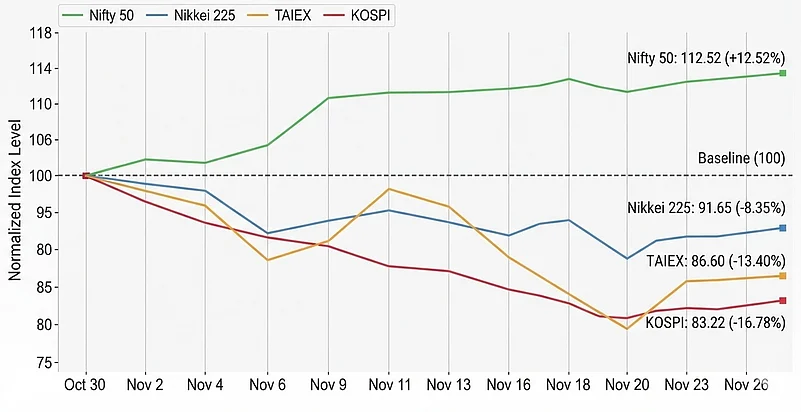
The Nifty 50 has surged over 12% in November, eyeing its best performance for the month since 1993, as record foreign inflows contrast with a sharp sell-off across Asian markets.
The unwinding of the global AI trade, stronger-than-expected corporate earnings, falling crude oil prices and a recovering rupee have renewed foreign investor interest in Indian equities.
Despite the sharp recovery, derivatives positioning suggests the rally has been largely driven by short-covering.
The Nifty 50 has risen more than 12% so far in November and is on course for its best-ever performance for the month since 1993. Foreign portfolio investors (FPIs) have poured ₹1.42 trillion into Indian equities, the highest monthly inflow on record, as investors rotate out of the crowded artificial intelligence (AI) trade. A stronger rupee and lower crude oil prices have further lifted investor sentiment towards Indian equities.
The rally marks a reversal in global market fortunes. South Korea’s KOSPI, Taiwan’s TAIEX and Japan’s Nikkei 225 have declined 9–13% this month. The tech-heavy Nasdaq Composite has fallen 14.5% from its all-time high and is down more than 7% in November.

1 November 2026
Get the latest issue of Outlook Business

This contrasts sharply with the first half of 2026, when the KOSPI surged more than 100%, while the TAIEX and Nikkei 225 rose 57% and 39%, respectively. The Nasdaq Composite gained nearly 13% during the period, while India’s Nifty 50 was among the few major global indices to decline, falling 8.7%.
The MSCI Emerging Markets Index has come under pressure from a sell-off in heavyweight semiconductor and technology stocks, particularly in South Korea and Taiwan. The MSCI Emerging Markets Index dropped nearly 21% from its June 2026 peak on Friday, as emerging markets entered bear-market territory.
Advertisement
Shares of Samsung Electronics, SK Hynix, TSMC and Foxconn have suffered sharp losses in South Korea and Taiwan. In contrast, banking, financial services and fast-moving consumer goods (FMCG) stocks have driven the rally in the Nifty 50.
AI Trade Unwinds
The unwinding of the AI trade, stronger-than-expected September-quarter earnings at Indian companies and falling risk premiums in the crude oil market have driven record foreign inflows into Indian equities, analysts said.
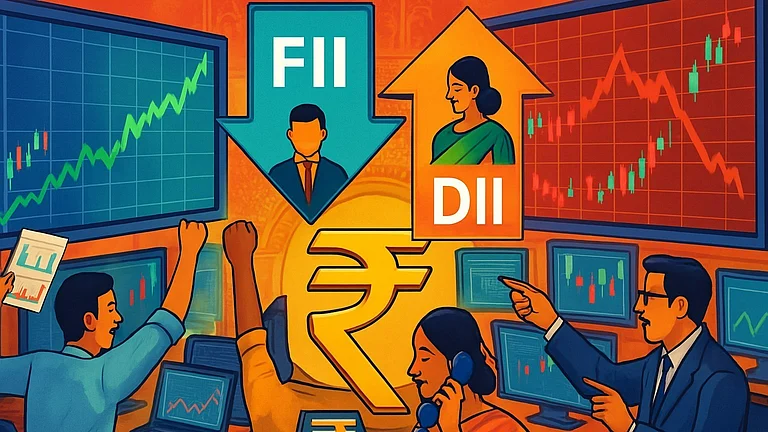



In the first ten months of 2026, FPIs sold a net ₹2.95 trillion of Indian equities amid high crude oil prices and the domestic market’s limited exposure to AI-related stocks, which drove the bulk of global market gains earlier this year.
Advertisement
What was once a disadvantage has now become a draw for foreign investors. India’s limited exposure to the AI trade has emerged as a key reason for the return of foreign capital.
A slowdown in the AI capital expenditure cycle, coupled with concerns over high debt and losses at AI companies, is driving the global unwinding of the trade. India has consequently received a significant share of foreign equity inflows since mid-October, Goldman Sachs said, adding that the it expects Nifty 50 to reach 28,500 level by December 2027.

Anthropic’s strong market debut and Nvidia’s reappointment of Jensen Huang briefly revived the AI trade, but the rally proved short-lived. The Nasdaq Composite rose 6.5% on Monday, only to give up on a third of those gains over the next two sessions as underlying concerns overshadowed the initial euphoria.
Questions persist over the sustainability of AI’s debt-fuelled growth. Regulatory hurdles surrounding Huang’s return, alongside tighter scrutiny of chip exports, could also continue to weigh on the sector, analysts said.
The Premium on Predictability
Despite high crude oil prices, Indian companies reported stronger-than-expected earnings for the September quarter, strengthening the investment case for Indian equities.
The aggregate net profit of Nifty 50 companies hit a 17-quarter high, rising 27% year-on-year and exceeding Motilal Oswal Financial Services’ estimate of 24%. Following several quarters of earnings downgrades, the brokerage raised its FY27 earnings per share (EPS) estimate for the Nifty 50 by 0.9% to ₹1,243.
“India is the only compounder among EMs (emerging markets)… and has the best growth-to-volatility ratio among the large markets. Investors pay for predictability,” said analysts at DSP Mutual Fund.
Since 2019, Indian corporate earnings per share have compounded at around 17.5%, while the index has returned around 10.7%. According to the mutual fund, India now needs trend earnings growth of just 9%, roughly half the pace recorded since the Covid-19 pandemic, to deliver returns comparable with those of South Korea and Taiwan.
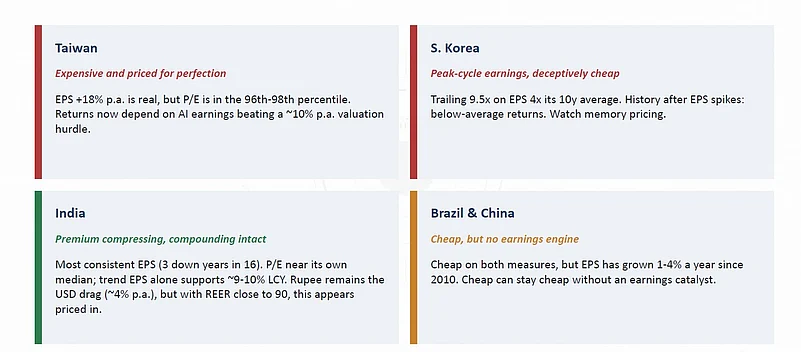
Other major Asian emerging markets, however, may find it increasingly difficult to replicate the earnings growth of the past two years. DSP Mutual Fund described the earnings surge in South Korea and Taiwan as a “positive gray swan” event.
If price-to-earnings (P/E) ratios return to their median levels since 2005 over the next five years, Taiwan would need annual EPS growth of around 11% just to generate flat equity returns. That could prove challenging given the high earnings base and the scale of AI capital expenditure required to sustain such growth.
South Korean equity returns could turn sharply negative if earnings revert to their 10-year average. South Korea’s 2025–26 earnings reflect a cycle rather than a trend, the mutual fund said.
The mutual fund laid out its rationale for superior earnings growth in India:
Oil And Rupee Tailwind
Even if the AI trade recovers, lower crude oil prices could continue to support India’s macroeconomic outlook, according to Axis Securities.
“We expect India’s macroeconomic position to improve dramatically over the next few months, as crude prices come down to ‘normal’ levels on likely improved supply-demand balance,” said analysts at the brokerage.
Front-month Brent crude futures have fallen 19.6% so far in November after surging 62.3% between the outbreak of the war in West Asia in late February and the end of October.
Global oil and other liquids inventories rose in October as supply exceeded demand by roughly 1.7 million barrels per day. The International Energy Agency has shifted from projecting a deficit to forecasting a supply surplus in the December quarter. However, despite falling prices, the ongoing war in West Asia continues to pose risks to maritime oil shipments.
Lower crude oil prices and the Reserve Bank of India’s efforts to stabilise the rupee have supported the currency’s recovery after months of pressure from the oil price shock. On 25 November, the rupee strengthened to its highest level since 12 March and has outperformed other emerging market currencies this month.
Where Is Foreign Capital Flowing?
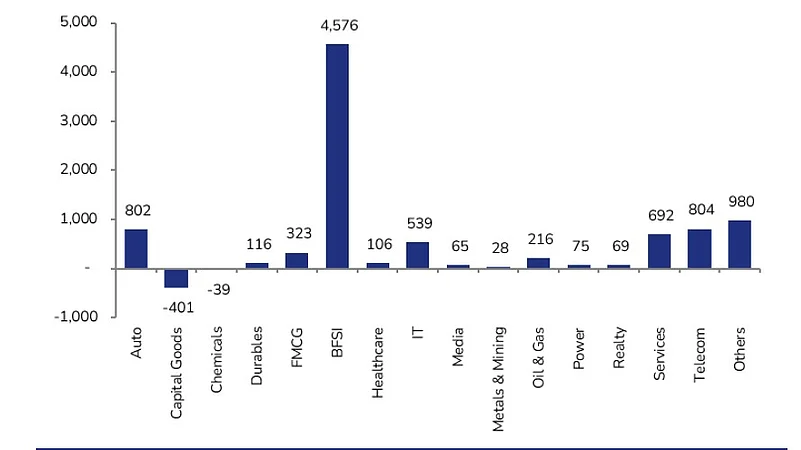
Foreign investors are returning selectively, adding to their already substantial exposure to banks and financial services. Banking, financial services and insurance stocks attracted $4.6 billion, accounting for 51.1% of net foreign equity inflows in the first half of November. Telecommunications and automobile stocks attracted $804 million and $802 million, respectively, followed by services at $692 million and information technology at $539 million.
The buying was not confined to financial stocks. Fourteen of the 16 sectors recorded net foreign inflows, with capital goods and chemicals being the only sectors to witness net selling in November, data from National Securities Depository Ltd. showed. The breadth of buying points to improving investor appetite for Indian equities, JM Financial said in a report.
The Nifty Bank index has outperformed other sectoral indices in November, rising 16.5% so far this month. It surpassed its previous record closing level on 20 November, ending at 64,635.20 points. Strong credit growth and healthy balance sheets are driving investor optimism, analysts tracking the sector said. They also expect an improvement in banks’ net interest margins—which have remained under pressure for several quarters—on the back of upcoming hikes in benchmark lending rates.
FMCG stocks have also rallied, with the Nifty FMCG index gaining 14% so far in November. Price increases and expectations of an end to the war in West Asia have eased concerns over input cost pressures and profitability at consumer goods companies.
The bulk of foreign buying has been concentrated in large-cap stocks. While the Nifty 50 and BSE Sensex have gained more than 12% and around 13%, respectively, so far in November, the Nifty Midcap 150 and Nifty Smallcap 250 have lagged, rising just 5–7%.
How Sustainable Is The Rally?
Despite the sharp recovery in Indian equities in November, futures rollover data paints a more cautious picture for December, according to Systematix Shares and Stockbrokers.
Futures positioning suggests the rally in the November series was driven largely by short-covering. Substantial short positions had accumulated following a decline of nearly 7% in September and a broadly flat October. These positions were gradually unwound as the index recovered in November.
However, the Nifty 50’s rollover was marginally above its three-month average, offering an encouraging but inconclusive signal for December.
Rollover data for the Nifty Bank offers the clearest indication that the rally was not accompanied by substantial fresh long positions, Systematix said. Open interest in December futures remained largely unchanged despite the sharp rise in the index, suggesting that, much like the Nifty 50, the rally was driven primarily by short-covering in the futures market.
The November rally may have brought foreign investors back to Indian equities, but derivatives positioning suggests that conviction is yet to catch up with the recovery. Whether the gains extend into December may depend on fresh buying rather than the unwinding of existing bearish positions.